This is adroit you’re looking for.
The ambitious TV series Andor brings new maturity to the STAR WARS saga. Not a space romp, nor a video game or memory lane, but a devastating war allegory told more intensely and honestly than before. It reveals the secret past of Cassian Andor, a mercenary who will come to be an important rebel in the film ROGUE ONE (2016).
Andor, a prequel which is set just before the original 1977 film, not only mines all of the edge and craft embedded in the Original Trilogy, but reflects the deeper sources for its cinematography, political themes, and ambitions.
With the extensive photos that follow, rediscover the roots of the STAR WARS creative style in a new light, and how Andor stems them audaciously forward.
C H A P T E R L I N K S :
• 1- The Roots
• 2- Cinematography
• 3- Sociopolitical
• 4- Dichotomy
• 5- Rebel

This article covers the roots of
Andor, Season 1.)
“One choice. We win, or everybody dies. Starts now.”
- Vel Sartha
SubChapter Links:
S C I - F I __________
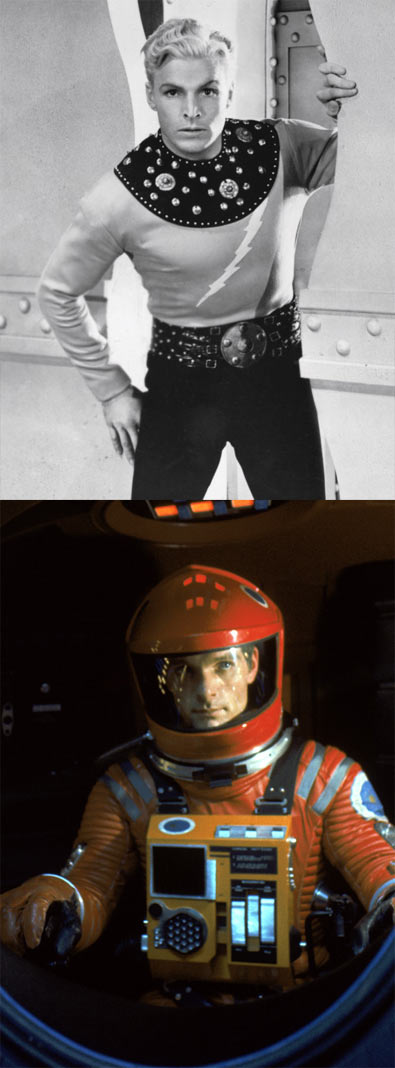
• 2001: A SPACE ODYSSEY (1968)
STAR WARS (1977) reconciled an evolutionary span in Sci-Fi, wedding the zappy space opera of FLASH GORDON (1936) and the Pulp mags to the mature art of 2001: A SPACE ODYSSEY (1968) and New Wave Science Fiction literature.
P U L P +
G O L D E N E R A S __________
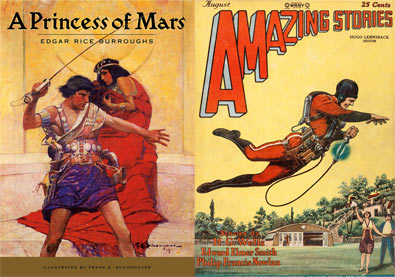
• The debut of both Buck Rogers, and Space Opera
(cover story), in Amazing Stories (Aug, 1928)
“A Princess Of Mars” (1912) blueprinted modern Science Fiction.
First printed as episodes in a pulp mag, Edgar Rice Burroughs’ serial chapters about the first outer-space adventurer, John Carter of Mars, were later compiled into a 1917 book. While Verne and Wells had prospected the general concepts of the genre, ERB’s dashing hero polished them up for the new century: a displaced adventurer with extraordinary physical abilities on a desert world, caught up in alien culture clashes. Burroughs rethought this into the smash success of Tarzan, while the John Carter concept inspired everything that followed, including Superman, “Stranger In A Strange Land”, “Dune”, STAR WARS, and AVATAR.

• Buck Rogers #1 comic (1940)
The Pulp Era (1920s-‘30s) cloned John Carter into Buck Rogers, a spaceship traveler fighting cosmic wars, jumping from pulp story to comic strips to radio shows. His superior rethink, Flash Gordon, helped turn comic strips into fine art while conquering the movie screen.*
* (The space hero clone chain continued on with Martian Manhunter, Duck Dodgers, Adam Strange, Green Lantern, Perry Rodan, Captain Kirk, Den, Nova, Han Solo, Galatia 9,> Buzz Lightyear, Jonni Future, Mal Reynolds, Captain Marvel, Poe Dameron…)
In the Golden Age (1936-1946) the newly-named genre of Science Fiction came of age, advancing across Pulp mags, Sunday comics pages, radio waves, silver screens, and comic books, while inspiring the very first ‘fandom’, the first convention, and the first costume-play. This was the era of Space Opera, with robust heroes in rocketships hopping planets in laser battles.

Across that span, there were other visionary movements in motion. Political concerns about the new century galvanized dystopian literature like Zamyatin’s “We” (Russia, 1924), Huxley’s “Brave New World” (England, 1932), and Orwell’s “1984” (England, 1949). These allegories reflecting the grave issues of the real world gave literary credibility and social relevance to the speculative fiction field.

• "Fahrenheit 451", Ray Bradbury (1953)
• ANIMAL FARM film (1954)
• INVASION OF THE BODY SNATCHERS (1956)
• FORBIDDEN PLANET (1956)
Some writers argue that the actual Golden Age is the 1950s, when the medium became sophisticated, mature, and mainstream, leaving the pulps behind for lit mags and technicolor flicks, hardbacks and paperbacks. The post-War stories grew sober with social issues, expansive with world-building epics, literate with the poetic or the hardboiled. The medium was becoming a literature of ideas, fluid with the times.
N E W
W A V E __________

New Wave Science Fiction> (1960s-‘70s) is where the medium went postmodern.
Any cutting-edge movement in the ’60s was called a New Wave because of the impact of the Nouvelle Vague,> where French filmmakers were deconstructing the rules of making cinema; Godard’s handheld movies were loose, improvised, absurdist, sardonic, alienated, impressionistic. In the wider view, Counterculture films, books, plays, albums, comix, and art decoded all social mores with the hopeful fervor of radicals and fearless glee of kids.

• "Do Androids Dream Of Electric Sheep",
Philip K. Dick (1968)
• "Nova", Samuel R. Delaney (1968)
• "The Left Hand Of Darkness",
Ursula K. Le Guin (1969)
While the world marveled at the Space Race, literary New Wave Science Fiction books, stories, and films were replacing Science boosterism with humanist existentialism, adventuring with inner exploration, and rational laws with enigma. They were both experimental and experiential, fluxing by turns sensual, hallucinatory, environmental, alienated, and conspiratorial.
This was also true of Fantasy. The immense intricacy and scholarship of Tolkien's "The Lord of The Rings" trilogy (1953) had redefined High Fantasy, and New Wave authors like Zelazney, Moorcock, Le Guin, and McCaffrey began blending Science Fiction, social commentary, world mythology, and the experimental into their Fantasy works.
➤ LORD OF THE RINGS: The Rings Of Power ⬤ The One Rules All

2001: A SPACE ODYSSEY (1968)
• opening credits,
Andor (2022)
Precisely as New Wave paperbacks infiltrated drugstore spinners and campus bookstores, the tsunami hit. 2001: A SPACE ODYSSEY (1968) turned Science Fiction into cinema art. It was the dividing line between Before and After for all speculative fiction in every medium.
➤ 2001: A SPACE ODYSSEY - Its Transcendent Influence on all Pop Culture, with Music Player!

The tribal 'Dawn Of Man' and...
• ...the future tech...
• ...are combined on Andor in this moment.
2001 is told with the clinical distance of a space launch, even as it hums with a surrealism which unnerves. It is a science psalm whose cathedral is the universe, building into an hallucinatory orgasm that opens the beyond.

• STAR WARS (1977)
• Andor (2022)
Also in 1968, Samuel R. Delaney wrote “Nova”, a seeming dichotomy of Space Opera spliced with New Wave, a duality mistaken then as a fluke which actually templated the future.
M E T A L
H U R L A N T __________
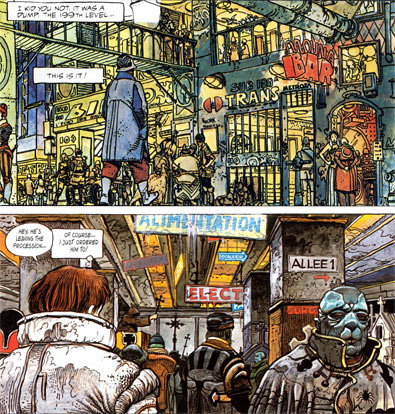
• "Nikopol", Inki Bilal (1980)
Underground Comix transcended with “Metal Hurlant” magazine.
In Paris, artists Jean Giraud ('Moebius') and Philippe Druillet realized that trippy head comix by Crumb could dream higher into boundless vision epics on par with Kubrick, Tolkien, and Castañeda. Launched in 1974, the adult fantasy anthology mag was the New Wave as hallucinogenic travelogues improvised freestyle, a skewed dream of Punk futurism, wanton eroticism, desert vision quests, and illustrative genius. (It was later repackaged in the United States as “Heavy Metal”.)
The work of Moebius and Druillet was often a hybrid of Science Fiction and Fantasy and dreams (and trips). In the egalitarian ethos of the counterculture, all borders were dissolved between nations, people, genres, and styles. Every hybrid bred new possibilities.

• STAR WARS (1977)
• BLADE RUNNER (1982)
• • Andor (2022)
The Russian auteur Tarkovsky hated Kubrick's clean vison of the future, and his film SOLARIS (Russia, 1972) emphasized the gritty, the ruined, and the unknowable. The corroded dystopias and film noir fatalism of Moebius and Inki Bilal’s illustrated stories reflect this with their decrepit prefab cities, greasy and flaking and hostile, and their international serfs trudging through funky squalor.
Their 'used universe' aesthetic would become manifested everywhere in STAR WARS, from Tattooine to Coruscant’s underground. It directly influenced all SF films after Punk Rock, from ALIEN, BLADE RUNNER, and MAD MAX, to THE FIFTH ELEMENT, GHOST IN THE SHELL, and FURY ROAD. (It also bridged Delaney's "Nova" to the rise of CyberPunk.)
S T A R
W A R S __________

• METROPOLIS (Germany, 1927)
• THE ADVENTURES OF ROBIN HOOD (1938)
• Planet Stories, ft. Leigh Brackett (1951)
• HIGH NOON (1952)
• THE DAM BUSTERS (1955)
• Incredible Science Fiction comics (1955)
• THE HIDDEN FORTRESS (1958)
• LAWRENCE OF ARABIA, w/ Alec Guinness (1962)
• DR. WHO film, w/ Peter Cushing (1967)
• Metal Hurlant (1977)
• Monark Starstalker (1976)
STAR WARS (1977) is a prism of everything that came before it.
Thesis and Antithesis are always superseded by Synthesis. George Lucas grew up through all of modern pop culture: Golden Age kid, late-’50s teen, late-‘60s film grad, New Hollywood director. He was Saturday serials, all-day movie bills, Screwball romances, rowdy Westerns, cartoon slapstick, War sieges, Golden Age TV, Silver Age comics, Rock’n’Soul platters, drag racing, civil rights marches, Arthouse cinema, New Wave SF books, campus demonstrations, Message pictures.

racing with the wind /
Fire all of your guns at once
and explode into space."
• EASY RIDER (1969)
• RETURN OF THE JEDI (1983)
• Andor (2022)
Initially, he was supposed to debut directing John Milius’ 1969 script for APOCALYPSE NOW, an apostasy calling out the latest holy war as a black comedy while it was happening and on location(!). But this was beyond their clout and funds, and it went to glory later with Coppola. The horror of war always sparks the creative backlashes against it: Modernist literature, which sought to sever the rote past by embracing complexity and change, ran parallel to World War I; modern cinema reached bracing maturity in the bitter aftermath of World War II; and all the worldwide film New Waves, and their heir the New Hollywood, raced concurrent with Vietnam. >
“Oppression breeds rebellion.”
- Luthen Rael

• THE EMPIRES STRIKES BACK (1980)
• The Young Indiana Jones Chronicles (1992)
Lucas was concerned with the antidote to war and the solution for prosperity. It’s in the anti-technocracy of his debut, THX-1138 (1971); the rebellion against the Empire in STAR WARS; and the global humanity caught in the crossfire of WWI in the visionary “The Young Indiana Jones Chronicles” TV series (1992).
STAR WARS synthesized all of his cultural roots and spiritual concerns together. And it was the precisely timely hybrid that the public needed, fusing the swashbuckling fun of Golden Age serials with the mature craft of post-Kubrick Sci-Fi statement films. It was great art and you could dance to it.
With the passage of time, new fans of the branching STAR WARS franchise may lose touch with all these roots. The films are literally about cultural handoff by generations, so an understanding of its origins are the keys to appreciating its real worth and future potential.
Without cultural context, new STAR WARS media is in danger of becoming a shooter game or a nostalgic möbius strip. The films and shows since 2015 know this, and their success comes from reconsidering what’s come before to open up what hasn’t been done yet. Inherent in this is how they have reassessed the roots and techniques that it all came from.

• Andor (2022)
The prequel film ROGUE ONE, and its own prequel TV series Andor, are a new maturity in the saga, stripping out redundance and honing the cinematography, relevancy, and innovation inherent in the original film for new possibilities in the present.
T O G R A P H Y

Francis Ford Coppola,
and George Lucas
SubChapter Links:
- NEW HOLLYWOOD
- CENTER RATIO
- ARCHITECTURE
- INTERIORS
- NATURAL LIGHT
- NOIR LIGHT
- CHIAROSCURO
- DARKNESS
- IMPRESSIONISM
- TEXTURE
- FRAMES
“You just walk in like you belong.”
— Cassian Andor
N E W
H O L L Y W O O D __________
The ‘70s New Hollywood > filmmakers were ’60s film students who had absorbed all of the movements of film: ’10s Silent slapstick; ‘20s German expressionism and Russian montage; ‘30s and ‘40s Golden Age Hollywood, and post-War Neorealism; the cinemascope spectacles and the mature global films of the ‘50s; and the cinéma vérité and experimental international (and sociopolitical) New Waves of the ’60s.> The Counterculture auteurs saved Hollywood exactly as it was falling apart in the early-'70s, making commercial films that were also fine art.
The cinematography for STAR WARS (1977) by Gilbert Taylor blended the bright adventure of Classic Hollywood flicks, the widescreen spectacle of ‘50s period epics, the cavalier deconstruction of New Wave films, the impressionism of Arthouse, and the studied symmetry of Kubrick.
Andor has specifically routed these sources to amplify and expand on them. Now, to be clear, other STAR WARS new media -whether in films, shows, animateds, books, or comics- have done fine work in reflecting the fundamentals of the saga, while bringing fresh inspiration to it. Where is Andor different? In focus, tone, and outlook.
The original STAR WARS is not actually Science Fiction, but more accurately a Space Fantasy. It combines classic SF adventurism and postmodern edge with major tenants of Fantasy, with sorcerors, knights, a princess, a fellowship on a quest, swordfights, mysticism, and more. It is as much "The Fellowhip Of The Ring" (1953) as it is FLASH GORDON SAVES THE UNIVERSE (1940) or THE HIDDEN FORTRESS (Japan, 1958). The three Trilogies and their spin-off media consistently reflect those Fantasy elements with their lens on the Jedi versus the Sith.

ROGUE ONE changed this. It stripped the Fantasy out, dropped from the stars to the streets, put the background dregs into the foreground leads, running breakneck cinéma vérité style behind normal masses battling tyranny and hopelessness. It was the war heists of THE GUNS OF NAVARONE (1961) and THE DIRTY DOZEN (1967) if they'd collided with the political chaos of THE BATTLE OF ALGIERS (1966) and THE YEAR OF LIVING DANGEROUSLY (1982).
The best way to understand George Lucas' politics clearly is to watch “The Young Indiana Jones Chronicles” TV series (1992-'96): it denudes STAR WARS to its true inspirations from history, using World War I to clarify his rejection of oppression and bigotry, and championing of inclusion and pacifism. The episode "Verdun" was the most intensely anti-war statement shown on television at that point, analogous to Remarque's "All Quiet On The Western Front" (1930). ROGUE ONE and Andor are the scion of this, confronting the harsh reality of the war through the lives of the ordinary and forlorn. It reframed the revolution as coming from the common first, no longer in the abstract but as the story itself. No longer a grand fable about knights (Jedi) and ronin (Mandalorians), but a candid novel about the serfs. The betweens who are actually everyone. Focus, tone, outlook.
While other STAR WARS media reference the fantastical trunk of itself, the realist perspective of the Andor series reviews the history of the origins to bring an original new view.
C E N T E R
R A T I O __________

With 2001: A SPACE ODYSSEY, Kubrick became a graphic formalist. He (and cinematographer Geoffrey Unsworth) used centered medium shots with dynamic symmetry to arrest the eye. By holding the shots for long periods, he created tension and uncertainty that engaged the viewer more intently. He made each composition an experience.
Kubrick and Arthur C. Clarke’s film established both the new look and the tone for 1970s speculative fiction films: cool to the touch, startling to the eye, unsettling to the mind. Lucas’ THX-1138 (1971) was one of the first, and the influence cascaded through classic films like Tarkovsky’s SOLARIS (1972), Trumbull's SILENT RUNNING (1972), Scott’s ALIEN (1979), and Hyams’ OUTLAND (1981).

• THE EMPIRE STRIKES BACK (1980)
STAR WARS reflects Kubrick often by using center ratio balance, such as within the clinical geometries of the Empire to emphasize its despotic austerity and constriction.
(The film also homages the panoramic vistas of Freddie Young’s shots for LAWRENCE OF ARABIA [1962].)

Most STAR WARS productions repeat this composition technique generally, but Andor remembers where it comes from, exercising it in the service of distinct feels as much as sharp visuals, like Kubrick would have done. The series vibrates more with the cascading moodiness of A CLOCKWORK ORANGE (1971) than with the clean remove of 2001.
“Tyranny requires effort. It breaks. It leaks. Authority is brittle. Oppression is the mask of fear. Remember that.”
-Karis Nemik
A R C H I T E C T U R E __________

• A CLOCKWORK ORANGE (1971)
• CONQUEST OF THE
PLANET OF THE APES(1972)
• THE HOLY MOUNTAIN (1973)
• THE PARALLAX VIEW (1974)
• Andor
Counterculture directors of the New Hollywood films (mid’ 60s-early ‘80s) used architecture to describe oppressive modernity. Conspiracy thrillers and dystopia films particularly used contemporary buildings as sculptures of cold power.

• THE OMEGA MAN (1971)
• CONQUEST OF THE
PLANET OF THE APES(1972)
• SOYLENT GREEN (1973)
• ROLLERBALL (1975)
• Andor
The Empire is all chilly geometry, devoid spaces whose only design and function is for domination, populated by abject staff. A prison pretending to be a temple. Contrast this with the funky factory town on Ferrix where Cassian grew up, a gritty bazaar of brick and stucco teeming with bustling workers, snaking pipes, clutter and clatter, and food steam. A serfdom which is actually a community.

• Andor
• Moebius
• Andor
Moebius and Bilal drew decaying cities of rough tenements, sterile housing blocks, and stacked apartment crypts for the working class, versus the decadent penthouses and retreats for the rich.
This ran parallel to the acidic New Wave-era writings of William S. Burroughs, Philip K. Dick, and J.G. Ballard.
Dan O'Bannon and Moebius’ influential 1975 story, “The Long Tomorrow” (shown above), had direct stylistic influence on designs and concepts in THE EMPIRE STRIKES BACK, BLADE RUNNER, and PROMETHEUS.

• SOLARIS (Russia, 1972)
• LOGAN'S RUN (1976)
• Andor
Pleasantly shaped spaces can take on a cold practicality with those who are using them. Open becomes empty, elegant featureless, clean dead.

• "The Long Tomorrow", O'Bannon + Moebius (1975)
• "The Incal", Jodorowsky + Moebius (1981)
• Andor
Like the skyscrapers of Lang’s METROPOLIS, Moebius’ modular stacks are laced by a labyrinth of bridges and tunnel halls. Andor connects the flanks of its heptagon prisons with similar corridor arms.
(see also: the underground world of Coruscant)
I N T E R I O R S __________

• 2001: A SPACE ODYSSEY (1968)
• SOLARIS (Russia, 1972)
• STAR WARS (1977)
• Andor
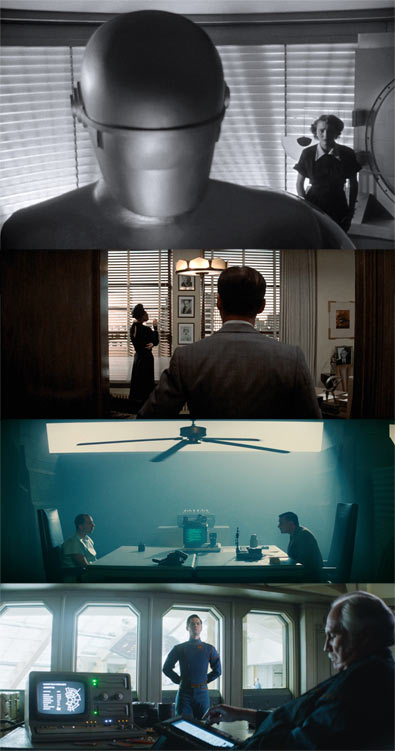
A practical geometry in a conference space paces out equal seating, yet is loaded with the ambitious tensions between the seated. It feigns equality while masking hierarchy.

• MARATHON MAN (1976)
• Andor
Modern architecture is meant to be a clear diagram of mutual ascent. Viewed in conspiracy thrillers, the basilicas of bureaucracy are a vast emptiness fueled by servitude.

• FANTASTIC VOYAGE (1967)
• 2001: A SPACE ODYSSEY (1968)
• SILENT RUNNING (1972)
• SOLARIS (Russia, 1972)
• CONQUEST OF THE
PLANET OF THE APES (1972)
• STAR WARS (1977)
• THE EMPIRE STRIKES BACK (1980)
• Andor

• THE ILLUSTRATED MAN (1969)
• SOLARIS (Russia, 1972)
• STAR WARS (1977)
• ALIEN
concept art by Ron Cobb (1979)
• OUTLAND (1981)
• Andor
The white plastic modularity of post-Kubrick futurism is pre-fab functionality for general use, made for longevity and work, without concern for hominess or comfort. These stark spaces lend themselves to feelings of displacement, alienation, confinement.

by Edward Hopper (1955)
• SILENT RUNNING (1972)
• SOYLENT GREEN (1973)
• STAR WARS (1977)
• ALIEN (1979)
• ATTACK OF THE CLONES (2002)
• Andor
Much like Hopper’s paintings, people within such spaces can seem like ciphers in an indifferent showroom, looking for a sense of place.
N A T U R A L
L I G H T __________

• JEREMIAH JOHNSON (1972)
• STAR WARS (1977)
• Andor
In contrast to artificial spaces, filming in natural light among wide nature opens everything up, feels alive, connects the person to the organic and the tangible, frees the mind for reverie and the possible.

• PATTON (1970)
• EL TOPO (1970)
• STAR WARS (1977)
• Andor
Much of the power of the Original Trilogy came from being filmed in spectacular locations or in large fully-constructed sets. After the extensive use of green screen and CG used in the Prequel Trilogy (1999-’05) for its imaginary locations, many lauded the Sequel Trilogy (2015-’19) for returning to natural and physical environments.

• AMERICAN GRAFFITI (1973)
• BOUND FOR GLORY (1976)
• DAYS OF HEAVEN (1978)
• Andor
‘70s cinematographers like Haskell Wexler (BOUND FOR GLORY, COMING HOME, DAYS OF HEAVEN) and Vilmos Zsigmond (DELIVERANCE, HEAVEN’S GATE) are acclaimed for their capture of natural light with its haze, murkiness, mood, or colors.

• BROTHER SUN, SISTER MOON
(1972)
• SCARECROW (1973)
• Andor
Notably, Andor always films in subdued natural light under cloudy skies. It’s not the bright intensity of Tattooine or Jakku, but instead always muted and overcast. (The exception being the sunny resort planet, which is the point.) This underlines the spiritual mood of a story about underdogs trying to escape the shadow of the Empire.

• Andor
N O I R
L I G H T __________

• LE TROU (FRANCE, 1960)
• PALE FLOWER (Japan, 1964)
• UPTIGHT (1968)
• WOMEN IN LOVE (England, 1969)

• • • • Andor
STAR WARS films traditionally start in space, flinging the viewer into the middle of explosive drama and goosing them to keep up. But Andor opens in a bright light, the camera pivoting sideways from the streetlamp into a wide shot of a night bridge, the far city impressionistic smears in the rain. Immediately, you are told that this is BLADE RUNNER instead, preparing you for the tone, look, and edge of another kind of story than we’re used to seeing here.
At its heart, Andor is a Film Noir, which will also open it to becoming a heist, a thriller, and a breakout.

• "Nova Express" (1964)
• "A Scanner Darkly" (1977)
• "Neuromancer" (1984)
Also true to Noir films, the series strips everything flashy back to the gritty basics: no Fantasy or the Force, less Space Opera and aliens, all human spiritual conflicts, a sardonic tone threaded by wry humor, and clipped dialogue that reads like Beat playwrights.
“I don’t have lately. I have always. I have a constant blur of plates spinning, and knives on the floor, and needy, panicked faces at the window, of which you are but one of many.”
- Kleya Marki
“I’ve given up all chance at inner peace. I’ve made my mind a sunless space. I share my dreams with ghosts.”
- Luthen Rael
“There is darkness reaching like rust into everything around us. We let it grow, and now it’s here. It’s here, and it’s not visiting anymore. It wants to stay.”
- Maarva Andor
Actors in Science Fiction films from the '30s on up spoke like they were on stage. One of the innovations of the 1977 STAR WARS -often hailed at the time- was that everyone was yelling over each other like a modern Altman film, with casual inflection and breezy phrasing. Luke talked like Cali sunsets, Han like Okie dust, Leia like L.A. sass (by way of London). With cinema performances now routinely naturalistic, this performance revolution in Sci-Fi gets forgotten. Andor's embrace of the hardboiled, the lyrical, and the pensive in its dialog newly attunes the frequencies of the saga.
There is a similar bandwidth shift in the soundtrack. John Williams' immortal scores for the Original Trilogy were heraldic anthems, in the mode of '30s Adventure film scores by Korngold and Steiner. But Nicholas Britell's soundtrack for Andor takes its cues more from Vangelis' synth-futurism score for BLADE RUNNER, with moody chamber strings, serial music tones, and industrial tympani builds. While Kevin Kiner brought global music textures to Williams' style with his scores for the 'Clone Wars' animated series, Britell goes awol from Classical nouveau into tech-noir.
• CHINATOWN (1974)
• BLADE RUNNER (1982)
• Andor
Director Ridley Scott followed his breakthrough ALIEN (1979) with the future-noir of BLADE RUNNER (1982); Jordan Cronenweth’s cinematography combined the moody lighting and intense angles of classic Film Noir with the corroded futurism of concept artist Moebius. The visual style invented ‘Tech Noir’, which has become standard in Science Fiction movies ever since.
Hitchcock’s noir films often followed ‘the wrong man’, accused of a crime that forces him to go on the run and prove his innocence. Cassian Andor is a wronged man, since his childhood, who is trying to make things right.

• LA POINTE COURTE (France, 1955)
• CRUEL STORY OF YOUTH
(Japan, 1960)
• PERSONA (Sweden, 1966)
• LUMINOUS PROCURESS (1971)
• PANIC IN NEEDLE PARK (1971)
• THX-1138 (1971)
• LENNY (1974)
Film Noir, dealing with the shadowy behavior of ambivalent people, was darkness stabbed with broken light. The light often came from slanted angles that rimmed the form, uplit the face, spotlit the eyes. Faces were cropped tight together in symbolic graphic overlaps, highlighting tension or empathy.

• STAR WARS (1977)
• ALIEN (1979)
• THE EMPIRE STRIKES BACK (1980)
• BLADE RUNNER (1982)
• Andor
The use of dark and light with carefully placed actors and forms emphasizes people trying to find truth out of secrecy, or love out of isolation, or hope out of despair.

• 2001: A SPACE ODYSSEY (1968)
• EASY RIDER (1969)
• KLUTE (1971)
• Andor
Our perception focuses primarily through our eyes, above all senses. Motion pictures are a love affair with the eye, using visuals to touch the emotions and thoughts, or seeing the souls of characters through their gaze, or challenging you about what you perceive and why.

• STAR WARS (1977)
• • THE EMPIRE STRIKES BACK (1980)
• RETURN OF THE JEDI (1983)
• THE FORCE AWAKENS (2015)
• ROGUE ONE (2017)
• SOLO (2018)
• Andor
C H I A R O S C U R O __________

• KLUTE (1971)
• THE CONVERSATION (1974)
• BLADE RUNNER (1982)
• Andor
Before Noir, before Expressionist film, there was Chiaroscuro.
Renaissance painters illumined their scenes with available light sources instead of broad lighting, focusing the eye only on what mattered for dramatic impact. In an era that only knew sunlight or candlelight, they instinctively saw this lucent focus like graphic design. Rembrandt and Carravagio works were ‘lit from within’, such as by a held candle or lantern, with everything outside the light source dropping into shadow.
Vermeer’s works were ‘lit from without’, with the sun shafting through a window into a dark room. (see also: ‘Better Call Saul’) His people were alone in moody interiors, seen beyond door frames, with the bright world another dimension outside the glass, psychological spaces that we rorschach as isolation, outlook, or refuge.

• Andor
Light can be the only tether when the subject is lost or afraid or in turmoil.

• THE FRENCH CONNECTION (1971)
• THE CONVERSATION (1974)
• ALIEN (1979)
• Andor
The less light, the less secure one feels in a dark and hostile environment.

• SOLARIS (Russia, 1972)
• FANNY AND ALEXANDER (Sweden, 1982)
• • Andor
A window frames someone in possibility when they are in a dilemma. Sometimes the possibilities confront us with making choices we’re unsure how to quantify or face.
Soul-searching is the crux of Andor. With a disparate assortment of characters driven by motivations which fate is forcing them to sort out, this STAR WARS story is told more like a Bergman film than a Kurosawa epic.
The origin story of Cassian Andor is also the inception of the Rebel Alliance. At this point, there isn't one yet, only a scattered array of secret factions unaware of each other or working at cross-purposes. The mutual spark between all of them is desperation. They are a possibility in darkness searching for how to quantify themselves in the light.
D A R K N E S S __________

• ALIEN (1979)
• • Andor
Darkness is more than a literal space. It is the soul feeling powerlessness, fear, distance, or confusion. Like Chiaroscuro and Noir, film uses available light to define our empathy with the turning points of the story.

• APOCALYPSE NOW (1979)
• Andor
Spiritual darkness is the bleakest, a twilight of character where we can defeat ourselves or rise up for promise within reach. A hope renewed.
I M P R E S S I O N I S M __________

• UN HOMME ET UNE FEMME (France, 1966)
• THIS PROPERTY IS CONDEMNED (1966)
• THE CONFORMIST (Italy, 1970)
• THE GODFATHER II (1974)
It’s all in how you focus.
The Golden Age of Hollywood knew how to use soft and hard focus in a single shot to center attention while creating a mood. By the ’60s, with carriable cameras and variable lens depths, New Wave cinematographers could film loosely on location like ‘40s newsreel journalists while composing with the sensitivity of painters and poets.
New Wave filmmakers, like New Wave SF writers, were expressing the experimental, the sensory, the dreamy. An impression of how things look most concerned with how that moment feels. At times, Claude Lelouche used depth of field and soft focus in A MAN AND A WOMAN like he was Monet. Vittorio Storaro shot THE CONFORMIST like a memory, hazy and tinted and elegant. His work directly influenced the New Hollywood, such as how Gordon Willis shot the GODFATHER films with chiaroscuro from ambient light.
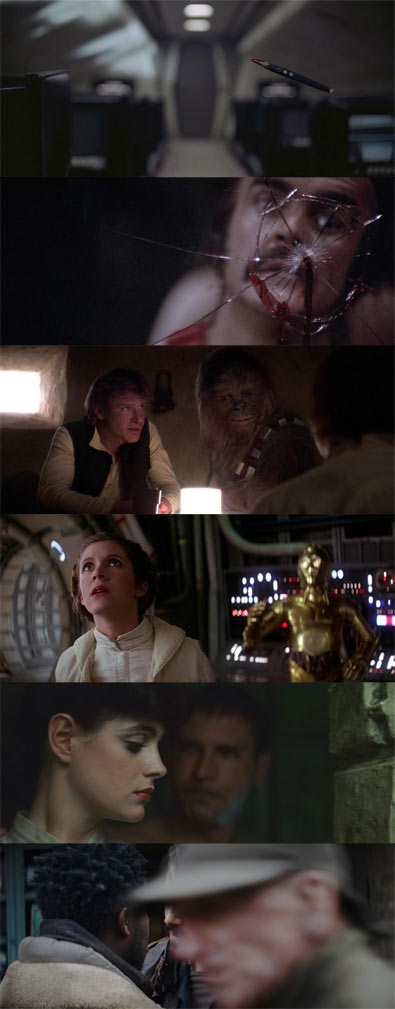
• ZARDOZ (1974)
• STAR WARS (1977)
• THE EMPIRE STRIKES BACK (1980)
• BLADE RUNNER (1982)
• Andor
Speculative fiction films are part of this impressionistic revolution. Since the late-’60s they have combined depths of focus, noir light, graphic juxtaposition of forms, natural light, and handheld looseness in ways hallucinatory, gritty, sensuous, or covert to combine realism with feeling.
T E X T U R E __________

• STAR WARS (1977)
• • Andor
Another aspect of film impressionism is overlaid textures. This is artful compression that blocks multiple elements into one shot overlaid on top of each other. It blends actors and actions in a dynamic visual. It also makes the flat screen dimensional and abstract at the same time.

• THE CONVERSATION (1974)
• ALIEN (1979)
• BLADE RUNNER (1982)
• Andor
Glass barriers can become reflections of the character’s thoughts, plans, struggles.

• SHAFT'S BIG SCORE (1972)
• MEAN STREETS (1973)
• TAXI DRIVER (1976)
• THE AMERICAN FRIEND
(W. Germany, 1977)
• BLADE RUNNER (1982)
• Andor
Vehicle windshields reflect cities by out-of-focus implication, and a character’s connection or disconnection from it.
F R A M E S __________

• THX-1138 (1971)
• SHAFT (1971)
• PAPILLON (1973)
• WORLD ON A WIRE (1973)
• THREE DAYS OF THE CONDOR
(1975)
• • Andor
Vermeer often framed his models just beyond door frames and curtains in a tight space. This textural build gave both depth and mystery to the scene. We feel like voyeurs, just turning a strange corner.
Framing foreground objects over anxious actors conveys their struggle against something threatening or intangible or tenuous.

• JAWS (1975)
• Andor
Looking from seclusion over a contested space gives intimate tension to a wide shot. What would have been a place setting is now framed with edgy surveillance or foreboding.
Film departments began seeding through select American universities in the mid-'60s. The '70s directors were among the first able to synthesize all of the previous 5 decades of film techniques together in revolutionary ways. Now, with film schools ubiquitous, every student blends those innovations into a century of wider techniques as a matter of literal course. The tactics outlined above are prevalent now in every film, show, music video, and even commercial. So what makes Andor so different? The substance below the styles. Everyone can do Center Ratio, but no one else is Kubrick. Many people can bring new life to STAR WARS, but no one will confuse them with Andor because it steps back and looks from a unique frame: populist, realistic, introspective, mosaic, experimental, vérité. A new way.
The success of its innovation, its widening of the context, opens the portal for new explorations. It's now possible, going beyond the Space Fantasy parameters, to tell STAR WARS stories about all the other aspects of the shared universe in liberated ways. Possible to make a standalone film about outskirt villagers in the mode of PATHER PANCHALI (India, 1955), or the noir underground of Coruscant like it was THE THIRD MAN (England, 1949). Perhaps a slapstick Droid comedy in homage to Chaplin or Tati, a struggling family drama like A RAISIN IN THE SUN (1961), or an hallucinatory animated like CASTLE IN THE SKY (Japan, 1986). A layered TV series in the stylistic spirit of 'The Wire', or 'Fargo', or 'Roots'. Nouvelle Vague.
P O L I T I C A L
“We’ve chosen a side. We’re fighting against the dark. We’re making something of our lives.”
-Vel Sartha

STAR WARS is political to its core.
It’s central mission is to empower the oppressed, learn from history and wisdom, topple dictatorships, and create peace and freedom for all in the future. Along the way, there might be fun, surrealism, explosions, and masks, but that’s sightseeing. STAR WARS has always been about political liberation from all forms of tyranny, violence, and corruption.
It’s important to remember that STAR WARS was filmed in 1976, reflecting film techniques, futurism styles, and topical stances contemporary with the auteurs of the New Hollywood. Andor, set 5 years before the film, treats itself as if it is filmed in the volatile and creatively rich 1971, with all of the sociopolitical edge and cinematic approaches intact.
Andor is about adults waking up to face the nightmare destroying their lives, and summoning the courage to face it.
SubChapter Links:
“You’re here until they don’t want you anymore.”
- Melshi
T R I B A L __________

STAR WARS is consistently anti-Colonialist.
The Empire of the original film is as much a critique of British colonialism as of German imperialism (note the accents). Cassian’s backstory, from a forest tribe of orphans on a world strip-mined by the Empire, reinforces the saga’s respect for the indigenous, the outcast, the marginalized, and its disdain for the corporate, the militant, the pillaging.
This echoes again later, with a communal land-based people subjugated for the sake of maintaining a strategic Imperial base.
“Leave it better than you found it.”
- Cassian
E C O L O G Y __________

• Andor
STAR WARS is ecological.
Herbert combined the desert messiahs of "John Carter Of Mars" and LAWRENCE OF ARABIA together for his book, "Dune" (1965), turning space opera into "Hamlet". Amid all the galactic power games, the sand people are environmentalists working to restore water and life back to the world. This intrinsic ecology is transmuted into Luke Skywalker in STAR WARS, who was raised on a moisture farm harvesting water vapor on an arid world. Forsaken in outback nowhere, his family literally scrapes the air in a desperate bid for survival. But the poor are never far enough from an Empire that will take it all away with callous indifference.
As a boy, Cassian’s world was being strip-mined (perhaps for raw materials to build the Death Star) until everything ended in environmental disaster. The Empire takes everything and leaves nothing, because greed is omnivorous and toxic.
Speculative Fiction has always spoken truth to the times, using allegory to reflect or deflect our folly. Failing to heed it causes it. Cassian's dilemma is abut facing hard truths when he can no longer turn away.
D R O I D __________

• STAR WARS (1977)
• Andor
“We don’t allow their kind in here.”
- Cantina bartender, STAR WARS (1977)
Since STAR WARS began, Droids have clearly been sentients with unique personalities who are mistreated as non-entities by all biological species. With laissez faire bias, they are treated like servants or pets throughout the saga. Except for a too brief exception in SOLO (2018), this slyly quiet commentary indicting bigotry has yet to be dealt with explicitly.
Stealthily, that general bias has been contrasted through the humane respect that royal Leia accords Threepio and Artoo, that young Solo feels for L3-37, that Cassian displays to B2 (and later K-2SO). This rapport brings out the souls in both.
In the spirit of Andor, a STAR WARS TV mini-series should be made about droids struggling for their equality, the rebellion that everyone has missed.
“The Empire is a disease that thrives in darkness, it is never more alive than when we sleep.”
-Maarva Andor
B U R E A U C R A C Y __________

• THE TRIAL (1962)
• THX-1138 (1971)
• Andor
THE LAST JEDI (2017) peeled the onion to expose the callous rich who fund the Imperial takeovers. Andor reveals the clerical bureaucracy that undergirds both.
THX-1138 (1971), made under the spell of Kubrick and Orwell, is a cold and antiseptic bright fascism stoked by nondescript thralls. With both of its bureaucracy and prison arcs, Andor brings that political and visual aesthetic from Lucas’ oeuvre into STAR WARS explicitly.
“The Mon Mothma people think they know, it’s a lie. It’s a projection.”
-Mon Mothma

Cassian,
Luthen,
Kleya
Cassian is orphan and/or son, mercenary and/or rebel. His life has been defined by changes he couldn’t control, people he found hard to trust, leaving him fissured and guarded.
Dichotomy themes the series, bisecting it with antithetical impasses which can only resolve through synthesis. Like reality, nothing is either/or but actually and/also.
Andor merges Pulp and New Wave,* Kubrick and Peckinpah, Huxley and Kafka, Space Opera and Tech Noir, action and politics. Synthesis brings it more to explore, and a new experience for viewers. In daring to face the human toll of both oppression and revolution with cold sobriety, its hard honesty about desperation clarifies more than ever how a renewed hope would become so vital.
*(as did ‘Star Trek’ in 1966)
SubChapter Links:
D U A L I T Y __________
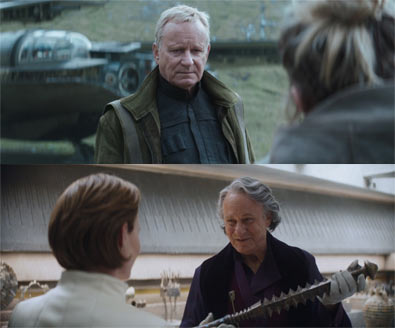
The mysterious Luthen Rael is whoever he has to be in a given situation: a flinty and shrewd rebel brokering sabotage, or a courtly shop owner buttering up the rich.
He’s a rebel counter-melody to the evil Palpatine, the main film saga’s prime villain, who pretended to be a urbane politician while truly being something hard and ruthless underneath.

• • Andor
Quietly, the character of Rael hinges the styles of the Prequel Trilogy to the Original Trilogy with his duality.
As the Coruscant businessman, he is all the high pomp and Golden Age Hollywood glamour of the prequels, a sophisticate in the NYC Art Deco futurism of the capitol planet. As himself, he is all the terse naturalism and political edge of the New Hollywood, a jaded idealist in the Leone badlands of social struggle. He literally connects the ‘30s styles of the former to the ‘70s styles of the latter.
Every aspect of Andor is about dichotomy: the democracy that has been trojan horsed into fascism; Mon Mothma, balancing being a Senator and a rebel funder, a powerbroker whose personal life is coming apart; the schism between Vel and Cinta trying to be rebels as well as lovers; the rebel leaders whose jaded mistrust is turning them as callous as the enemy they fight; the double-agents, the betrayers, the in-fighters, the ambivilent; and who is Kleya, really?
“Me, I’m in propulsion.”
-Willi
S O L O __________

• STAR WARS (1977)
• Andor
STAR WARS reinvents itself in variations.
Cassian Andor is an alternate reflection of the Han Solo archetype, following the paths not taken. In this very, very old Western, Han is a cowboy, Cassian is indigenous. The Correllian is charming and open, the Kenari is moody and closed off. Han is the easy stride of Gary Cooper, James Stewart, and Robert Redford, while Cassian is the measured tread of Tomas Milian, Al Pacino, and Pedro Pascal. If Solo plays poker with Ford, Huston, and Peckinpah, then Andor has barfights beside Leone, Altman, and Jodorowsky. Classic Western vs. Revisionist Western. >

• Andor
Both are smugglers, cynics, loyal friends, pilots, fighters. Both are orphans protecting their own interests until they have to choose a higher cause.
“Nobody here gives their real name.”
-Hostess

• Andor
The man with own aims.

• Paul McCartney, the "Get Back" sessions (1969)
• SERPICO (1973)
• Andor
Revolt into style.
The ultimate duality about Cassian is by implication: there is another. And she's just as important as he is. In ROGUE ONE, which follows this, it is Jyn Erso and Cassian Andor who lead the rebellion to the crucial finish. There should be a companion prequel two-season maxi-series called Erso showing her concurrent path toward their first meeting. It could have crossover elements in common involving the initial search for her, such as Saw Guerrera (Che Guevara... hmmm), Mon Mothma, Kleya, and Cassian.
"Rebellions are built on hope."
- Jyn Erso, ROGUE ONE (2016)

STAR WARS is a dystopia seceding its way into utopia.
The 20th Century was big nations at war with other big nations to prevent the spread of totalitarianism. And smaller nations freeing themselves from Colonialism. And civil rights movements to empower the oppressed within all nations. Much of this came to a head from the ‘40s to the ’70s, and fueled the most advanced creativity of the times in reaction.
SubChapter Links:
“Can one ever be too aggressive in preserving order?”
— Syril Karn
O P P R E S S I O N __________

• • Andor
In the real world, Stormtroopers were German shock troops in WWI and WWII. In STAR WARS, they are shorthand for the fist of Empire. Their alibi is that they are there to protect and serve the public, as they herd or murder them for the overlords.

• STAR WARS (1977)
• Andor
“I can’t breathe.”
- Eric Garner > >
When Cassian is nearly strangled to death by the thug enforcer droid for simply walking around, it is a direct indictment of the police state brutality of our current world.
Senator Dhow: “If you’re doing nothing wrong, what is there to fear?”
Mon Mothma: “Well, I’m fearing your definition of wrong.”
The privileged, the contented, and the indoctrinated always turn away from suffering they are enabling. Andor is about the disenfranchised people in the STAR WARS universe, the unfortunate, the discontented, and the waking.

• Nancy Walker, Rhoda (TV, 1974)
• Kathryn Hunter, Andor
C O N T R O L
R O O M S __________

THX 1138 4EB (short film, 1967)
• 2001: A SPACE ODYSSEY (1968)
• THX-1138 (1971)
• CONQUEST OF THE
PLANET OF THE APES (1972)
• WESTWORLD (1973)
• DARK STAR (1974)
• STAR WARS (1977)
• Andor
A subtle theme of 2001 is that technology is a tool only as good as the user and their intent. It can be used to advance humanity or destroy it.

• FAIL SAFE (1964)
• 2001: A SPACE ODYSSEY (1968)
• STAR WARS (1977)
• ALIEN (1979)
• Andor
The fate of our world lies in the control rooms of missile silos.
Since 1945, the world has lived under the spectre of atomic annihilation. Implicity, the Death Star is the personificaton of our real nuclear fears.
C O N S P I R A C Y __________

• Palpatine in REVENGE OF THE SITH (2005)
Conspiracy legally means a crime planned and committed by more than one person. That's not paranoia, it's just rational sense. An ultimate (and often sanctioned) extension of conspiracies is mafias, corporations, and fascism. Their downfall is activists and journalists who expose them.

• ALL THE PRESIDENT’S MEN (1976)
• • Andor
The counterculture felt the establishment was corrupt, and they were vindicated by the Watergate scandal (1972).> The 'leader of the free world' was exposed as a crook, and deposed. Journalism was at its peak exposing massive government crimes in this era, and conspiracy thrillers thrived: THE PARALLAX VIEW, THREE DAYS OF THE CONDOR, MARATHON MAN, and the true story of Nixon’s fall, ALL THE PRESIDENT’S MEN.
In Andor, when Kleya meets Vel clandestinely, it is a direct visual homage to reporter Bob Woodward meeting his secret source “Deep Throat” in the shadowy parking garage for info disclosing the Watergate cover-up by Nixon.

• THE PARALLAX VIEW (1974)
• MARATHON MAN (1976)
• Andor
Andor is quietly a conspiracy thriller, from both sides of it. On the rebel side, there’s Luthen, Kleya, and Mon working different strata of the political landscape. On the Imperial side, there is Meero with her investigation into a possible secret rebellion, and Karn trying to track down Andor.
Amid all this suspicion, each of them mistrusts each other. Totalitarian states eat themselves with fear and hate.
Andor is uniquely different from the other franchise media because of time. With 12 episodes per season, it has more time to be intricate, pensive, mysterious, faceted, novelistic. It is as much a political thriller as conspiracy, giving nuanced portrayals of Imperials like Meero and Karn misusing good talents for the wrong cause; complacent Senators cashing into fascism for position; Mon Mothma is the post-Padme urging compassion, while her spoiled daughter is an anti-Leia who scorns empathy for status and comfort. These are new levels of political nuance for STAR WARS.
“We’re cheaper than droids and easier to replace.”
- Cassian Andor
W O R K E R S __________

• THX-1138 (1971)
• Andor
Orwell’s “1984” posited that tyranny would be inflicted on people through brutal dictatorship. Huxley’s “Brave New World” countered that dystopia would creep in as a shiny comfort system that people would choose. Orwell was fighting fascism, while Huxley was sizing up capitalism.

• OLIVER (1968)
• PAPILLON (1973)
• Andor
The Empire conscripts citizens into prisoners for labor, and orphans for stormtroopers. Maybe you don’t have time to read this because you have to work. (Keep going, there’s cool pictures, and possibly snacks later. Maybe with flavor, if you meet your daily quota.)
“Everyone has their own rebellion.”
- Vel Sartha
P R I S O N E R __________

• CHARULATA (India, 1964)
• MIDNIGHT EXPRESS (1978)
• APOCALYPSE NOW (1979)
• ROGUE ONE (2016)
• Andor
People are in real and subjective prisons by degrees, and the realization to escape is the fuse for rebellion.

AND THE SUNDANCE KID (1969)
• Andor

• THX-1138 (1971)
• STAR WARS (1977)
• Andor
Rebel, resist, rise.
“I’d rather die trying to take them down than die giving them what they want.”
- Cassian Andor
R E V O L U T I O N __________

• Andor
The next move is to organize and plan.

• THREE OUTLAW SAMURAI
(Japan, 1964)
• THE DIRTY DOZEN (1968)
• BLACK PANTHERS (1968)
• A CLOCKWORK ORANGE (1971)
• Andor
Then infiltrate the system.

• Z (France, 1969)
• • Andor
And galvanize the masses to stand up and fight back.
“Fight the Empire!”
- Maarva Andor

• 2001: A SPACE ODYSSEY (1968)
• ATTACK OF THE CLONES (2002)
• Andor 1 (2022)
• ROGUE ONE (2016)
• Andor 2 (2025)
• STAR WARS (1977)
• THE LAST JEDI (2017)
• THE LAST JEDI (2017)
• THE RISE OF SKYWALKER (2019)
O U T R O __________
“There will be no rules going forward.”
- Luthen Rael

ROGUE ONE (2016), a prequel taking place days before the original 1977 STAR WARS, had the bold courage to tell an accurate war espionage story without the brakes on. Behind the scenes, there’s been much mystery about how the acclaimed film was revised with new script and scene shoots to complete the final version. Those were overseen by Tony Gilroy, a screenwriter (the BOURNE trilogy) and film director (MICHAEL CLAYTON).
Gilroy is the showrunner and main writer for the Andor two-season maxi-series, a prequel set-up leading up to ROGUE ONE. Careful not to fall into a self-referential nostalgia in danger of eating itself, Gilroy instead joins J.J. Abrams and Rian Johnson by pushing the envelope of the STAR WARS universe with what hasn’t been explored and how far to progress it.
STAR WARS can avoid mirroring only itself by remembering its inspirations, goals, and possibilities. Lucas was a counterculture film student who remade Saturday serials through an arthouse maturity. Now, that adult lens is returning. If the Original Trilogy was the revolution as a symbolic fable, the recent films have explored its good/evil absolutes as a nuanced ethical spectrum, with defecting stormtroopers and conflicted rebels. A war, not a video game. The messiness of reality. The anguish of repercussions. The complexity and randomness of fate. The desperation, the compromises, the toll.
Andor is a hyperjump advance, a tale of personal crisis within an espionage epic, which includes a heist, political drama, class soap, prison break, and slave revolt. Shot like an art film, paced like a novel, felt like a nervous breakthrough. Profoundly humanist, vehemently anti-fascist, fragilely hopeful.
Catch up to the Revolution.

Andor is showrun by Tony Gilroy.
The first season was directed by Toby Haynes, Susanna White, and Benjamin Caron.
It was written by Gilroy, Dan Gilroy, Stephen Schiff, and Beau Willimon.
The cinematography was by Adriano Goldman, Frank Lamm, Damián García, and Jonathan Freeman.
© Tym Stevens
See also:
• BEST MOVIES + TV: 2022
• How STAR WARS Is Changing Everything!
• 2001: A SPACE ODYSSEY - Its Transcendent Influence on all Pop Culture, with Music Player!
• How SPAGHETTI WESTERNS Revolutionized Rock Music!, with 3 Music Players!
• TWIN PEAKS: Its Influence on 30 Years of Film, TV, and Music!, with 5 Music Players!
• LORD OF THE RINGS: The Rings Of Power ⬤ The One Rules All
• THE CANON 1: 50 Books That Created Modern Culture, with Music Player
• THE CANON 2: 50 More Books That Created Modern Pop Culture, with Music Player
• THE CANON 3: 50 Recent Books That Created Modern Culture, with Music Player
• The Real History of ROCK AND SOUL!: The Music Player Checklist







 Posts
Posts