Showing posts with label Girls In the Garage. Show all posts

Tuesday, June 28, 2016

WOMEN OF ROCK: The 1960s


...with 2 World-Spanning Music Players!
(Part 2 of 7 decades)


Grace Slick and Janis Joplin.
Photo: Jim Marshall.

RockSex
now brings you the actual, all-inclusive history of Rock'n'Soul music, with Music Players.

Music Player Checklist

WOMEN OF ROCK:
1960s

#2 of 7


This 7-part series with Music Players will cover
every decade of the Women Of Rock,
from the 1950s to today!

Learn the real and inclusive history
you've never heard!

'50s---'70s---'80s---'90s---'00s---'10s


Shortcut links to Music Players:
Women Of Rock: 1960-'66
Women Of Rock: 1967-'69


W O M E N
O F
R O C K:

1960-'66

The Luv'd Ones


Spotify playlist title=
Women Of Rock: 1960-'66
This is a Spotify player. Join up for free here.

*(This Player is limited to the first 200 songs.
Hear the unlimited Playlist here.)


This Music Player covers women in all forms of Rock'n'Roll music, from 1960 through 1966, in chronological order.

Rockabilly! Soul! Surf!
Girl Group! Beat! Garage!
Folk! Blues! Country!
Ye-Ye! Shake! World!

(All Bold names are heard on the Player.)


Rock'n'Roll has always been shaped by everybody. So why do we even have to specify 'Women Of Rock'?

Because presence defeats absence. You have to see something to know that it's there. When someone is kept out of sight, it's that much more crucial to shine the spotlight on them at every turn, until everyone finally recognizes who was there all along.

Women have been a part of every musical movement, but for decades the cartoon history of Rock has been told as select men and modes turning over. This simplistic outlook and biased exclusion is what demands the move toward fairer inclusion. It's long past time to see clearer and deeper. In truth, Rock'n'Roll is a fluid ocean, rotating noted waves on the surface but driven by less visable and complex currents beneath. The people excluded from the narrative have ridden every wave noticed on the surface as much as those select men, while helping shape all the much subtler currents powering them.

Inclusion comes when exclusion ends. These Music Players, and the insights into them which follow, spotlight the vast range of global women who shaped Rock in the 1960s and ushers them gratefully into the room.

The Chantels

The original Rock'n'Roll didn't end in the early '60s just because a handful of male heroes fell out,> and didn't return magically in 1964 from English guys. It actually kept rolling right on into the new decade uninterrupted with fresh tides. What's most important to remember about Soul, Girl Group, Doo Wop, and Surf is that they were all seen collectively as forms of young Pop, all heard as Rock'n'Roll, because they were.

Repression is static, progression is dynamic. AM radio was a stealth revolution, a forum for all music forms where any record won if it had 'a good beat and was easy to dance to'. Stealthily, those dance moves were swaying into a diverse movement, a jet-age generation sharing new outlooks and expressions beyond the stolid and the segregated. Where adults outside of it just noted fads and idols, the youth were swimming in rich new possibilities that would drive the decade.

Sister Rosetta Tharpe,
Wanda Jackson; LaVern Baker.

Rock is polyglot; it morphed from many sources and kept on mutating exponentially.> In the early '60s, women from the original wave of Rock'n'Roll> kept cresting boldly forward, like Sister Rosetta Tharpe, Wanda Jackson, Janis Martin, and LaVern Baker. Even as Elvis, Jerry Lee, Buddy, Richard,, and Chuck were sidelined, their fire was clearly relayed in songs like the all-female band The Chantels' "Well, I Told You", The Charmaines' "Rockin' Old Man", and The Crystals' "All Grown Up".

The Shirelles; The Ronettes; The Shangri-Las.

If it seems odd that those famous Girl Groups were belting Rock'n'Roll, it proves the true point; Girl Group is another catchall limitation placed on women who were beyond its doll-toy boundaries. The Shirelles, The Cookies, and The Ronettes sang a range of melodies, and their streamlined pop and production punch molded the British Invasion. As did the soulful pop of Motown with the sass and class of The Marvelettes, Mary Wells, Martha And The Vandellas, Debbie Dean, The Supremes, and Chris Clark. Keeping it streets, The Shangri-Las, The Goodies, and The Whyte Boots covertly turned goodgirl and badgirl polarities inside out with their biker songs and dramatic confessionals.

Behind the curtain lay the songwriting wizardry of Ellie Greenwich, Cynthia Weil, and Carole King at the Brill Building, and Sylvia Moy, Janie Bradford, Syreeta Wright, and Valerie Simpson at Motown.

Soul is human experience writ passionate, and mature scribes like Etta James, Aretha Franklin, Fontella Bass, Timi Yuro, and Carla Thomas reinterpreted how to be a modern song interpreter outside of lounges and cabarets, setting the new standard to follow. The rollicking Ike And Tina Turner Revue also gave us bold soul sisters like The Ikettes ["I'm Blue (The Gong Song)"], The Mirettes, and P.P. Arnold. The James Brown Show would bestow us with hard-workin' women like Yvonne Fair, Sugar Pie DeSanto, and Tammy Montgomery (Tammi Terrell).

Chiyo Ishi And The Crescents;
Carol Kaye; Darlene Love.

Surf> rose past its initial wave in the sun to continue undulating for decades. Riding with it from the start were women like Kay Bell And The Tuffs' "(The Original) Surfer Stomp" (1961), Kathy Lynn And The Playboys' "Rock City", and guitarist Chiyo Ishi on The Crescents' "Pink Dominos". The great Carol Kaye played bass on all The Beach Boys and The Honeys productions. Twining some soul twist into the beach cookout were Dee Dee Sharpe, The Supremes, and The Orlons, while Darlene Love and The Blossoms sang Surf hits for Hal Blaine, Al Casey, and Duane Eddy.

“Protest against the rising tide of conformity.”
Bob Dylan and Joan Baez, 1963.

Folk was the rallying call for the young, compassionate, and aware. It harbingered a back-to-the-roots outlook that embraced rural roots musics like Gospel, Blues, and Country, and vitalized populist acts like Miram Makeba (South Africa), The Staple Singers (with Mavis), Malvina Reynolds (with her pleasantly scathing "Little Boxes"), Odetta, Nina Simone, Judy Collins, and the flexible Judy Henske. Troubadour activist Joan Baez gave Bob Dylan his entrée to the scene, while Native American activist Buffy Saint Marie penned classic songs famously covered like "Universal Soldier" (Donovan) and "Codine" (The Charletans SF).

The egalitarian outlook of the folk movement was reflected in pairings like Peter, Paul, And Mary, Ian And Sylvia, and Mimi And Richard Farina (and soon in the PsychFolk duos and bands).

Barbara Lynn;
Barbara Dane; Judy Roderick.

Folk ignited reappreciation of Blues elders like Muddy Waters, Howlin' Wolf, Big Mama Thornton, Sippie Wallace, and Elizabeth Cotten, who toured on festival bills around the world. The healthy focus on rich traditions benefitted new artists like the soulful guitarists Barbara Lynn, Barbara Dane, and Judy Roderick, a generational hand-off of living cultural traditions that still continues. Singer Koko Taylor would bring gutbucket glory to rival Janis Joplin in the latter '60s.

Folk, Gospel, and Blues were also a refuge for female musicians to play their instruments with a little less of the pressures of the Pop world trying to domesticate or doll-ify them for mass consumption.

Les Surfs; Tina Y Tesa;
Kayoko Moriyama.

'50s Rock'n'Roll was immediately reflected globally, and even more so in the early '60s. All across Europe with Helen Shapiro and The Vernons Girls (England); Heidi Bruhl and Dany Mann (Germany); Hedika and Nicole Paquin (France); Les Surfs (Madagascar); Gelu, Tina Y Tesa, and Trio Juventud (Spain); and Laura Bordes And The Revolts (IndoRock from the Netherlands).

And across the Equator with Derrick And Patsy (Jamaica); Vianey Valdez and Angelica Maria (Mexico); Meire Pavão (Brazil); and T.N.T. (Uruguay).

And across all oceans with organist Cherry Wainer (South Africa); Betty McQuade, Toni McCann, and Dinah Lee (Australia); Ivor Fisher And The Satellites (New Zealand); and Kayoko Moriyama and Yukari Ito (Japan).

France Gall; Caterina Caselli.

In France, upbeat dance music was called Yé-yé, with ironic Lolitas like France Gall ["Laissez Tomber Les Filles" (a.k.a., "Chick Habit"], Beat divas like Sylvie Vartan, rockers like Jacqueline Taïeb, and moodier interpreters like Francoise Hardy and Marie Laforet. In Italy it was called Shake, with brash belters like Mina, Rita Pavone, Catherine Spaak, and Caterina Caselli. There were equivalent scenes in Spain and Japan.

(The danger of infantalizing anyone young and female into packaged doll groups that haunted Girl Group and Yé-yé has now hyper-escalated with J-Pop and K-Pop.)

The Supremes' "A Bit Of Liverpool" (1964).

The British Invasion wouldn't exist like it did without the inspiration of Girl Group songs, as proven by career-making covers of The Shirelles' "Boys" and "Chains" and "Putty In Your Hands", The Donays' "Devil In His Heart", The Exciters' "Do-Wah-Diddy", Nina Simone's "Don't Let Me Be Misunderstood", Bessie Banks' "Go Now", and Goldie And The Gingerbreads' "Can't You Hear My Heartbeat?".

Conversely, the dialogue went both ways as the unprecedented success of The Beatles then inspired female artists. Their sound was reflected immediately by Jeannie And The Big Guys (England), Rod And Carolyn (England), The Beatle-Ettes, The Bootles, Die Sweetles (Germany), and Les Beatlettes (Canada). Ella Fitzgerald shocked her upscale set by enthusiastically swinging "Can't Buy Me Love". At Motown, Oma Heard resounded about her "Lifetime Man", and songbook cover albums like The Supremes' A Bit Of Liverpool and Mary Wells' Love Songs To The Beatles were served to a tee.

Motown made its big splash into England via a TV special by Dusty Springfield hosting label acts. Dusty led a home court of women equally vital to the range of the British Invasion, like Marianne Faithfull, Lulu, Sandie Shaw, and Cilla Black. Meanwhile, some of Jimmy Page's earliest session gigs were for Jackie DeShannon's "Dream Boy" and Brenda Lee's "Is It True?".

The Liverbirds

The most vital impact of The Beatles on women was not the screaming teens, but actually the scores of all-female bands that formed by their inspiration. Chided as novelties, under-recorded at every turn, mistreated like everything but the earnest musicians they were, these sweet punks were the future regardless of the mean and the clueless. They blasted out Beat, Freakbeat, FolkRock, and then Garage with all the gusto of their brothers. This went unheralded for decades until collectors and cratediggers brought them properly to light.

Goldie And The Gingerbreads;
The Daughters Of Eve; Dara Puspita.

The Girls In The Garage included The Liverbirds, The Pleasure Seekers (with Patti and Suzi Quatro), The Womenfolk, Goldie And The Gingerbreads, The Girls (the teenage Sandoval sisters), The Continental Co-Ets, The Belles (who turned the garage anthem "Gloria" into "Melvin"), The Clinger Sisters, The Bitter Sweets, Les Intrigantes (Canada), The Fair Sect (New Zealand), Las Mosquitas (Spain), Las Akelas (Spain), Dara Puspita (Indonesia), and The Luv'd Ones with the brilliant guitarist Char Vinnedge. (There are scores more of all-female bands unavailable on the Player. Learn about more here and here)

Weaselspeak phrases like "one of the few female..." should always raise a red flag. It doesn't mean women couldn't do a task, it's simply doublespeak glossing over how they were kept from doing it. When historians say "rare", it really means they are just unaware. Women had been playing instruments well since they were invented; the trick is being acknowledged doing it. In the '50s, the relentless crush to domesticate women didn't curtail Rockers like Sister Rosetta and Wanda, or Jazzers like Vi Redd and Dorothy Ashby, or all-female bands like The Rhythm Ranch Girls and Las Mary Jets (Mexico), or The Mary Kay Trio (guitarist from Hawaii), from giving it their all. But if you're under-recorded or un-archived, you disappear as if you were never there.

And sometimes you can vanish in plain sight. Quite a few '60s male bands included female players, even as management tried to push them out or forward. Honey Lantree was treated like a novelty as the drummer for The Honeycombs, but other drummers like Jan Errico (first The Vejtables and then The Mojo Men) and Karen Carpenter (The Carpenters) were brought forward as the frontperson instead, made visable now more for their allure instead of for their skills.

Fortunately, some artists rebelled the other way with deliberate parity. Bo Diddley dueled happily with two female guitarists, first Lady Bo and then The Duchess. The equitable Sly And The Family Stone proudly flaunted their sisters in lyrics and onstage, with Rose Stone on keys and Cynthia Robinson on trumpet. And some won by quality and quantity: session ace Carol Kaye played bass on more timeless hit classics and TV themes than anyone can ever count.

Velvet Underground and Nico

But women held their own upfront as well with female-fronted outfits like Raylene And The Blue Angels, Denise And Co., The Clefs Of Lavender Hill, Monique And The Lions (Germany), Linda Van Dyck backed by Boo And The Boo Boos (Netherlands), and Nico with The Velvet Underground (with drummer Maureen Tucker).

Listening through the Player, it's clear that women flowed with every current and cross-current of the '60s, sidelong with Elvis, The Beach Boys, Bob Dylan, The Beatles, Marvin Gaye, and The 13th Floor Elevators. As the counterculture now consolidated in the Summer Of Love, they would become even more pervasive and integral.


W O M E N
O F
R O C K:

1967-'69


Os Mutantes


Spotify playlist title=
Women Of Rock: 1967-'69
This is a Spotify player. Join up for free here.

*(This Player is limited to the first 200 songs.
Hear the unlimited Playlist here.)


This Music Player covers women in the mutating forms of Rock'n'Roll music, from 1967 through 1969, in chronological order.

Garage! Psychedelic! Roots!
PsycheFolk! World! HAIR!
Funky! Electronic! Hard Rock!

(All Bold names are heard on the Player.)


When people think of women in '60s Rock, they think of Grace Slick and Janis Joplin.

As they should, because they're both essential. But they are the surface tsunamis of a deeper, wider scene.

San Francisco became the vanguard of the social revolution precisely because it was cosmopolitan. Culture is the constant assimilation of fresh ideas from all angles, from all people, and crossroads cities have always been the nexus of progressive creativity because of it. As such, the Bay Area had more eclectic line-ups and sounds than almost anywhere, first.

The Vejtables; The Peanut Butter Conspiracy;
It's A Beautiful Day.

Visibility is the key. Because Grace Slick of The Great Society and Jefferson Airplane and Janis Joplin of Big Brother And The Holding Company had smash hits, they were seen nationally on music shows and the MONTEREY POP (1968) and WOODSTOCK documentaries (1969). But less seen were Bay Area bands with female members also slinging modern folk and blues like The We Five, The Vejtables, The Mojo Men, The Generation (with Lydia Pense), The Serpent Power, The Peanut Butter Conspiracy, Fifty Foot Hose, Mother Earth (With Tracy Nelson), and It's A Beautiful Day.

Sly And The Family Stone

Sly And The Family Stone are often heralded as 'the first (and only) integrated band, male and female, black and white'. But it takes nothing away from one of the greatest groups of all time to say this is inaccurate. They were cousined by US brothers and sisters like The Loading Zone (with Linda Tillery), The Rotary Connection (with Minnie Riperton), and Sweetwater; and in England with The Ferris Wheel and Blue Mink.

Also in England, illusory borders continued dissolving as P.P. Arnold jammed with The Small Faces and Rod Stewart, Marsha Hunt with Deep Purple, Sharon Tandy (South Africa) with Les Fleur De Lys, Yoko Ono with John Lennon and The Rolling Stones, and Martha Velez with everyone. If the culture at large still thought the world was color faces in slotted places, the counterculture saw one world one people and infinite possibilities.

The pattern toward progress here is hybrid. With each passing year, the sounds that youth had heard side-by-side on AM blended together into the personnel, sounds, and outlooks of new bands who embraced diversity as freedom, and who found support on college stations in the freeform frontier of the new alternative FM radio.
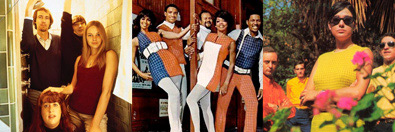
The Mamas And The Papas;
The 5th Dimension; Los Stop.

These good vibrations are why vocal groups blended Motown, Dylan, Brian Wilson, and The Beatles to become acts like The Mamas And The Papas, Spanky And Our Gang, Sagittarius, The Fifth Dimension, The Free Design, Honey Ltd., The City (with Carole King), Chorus Reverendus (France), Los Stop (Spain), and Sergio Mendez And Brazil '66 (Brazil).

The success of Grace and Janis bolstered the arrival of more female-fronted Rock bands like The Ravelles, Lydia Pense with Cold Blood, Yuya Uchida And The Flowers (Japan), Ann Wilson And The Daybreaks (who would become Heart), and the great Mariska Veres with Shocking Blue (Netherlands).

Psychedelic bands had female members in the US with Neighb'rhood Childr'n, Daughters of Albion, Birmingham Sunday, The Unspoken Word, The Savage Rose, The Love Exchange, Ill Wind, and Kangaroo; and globally with Os Mutantes (Brazil), The Executives (Australia), Hljómar (Iceland), Aguaturbia (Chile), Trúbrot (Iceland), De Kalafe (Brazil), and Os Novos Balanos (Brazil).

The Daisy Chain; The Ace Of Cups; The Feminine Complex.

All-female bands opened tour bills and recorded singles, and sometimes full albums, like Dara Puspita (Indonesia), The Daisy Chain (who later became the mega-heavy Birtha), The Ace Of Cups, The Daughters Of Eve, The Puppets, The Feminine Complex, The She Trinity, and She.

Joni Mitchell; Vashti Bunyan; Deborah Harry.

Folk took on manifold forms. From the sinuous flux of Joni Mitchell and eerie soliloquies of Vashti Bunyan (England), to duos flexing out like Blackburn And Snow, Smokey And His Sister, and Lily And Maria. And into uncharted furrows with the PsycheFolk of The Insect Trust, The Bristol Boxkite, It's A Beautiful Day, and The Wind In The Willows (with Deborah Harry). Many Americana roots musics laced back to European seeds; a harvest of new English artists like Fairport Convention (with Sandy Denny), Pentangle, and Renaissance (with Annie Haslam) were now branching out into forms of progressive folk.

The back-to-the-roots music ethos rippled in tandem with the back-to-nature movement, as the counterculture embraced communalism, ecology, alternate spiritualities, rustic fashions, and natural appearance as a counterpoint to the slick, the selfish, and the flashy. Protest folk had formed an activist society grounded in the humanitarian and the equitable, in direct contrast to conformity and consumerism. It paralleled the general pattern of a massive and complex generation trying to reexamine and recontruct themselves at every turn. To be free in body and spirit, and to connect with each other fully.

Aretha Franklin; Sarolta Zalatnay; Les Planetes.

Aretha Franklin redefined herself and Soul music in 1967, making it more raw, more epic, more intimate. Soul artists were singing Rock songs, Rock artists were jamming Jazz, Jazz was going funky, and everyone was playing on the same festival bills with World artists. Every soul has soul and putting passion into the compassion were The Flirtations, the swamp soul of Bobbie Gentry and Delaney And Bonnie, Linda Lyndell ("What A Man"), Chicken Shack (with Christine McVie), Laura Nyro, Las Quatro Monedas (Venezuela), the bluntly-named Females (Indonesia), Sarolta Zalatnay (Hungary), Sodsai Chaengkij (Thailand), and Les Planètes (Canada). Get it on the good foot, good god, y'all!

The HAIR cast upbraid London, 1968.

After decades of vanilla sing-songs, Broadway was occupied by the revolution in 1968 with HAIR: The American Tribal Love-Rock Musical, which broke every social restriction overnight to smash success. Along with the first black female Broadway lead ever with Melba Moore, its international productions launched the careers of cast members like Diane Keaton, Sonja Kristina (Curved Air), Elaine Paige, Marsha Hunt, Donna Summer, and Sônia Braga. Its songs became new utopian standards covered by The Supremes, Nina Simone, The Free Design, The 5th Dimension, Julie Driscoll, Carla Thomas, and countless more. No matter what anyone looked like, no matter what niche they were boxed by, these artists knew themselves instead as a tribal community of hearts and sounds.

Electronic music broke through to the mainstream with the 1968 success of Wendy Carlos' all-electronic Switched On Bach album. Other pioneers continued collaging patch-cord and tone-honed miracles like Delia Derbyshire (the original "Doctor Who Theme"), Alice Shields, and Pril Smiley. The revolution shifted from college labs to pop studios with the first Moog synths in 1968, as it synergized into experimental Rock by The United States Of America (who became Joe Byrd And The Field Hippies) and Fifty Foot Hose.

As Acid Rock warped into Heavy Rock, women hefted the heaviosity like Sharon Tandy with Les Fleur De Lys, the proto-Occult rock of Coven, the multinational The She Trinity, the iconoclastic Julie Driscoll with Brian Auger Trinity, Aquaturbia, and the Prog of Affinity. Char Vinnidge pitchshifted the Beatle-isms of The Luv'd Ones to full-bore Hendrix acidfuzz, as did The Pleasure Seekers in their transmutation toward becoming Cradle.

Betty Davis would outdo all of them. Being 'ahead of your time' just means everyone else was behind. The songwriter previously known as "Miles' wife", a counterculture dervish who's influence singlehandedly inspired Fusion with his BITCHES BREW (1969) album, stepped forward fronting acidic jams backed by Jimi's brothers Mitch Mitchell and Buddy Cox, and Jazz luminaries like Hancock, Masekela, Shorter, McLaughlin, Sample, and Felder. The sessions weren't released for many years, but she would ascend anyway as the queen of Funk Rock in the next decade.

The Svelts, 1968;
Jean Millington (L), June Millington (R).

But the final word here about the '60s should be about the first word of the '70s: Fanny. In 1964, the filipina sisters June and Jean Millington of California were inspired by The Beatles to form an all-female band called The Svelts. After the usual turnovers, they were Fanny by 1969, and became the first all-female band signed by a major record label to record multiple albums. They summed up all of women's momentum of the decade in one band, ready to open the next decade with wider possibilities.


1950s Rock'n'Roll started with hundreds of female acts, and this became rapidly exponential with each decade.

As this series of Music Players will prove, they dominoed every decade through the '60s, the '70s, the '80s, the '90s, the '00s, and the '10s.

We've heard enough of his story, so let's widen the world with the history of her story.


Next:
Women Of Rock: The 1970s


© Tym Stevens


See Also:

Part 1 (of 2):
YOU DON'T OWN ME: The Uprising of the 1960s GIRL GROUPS
Part 2 (of 2):
SHE'S A REBEL: Decades Of Songs Influenced By The GIRL GROUPS


-Women Of Rock: The 1950s (2 Music Players!)

Coming:
Women Of Rock: The 1970s (2 Music Players)
Women Of Rock: The 1980s (3 Music Players)
Women Of Rock: The 1990s (2 Music Players)
Women Of Rock: The 2000s (2 Music Players)
Women Of Rock: The 2010s (2 Music Players)


The Real History of Rock and Soul!: A Music Player Checklist


Monday, June 6, 2016

YOU DON'T OWN ME: The Uprising of the 1960s GIRL GROUPS


...with World-Spanning Music Player!
(Part 1 of 2)

_____

The Ronettes.

RockSex
now brings you the actual, all-inclusive history of Rock'n'Soul music, with Music Players.

Music Player Checklist


Spotify playlist title=
GIRL GROUPS: 1960s
This is a Spotify player. Join up for free here.

*(This Player is limited to the first 200 songs.
Hear the unlimited Playlist here.)


This Music Player covers the initial rise of GIRL GROUP vocal sounds from its origins in the '50s through its global range in the 1960s, in chronological order.

> Part 2:
SHE'S A REBEL: Decades Of Songs Influenced By The GIRL GROUPS


___________________


I'm Not Just one Of Your Little Toys:
Girls grouped


"Girl Groups" often means girls grouped together because they are girls. It's nice for alliteration but not illumination.

It's too often a quiet dismissal, trivializing 'female pop' as teenage trash, disposable in critics' minds by comparison to the British Invasion or Garage Rock. But in truth those musics wouldn't exist like they do without this music. And the girls grouped were really a vast range of vocal stylings, genre sounds, age groups, and national origins. It's high time to commend that range and how crucial it has been to the evolution of Rock.

Here, we'll use the term Girl Group as an appreciation of a general sonic movement and how female artists shone within it. This is to dismiss the misuse of the term, which treats them as little girls not Rock enough for the boys club, or as sexy dolls fronting machine pop. And this is to disrupt the shopworn cartoon narrative that continually strobes that limited view into the mainstream, instead replacing it with a clarified respect for these equally valuable sonic pioneers.

(The far-more expansive history of WOMEN OF ROCK, with Music Players, will be posted separately.)

Beside every man there's a woman doing the same things. She just always gets less credit or pay. Remember, the Blues first burned bright on international turntables because of the breakthrough success of Bessie Smith. Women then belted out Swing, herded the Honky Tonks, and were rockin' fillies like the rockabillies. During those times of constrictive attitudes, record producers treated their works like novelty records while raking in the money it brought them. Because women were often less-recorded, it makes their presence and impact seem spotty in the early years of Rock'n'Roll. (Lack of representation ensures lack of recognition). But they were there, always. As that first wave of rockers fell apart from bad luck, treachery, and dumb moves, the early '60s was an open playing field.> In that gulf the women finally got some attention. The age of the Girl Groups took full bloom, flourishing like a hothouse.

First, think about the age range of this material. There were handclap pop songs for early teeners at pajama parties; there were romance dreams for the prom girls; there were more wary and intimate songs for the young college women; and there were adult songs, declarative of identity or experience. This was real coming-of-age music for the biggest generation of females the world had ever seen.

(But heart music is heart music, which is why it inspired everyone from The Beatles to Blondie, from The New York Dolls to La Luz, for decades to come.)

Secondly, it wasn't simply bouffant belles relayed in quartets cheerleading for marital bliss. Within this general vocal pop tradition, there were the soulful shoo-wop sisters, the dreamscape girls, the drama divas, the biker chicks, the party poppers, the dance dolls, the brassy Brits, the soulstress soloists, and -completely neglected by history- the girls from the garage. Along the way (as heard on the Music Player) you could enjoy bossa novas, country soul, rockabilly, surf, Beat Girls, folk, and psychedelia. Being that women make up over half of the world, the pop scope was international, with diverse scenes in the UK, France, Italy, Singapore, Mexico, and more.


R: Carole King, Gerry Goffin, and Paul Simon.


Also, this wasn't all social engineering from male popsmiths in the Brill building. True, the key positions of the era were held by men; record execs, label owners, managers, most writers and producers, club owners, DJs. But women first began making huge inroads into the industry precisely because of this music. Carole King, Cynthia Weil, and Ellie Greenwich each wrote as many hit classics as practically anyone combined.

Let's not forget Motown writers Valerie Simpson, Pam Sawyer, or Sylvia Moy (who also produced many hits). Syreeta Wright started as receptionist at Motown, then co-wrote many of Stevie's hits, and broke through with hits of her own. Chris Clark seemed an unlikely Motown star, being a six-foot blond, but she went from being receptionist to the immortal "Love's Gone Bad", to an Oscar for co-writing the LADY SINGS THE BLUES film, to being a Motown vice president for video. In the current century, it became fact that women outsold men in every genre they performed in. This is the latest legacy of the doors the ladies kicked opened with this music. In heels, no less!


Phil Spector; Jimmy Page.


Separating sound by ideas of race never works, so the same applies to gender.> It takes everybody to make every thing. Just as varied complexions from myriad cultural traditions helped co-create Soul music, so men from every outlook collaborated with their sisters to create these songs.

Certain ones had an indelible effect. The perilous Phil Spector used his 'wall of sound' to surround his wife Ronnie's group, The Ronettes, in epic anthems to love consummated or lost. (Ahem.) Shadow Morton was another production wizard setting new standards with his dramatic work for The Shangri-La's. Burt Bacharach, with his lyricists Hal David and Carole Bayer Sager, wrote nearly baroque arrangements for chanteuses like Dionne Warwick and Sandie Shaw to shine in. Berry Gordy assembled the pop-soul factory of Motown, whose sound and roster influenced absolutely everyone. John Barry's spy themes and brassy horns were another perennial spectre in many of these songs. And quite a few of the kicking rockers by these songbirds (Lulu, Brenda Lee, Jackie DeShannon, Vashti Bunyan) were fueled by young session guitarist Jimmy Page.

The support was there, but it was the girls who stood facefront for the future.


I'll Keep On Holding On:
The women take the spotlight


The Gold Standard:
The Supremes.


Culture is an intersection of ideas in collusion and sometimes collision.

The 'Girl Group' sound evolved out of all the harmony groups that preceded it: The Boswell Sisters (the '30s) and the Andrews Sisters (the '40s); the barbershop quartets, classical chorales, and church choirs; the gospel groups like The Swan Silvertones who led into the secular doo wop of The Mills Brothers and The Ravens; the bebop vocalese of Ella Fitzgerald and Lambert, Hendricks, And Ross; and especially the elaborate strings and production behind mature torch singers like Cole, Sinatra, Washington, Bennett, and Cooke. Shake all this up with Rock'n'Roll, Soul, and headstrong youth and you get a heady concoction.

Girl Group music is some of the best-produced pop music ever recorded. The post-War torch song era created a pool of crack session musicians working under classically trained arrangers in state-of-the-art studios in New York and Los Angeles. From the simplest dance song to the grandest heartbreak ballad, the craft in these songs is impeccable and timeless. There is a directly relayed throughline from the lush '50s concept albums of Sinatra and Fitzgerald, through the string-scapes behind Girl Group and Motown, onward into Rock's maturation with the Pet Sounds and Sgt. Pepper albums, and beyond.

Truly, Girl Group isn't a box, it is a landscape. Girl Group and Doo Wop are retroactive terms for diverse vocal musics that only serve to genderize limits on a reality too boundless for them. These pop confessionals moved all hips and hearts, made by singles and sets of every age, place, and angle. As the Music Player bears out, there were many facets glimmering in that spotlight.


SHOO-WOP

Martha And The Vandellas with Dusty Springfield.


First up, let's hear it for 'the shoo-wop sisters'!

The only job they could expect in Detroit was as a maid or in a factory. Motown opened a new world for them to be in high society and have presence. The label was Soul but it had its eye on uptown and Vegas. There was a regal glam to all that sass and swoon. These tight pop melodies with their walloping rhythms galvanized early '60s youth, at home and abroad. Queens like Mary Wells, Martha Reeves And The Vandellas, Kim Weston, Brenda Hollaway, Tammi Terrell, and of course Diana Ross And The Supremes; songs like "Please Mister Postman", "Love Is Like a Heatwave", "Boys" ("Sha-shoo-bop, sha-sha-shoo-bop"), "Where Did Our Love Go?", and "Nowhere To Run".

They were matched by their New York sisters, who lived in similar working-class Euro, Afr-Am, and Puerto Rican boroughs with the same dreams. They were the doo wop corner girls now swinging a new modern pop. The songs they strutted had swing, swagger, laughter, and verve. Fingersnappers like The Shirelles, The Ronettes, The Cookies (who became The Rae-lettes, propelling Ray Charles), The Chiffons, and Little Eva; with classic songs like "One fine Day", "Boys", "Be My Baby", and "Give Him a Great Big Kiss".


DREAMSCAPE

The Caravelles; The Honey Ltd.


The 'dreamscape girls' were ethereal.

They were the angelic chorales that soothed the troubled soul from a world of radiant echo. They were the idealic self or spiritual other whose siren psalms promised transendence. Close your eyes and swoon to The Paris Sisters' "I Love How You Love Me", The Caravelles' "You Don't Have To Be A Baby To Cry", Les Intrigantes's "Sans Toi", the haunted folk of Vashti Bunyan's "Train Song", or anything at all by The Honey Ltd.


DRAMA

The Shangri-Las.


The 'drama divas' are bold and cinematic.

Orchestras with dazzling dynamics underscore their apocalyptic hopes and heartbreaks. The queen is the Shangri-Las' leader, Mary Weiss, in her haunted monologues, trembling in the stark spotlight. She turned the pop record into a vicarious confessional for raw and rapt youth in songs like "Past, Present, and Future" and the shattering "I Can Never Go Home Anymore". That poignant intimacy, with cinerama swells of sound, gets star billing in The Bitter Sweet's dizzying "What a Lonely Way To Start the Summertime", Dawn's neurotic "I'm Afraid They're All Talking About Me", Susan Rafey's softly sinister "The Big Hurt", and Timi Yuro' magesterial "The Love Of A Boy".

And first to throw the feminist fist are Dionne Warwick's ardent "Don't Make Me Over", and Lesley Gore's immortal declaration "You Don't Own Me".
[See also, Betty Everett's "S.P.C.L.G. (Society for the Prevention of Cruelty to Little Girls)".]


BIKERS


The 'biker chicks' were raucous, all street accents and gumsmack.

It was the original rebel grrrl, who knew about sex, bad guys, worse habits, seamy cities, and danger. And seemed to like all of them. The Crystals shaped it with "He's A Rebel", and The Ronettes crystalized it with their proud Puerto Rican sensuality and smirks. They coiffed their beehive hair perfect just so they could shake it loose in the heat of singing. The Shangri-Las single-handedly owned the genre with "Leader Of The Pack", and their hellion backstage ways; one exasperated rival called them foul-mouthed monsters, which they just laughed at.

The biker girls sneered at glam gowns and galas. They wanted life rough and wild. Check out The Whyte Boots with their tough stance and white whips, and their catastrophic "Nightmare". Or brave The Shangri-La's "Out In the Streets", The Girls' "Chico's Girl", The Ad Libs' "On The Corner", and the explicit threat of The Cookies' "Don't Say Nothin' (Bad About My Baby)".


DANCEFLOOR

"Shirley, Shirley bo Birley Bonana fanna fo Firley
Fee fy mo Mirley, Shirley!"


The 'party poppers' took the shoo-wop groove and broadened it from the block to the blowout.

It was now fun teen pop for the soiree, the zing in the shindig, the twist in the surfari, sprawling from gaiety to downright goofy. Kick your shoes off to "Surfin' Hootenanny" (with vocals by Darlene Love And The Blossoms), Little Eva's "The Loco-Motion", and Patti Labelle And Her Blue Belles' "I Sold My Heart To The Junkman".

The party really careens loopy with the manic Tammys' swirling and shrieking through "Egyptian Shumba"*, the jumprope handclaps of The Dixie Cups' "Iko Iko", the crazed organ bouncing The Coupons' "Turn Her Down", Donna Loren's surf with "The Cycle Set", the dizzying tongue-twist of "The Name Game" by Shirley Ellis, and The Gypsies' happy admonition to "Jerk It".

*At the "whoa-ah-oh"'s at 2:17, you can hear the precise moment The B-52's were born.


"Calling out around the world/
Are you ready for a brand new beat?"


The 'dance dolls' were the rhythm regals, getting you into the good groove.

They were the latest dance step or bumping sound. If the shoo-wops hopped the block and the party poppers kicked the sock hop, these ladies lit the niteclub and discotheque. Drop the stylus on The Velvelettes' cheeky "He Was Really Sayin' Something", where the lead sounds like she's both laughing and biting your earlobe. Or The Ikettes' sauntering "I'm Blue (The Gong Gong Song)", Martha And The Vandellas' ever-wonderful "Dancing In the Street", Val McKenna's funky "I Can't Believe What You Say", and Rita Pavone's piledriving "Il Geghege".

In France, the Yé-yé girls responded with France Gall's "Laisse Tomber Les Filles" (a.k.a, "Chick Habit"), Sylvie Vartan's "Ne Le Decois Pas" ("just like Putty in my hands/ uh huh!"), and Jacqueline Taieb's "On Roule A 160".


SURELY BRASSY

Shirley Bassey.


The 'brassy Brits' were the synthesis of the soul sisters and the drama divas, belting their own soul music on a theatrical scale.

Passion is borderless, and these UK women merged US soul, traditional ballading, and their own string-laden theatrical pop. (In truth, the classical strings that Spector and Gordy had so often borrowed, now coming full circle to its origins.) Their escalation from the drama divas brought in soundtrack scores, cabaret flourish, and haute couture. Much of this was personified in Shirley Bassey, whose fullthroated brass and supperclub zazz ramp-lified the spirit of Judy Garland; Shirley's gusto and power dynamizes epics like "Goldfinger" and "My Love Has Two Faces".

Their passionate smolder is klieg lights and shadows, bold and theatric. They are triumphant, bereft, and reflective in broad sweeps. Relish Sandy Shaw's "Girl Don't Come", Petula Clark's "Downtown", Lulu's "To Sir With Love", Vicki Carr's spy-twist "The Silencers", the lush ache of Cilla Black's "I've Been Wrong Before" (produced by George Martin), Nita Rossi's bombastic "Untrue, Unfaithful (That Was You)", Jackie Trent's operatic "Either Way I Lose", and US ex-pat P.P. Arnold's take on "The First Cut Is The Deepest".

Mina; Francoise Hardy.


The mindset of the early '60s was that adults made torch albums and teens made dance pop. But Girl Group and Motown bridged both. Globally, adult performers widened their repertoire to surf the young waves. From Italy with love came Mina's "So Che Mi Vuoi" (Lennon & McCartney's "It's For You"), Catherine Spaak's "Penso A Te" (scored by Ennio Morricone), and Ornella Vanoni's "Il Mio Posto Qual'E". More subtly, Chanson singers of France like Francoise Hardy gave us "Tous Les Garcons Et Les Filles". Conversely, pop teens like Helen Shapiro (England), Caterina Caselli (Italy), and Conchita Velasco (Spain) hinged from this vocal pop to become adult interpreters.


SOUL-O

Aretha Franklin; Laura Nyro.


The 'soul-o'ists' were soul queens from major labels like Atlantic and Stax, and countless minor ones beloved on backwater jukeboxes.

Singular artistes with sister wit like Aretha Franklin and Erma Franklin, Dionne Warwick, mavericks Nina Simone and Laura Nyro, south african refugee Sharon Tandy, and british contessa Dusty Springfield. They were the wizened and often wounded heart of mature women. They knew who they were by now and what really mattered.

Reflect deeply with Bessie Banks' original version of "Go Now", Dusty's beautiful ache on "I Just Don't Know What To Do With Myself", Nina's reconjuring of "I Put a Spell On You", Aretha's nonplussed bliss on "Save Me", Erma's original of "Piece of My Heart", and Mitty Collier's earnest sweetness on "I Had a Talk With My Man" (which will choke you up on every listen).

Soul is for every soul, and here to testify is the country soul of Margaret Lewis' "Reconsider Me", Emma Reade's stirring "I Gotta Be With You", and Julie Driscoll's valorous cover of "The Flesh Failures (Let The Sun Shine In)".


GIRLS IN THE GARAGE

The Luv'd Ones.


And the most unsung of all, the 'garage girls', the all-female bands who bashed out the beat with the best of them.

The Girl Groups inspired The Beatles who inspired groups of girls. The crayon history of Rock doesn't tell you that many '60s women worldwide took up the call to play modern Rock as full bands. (Lack of representation ensures lack of recognition). They were the slighted sisters of The Rolling Stones, The Beach Boys, and The Sonics.

(A more exhaustive post and Music Player of the garage grrrls will be posted separately.)

Folks like The Girls (the Sandoval sisters), The Liverbirds, Goldie And The Gingerbreads, Las Mosquitas (Mexico), The Fair Sect (New Zealand), The Womenfolk, The Luv'd Ones, The Ace Of Cups, The Daisy Chain, and The Feminine Complex saddled Beat, Garage, and Psychedelia sidelong. A wealth of their work is lately coming to light, bringing belated justice to these original punk priestesses. Bust out the fuzz with The Starlets' "You Don't Love Me", the proto-Garage of The Pleasure Seekers's "What A Way To Die", and Les Intrigantes' sunny cover of "Hello Goodbye" in French.


These are loose patterns to listen for on the Player that illuminate facets of the prism. But, as in everything, these all overlap and interweave. Within these musical angles lies a composite of the heart, voicing all the concerns and moods one could have. It gave a distinct and new voice to girls and boys everywhere. Besides the great harmonies and melodies, this emotive commonality is what has made these women's music so universal and its influence so eternal. And it resonates in all pop music to this day.


_____

Next:
Read about and hear their disciples in Part 2:
SHE'S A REBEL: Decades Of Songs Influenced By The GIRL GROUPS


© Tym Stevens


See Also:

Part 2 (of 2):
- SHE'S A REBEL: Decades Of Songs Influenced By The GIRL GROUPS

-WOMEN OF ROCK: The 1950s
-WOMEN OF ROCK: The 1960s


-The Real History of Rock and Soul!: A Music Player Checklist


Monday, January 19, 2015

The Real History of ROCK AND SOUL!: The Music Player Checklist


Learn and hear the Real History
of Rock and Soul with over

150 music players


ROCK Sex presents the actual history of Rock.

Each week, see and hear everything they never tell you or play for you!

Hear music players that will totally redefine and expand every style of music!

Chapter links:
The Manifesto
The Checklist


T H E
M A N I F E S T O


(super-quick!)


Each week, ROCK Sex will post essays with music players of every music genre, to rattle brains and shake asses.

Conventional views of Rock history are limited and divisive. The mature view is holistic and inclusive.

Here are the basic new rules.


Little Richard, Alis Lesley, Eddie Cochran

This history playlist party includes everyone with no divisions, no exclusion, no borders, and no limits.

Booker T and The MGs

Any Either/Or gets shown the door...
there's only And/Also, compadre.

Prince And The Revolution

It's nope again to outmoded separatists, absolutists, or frozen traditions.

Tribe 8

Because culture is not static or owned...
it is fluid and honed.
True creativity is hybrid, and everyone brings something new to it, continuously.


There's an entire world of great unheralded music to explore.

Tune in each week to ROCK Sex to read and hear the true history of Rock'n'Soul!


T H E
M U S I C
P L A Y E R
C H E C K L I S T


As each Playlist overview debuts weekly,
the link will appear next to the > arrow.


Each music player will be exhaustive and all-inclusive. Each will be in chronological order for progression and context. Each genre will include tons of unexpected guests who belong in that party.

Surprises, rarities, and revelations galore!

__________________


T H E
P L A Y L I S T S
:

In Chronological Order


MUSIC 101: The MUSIC PRIMER Series!
101 great songs from 101 great albums, for each decade! (7 music players)

300 Great Albums:
A 300-song overview of seven decades
>300 GREAT ALBUMS That Will Change Your Life!: 1956-2015


MUSIC 101:
One song each from 101 essential albums from each decade
>MUSIC 101: The 1950s
>MUSIC 101: The 1960s
>MUSIC 101: The 1970s
>MUSIC 101: The 1980s
>MUSIC 101: The 1990s
>MUSIC 101: The 2000s


__________________


1950s Rock'n'Roll
The radically diverse universe of Fifties rockin' musics (1 music player)
>Revolution 1950s: The Big Damn Bang of Rock'n'Roll!


1950s Punk and Sex
The rawest, raunchiest Fifties songs that predated Punk (1 music player)
>1950s PUNK: Sex, Thugs, and Rock'n'Roll!


  • Chuck Berry


  • Bo Diddley


  • Buddy Holly


  • Little Richard


  • Jimmy Reed

  • A music player for each artist, and a second for all of their disciples up to today (10 music players)
    >Chuck Berry
    >Bo Diddley
    >Buddy Holly
    >Little Richard
    >Jimmy Reed


    1950s Rock'n'Roll Disciples
    The torchbearers of Fifties rock in each separate decade to today (5 music players)
    >1950s Rock, A: The '60s Disciples
    >1950s Rock, B: The '70s Disciples
    >1950s Rock, C: The '80s disciples‏
    >1950s Rock, D: The '90s disciples‏
    >1950s Rock, E: The 2000s disciples
    >1950s Rock, F: The 2010s disciples


  • "Louie Louie"


  • "Peter Gunn"


  • "House of the Rising Sun"

  • The influence of each song from then to now (3 music players)
    >The Legacy of LOUIE LOUIE
    >The Pedigree of PETER GUNN


    John Barry
    His influential soundtrack music and his disciples (2 music players)
    >JOHN BARRY: The Influence Of The JAMES BOND Sound On Pop Music


    Surf
    Surf Rock classics, and their impact on music across the years (2 music players)
    >Shock Waves: How SURF MUSIC Saved Rock'n'Roll!


    Brian Wilson
    and The Beach Boys
    The Boys' history and their acolytes (3 music players)
    >BRIAN WILSON-esque: All The Songs Imitating His BEACH BOYS Music Styles!


    Girl Groups
    Girl Groups and their influence (2 music players)

    >YOU DON'T OWN ME: The Uprising of the 1960s GIRL GROUPS (#1 of 2)
    >SHE'S A REBEL: Decades Of Songs Influenced By The GIRL GROUPS (#2 of 2)


    The Women of Rock
    A thorough herstory of the massive amount of women who shape Rock'n'Soul, from the 1950s to today (14 music players)
    >WOMEN OF ROCK: The 1950s
    >WOMEN OF ROCK: The 1960s


    The Wrecking Crew
    All the hits that the '60s session musicians played on (1 music player)
    >


    Motown
    An overview of Motown Records and its disciples (4 music players)
    >


    Stax
    An overview of Stax Records and its disciples (2 music players)
    >


  • "You Can't Hurry Love"


  • "You Really Got Me"


  • "Satisfaction"


  • "I Want To Take You Higher"

  • The influence of each song from then to now (4 music players)
    >


    British Invasion
    The mid-'60s bands, the famous and the should've-been (1 music player)
    >THE BRITISH INVASION!


    Beatlesque
    An incomprehensibly large galaxy of Beatles-inspired music, both song-by-song and album-by-album (11 music players)
    >BEATLESQUE Albums: 450 Alternate Universe BEATLES Albums You Need! (2 Music Players)

    >BEATLESQUE Songs: 1963-esque
    >BEATLESQUE Songs: 1964-esque
    >BEATLESQUE Songs: 1965-esque
    >BEATLESQUE Songs: 1966-esque
    >BEATLESQUE Songs: 1967-esque
    >BEATLESQUE Songs: 1968-esque
    >BEATLESQUE Songs: 1969-esque
    >BEATLESQUE Songs: 1970-esque +
    >BEATLES 'Reunion Anthology': 1970-Now


  • Lennon-esque


  • McCartney-esque


  • Harrison-esque


  • >LENNON-esque: All-Star Homage Playlists To His BEATLES And SOLO Styles! (2 Music Players)
    >McCARTNEY-esque: All-Star Homage Playlists To His BEATLES And SOLO Styles! (2 Music Players)


  • Dylan-esque


  • Rolling Stones-esque


  • Led Zeppelin-esque

  • The artists and their followers (6 music players)
    >


    Soul '60s
    Soul music around the world (1 music player)
    >SHAKE AND FINGER POP! Soul Music and the Interior Truth


    Country Soul
    The deep overlap of Country and Soul music from the 1950s to 1970s (1 music player)
    >


    Garage Rock
    Fuzzy nuggets and their origins (2 music players)
    >DON'T TREAD ON ME: The Original Punk of 1960s Garage Rock


    Girls In the Garage
    All the women of Beat Music, Garage Rock, and Psychedelia, from the 1960s to today (2 music players)
    >


    Psychedelic
    Psychedelic music from 1966 to 1973 (2 music players)
    >HERE IN PURPLE VELVET NOW: The Psychedelic Revolution


    Psychedelic Soul
    Soul, Jazz, Funk, and HipHop musicians in Psychedelia, from the '60s to today (2 music players)
    >MY SOUL HAS BEEN PSYCHEDELICIZED: The Afro-delic Dimension of Psychedelia


    Nuggets 1970s-2020s
    Beat Music, Garage Rock, and Psychedelic revivals from 1970 to now (5 music players)
    >


    Spaghetti Westerns
    Italian Western soundtracks and their influence on popular music (3 music players)
    >How SPAGHETTI WESTERNS Revolutionized Rock Music!


    Soul '70s
    Soul from all angles (1 music player)
    >


    Funk 1960s-2020s
    A deep history of Funk music from the '60s to today (15 music players)
    >FUNK, The True History: The 1960s (3 Music Players)
    >FUNK, The True History: 1970-1974 (3 Music Players)


  • James Brown-esque


  • Sly Stone-esque


  • Parliament Funkadelic-esque

  • Overviews of the artists, plus players of their sonic disciples (10 music players)
    >SLICE TONES: Sly Stone & His Infinite Influence!


    Glam Rock
    Glam and its glommers (2 music players)
    >


    Prog Rock
    The roots and evolution of Progressive Rock, Funk, Electronic, and Jazz, 1965-1980 (1 music player)
    >


    Hard Rock
    Brutal chords from 1965 to 1980 (1 music player)
    >


    Punk roots
    The origins of Punk from the '50s to 1975 (1 music player)
    >


    Punk '70s
    Punk from around the world, 1975 through 1979 (1 music player)
    >


    PostPunk
    Progressive music in the surge of Punk, 1976-1984 (1 music player)
    >


    New Wave
    All variants of music lumped as New Wave from 1976-1984 (2 music players)
    >

    Power Pop
    From its '60s origins to today (1 music player)
    >


    Mutant Disco
    An alternative reality of experimental disco, 1974-1984 (1 music player)
    >


    Hip Hop
    The history of Rap from 1978 through 1999 (2 music players)
    >


    Alternate Rap
    A parallel history of rhythm and vocal poetics (1 music player)
    >


    Beastie Boy samples
    All the samples in order for the "Paul's Boutique" album (1 music player)
    >


    Public Enemy samples
    All the samples in order for the "It Takes A Nation" album (1 music player)
    >


    The 'Amen Break'
    The myriad modern songs all built on a drum loop from The Winston's 1969 "Amen Brother" (1 music player)
    >


    Alternative '80s
    The history of alternative musics from 1980 through 1989 (1 music player)
    >


    Alternative '90s
    The history of alternative musics from 1990 through 1999 (1 music player)
    >


    Grunge
    The whole Grunge arc from 1986 to 1998+ (1 music player)
    >


    Riot Grrrl
    A gloss on Revolution Girl Style Now (1 music player)
    >


    Twin Peaks
    The soundtracks and influence of Lynch's "Twin Peaks" on music (5 music players)
    >TWIN PEAKS: Its Influence on 20 Years of Film, TV, and Music!


    Trip Hop
    The roots and history of TripHop, 1962 to today (1 music player)
    >


    Soul: 1980s, 1990s, 2000s, 2010s, 2020s
    The many faces of international Soul across the decades. (5 music players)
    >


    Electro
    The history of Electronic Music and Pop, from the 1950s to now (3 music players)
    >


    Afro Punk
    AfroPunk: The Roots, and The Now Wave (2 music player)
    >


    __________________


    Superheroes
    All songs about superheroes, comics, and comic strips
    >


    Lonely Astronauts
    Major Tom and fellow drifters
    >Ground Control To Major Tom: The Lonely Astronaut Movies


    The Canon 1
    Songs influenced by famous speculative fiction books, 1700 -1940
    >The Canon: 50 Books That Created Modern Pop Culture

    The Canon 2
    Songs influenced by famous speculative fiction books, 1940-1970
    >The Canon 2: 50 More Books That Created Modern Pop Culture


    The Canon 3
    Songs influenced by famous speculative fiction books, 1960-2015
    >


    __________________

    __________________


    After this general overview of Rock'n'Soul, there will be a second wave.

    THE ORIGINS:


    Many musics influenced Rock'n'Roll. There will be music players for each music and the songs inspired by it.:

    -Classical
    -Blues
    -Country
    -Boogie
    -Bluegrass
    -Mambo
    -Gospel
    -Cajun
    -Jazz
    -Calypso
    -Folk
    -Indian sitar
    -Reggae
    -International
    -AfroBeat
    -Soundtracks


    -Art
    -Literature
    -Politics
    -Sex


    Culture is an ongoing party,
    and
    everyone is invited!


    © Tym Stevens