has reached its fearless conclusion.

Chapter links:
• What James Bond Was.
• What James Bond Might Be.
• What James Bond Needed To Become.
• Where Does James Bond Go After This?
films, without any specific spoilers.)
What if the revolution happened in front of you, but you failed to recognize it?
What JAMES BOND Was.
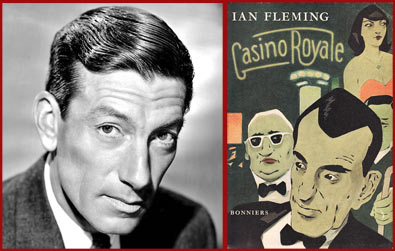
"Casino Royale" (Swedish edition)
Beginning in the 1950s, Ian Fleming’s James Bond books featured a hardboiled government assassin drowning his emptiness in wine and women. The Cold War man, cool demeanor, icy heart.

Playboy publisher Hugh Hefner
The 1960s films, influenced by the impossibly suave Cary Grant in TO CATCH A THIEF (1955), streamlined him as a Hefner fantasy stud, macking and mocking as he fought spectral villains in Mod futurist lairs. His charm seduced, his expertise triumphed. The impact was so seismic in the mainstream that Bond-mania dominated all pop culture in the ’60s, from screen> to music> to comics>.
The Bond formulas became like cultural codexes imprinted into our collective consciousness, omnipresent and almost immutable. He was always perfect, he was always single, he would always escape in the end.
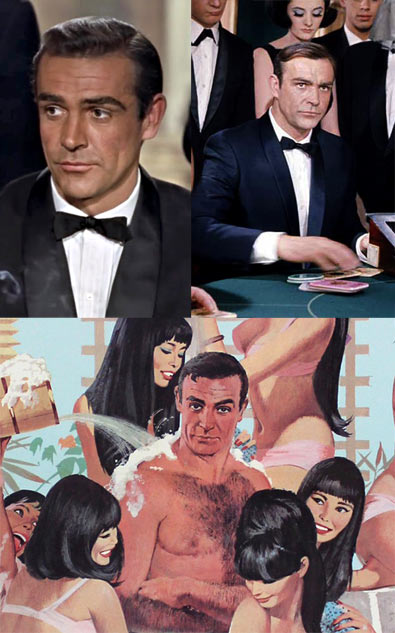
YOU ONLY LIVE TWICE poster
Under all the pulp exploits and cool style we enjoyed lay a lot of macho flaws that didn’t weather well across the franchise’s passing decades (or feminism): elite man, sexy girls, gunkill, flip quips, nationalism, warfare, bed tucking. (Think about how many other franchises that formula has inbred, from Matt Helm to THE KINGSMAN.)
While the enemy storyline of S.P.E.C.T.R.E. loosely threaded the ‘60s films, there was no character growth, no emotional turnover, no commitment for the man himself. Each contained adventure became a vogue of male conquest without any self-awareness for inner evolution. Unmussed, detached, invulnerable. It’s the subliminal undertow that reminds you that this is all a fantasy instead of realistic. (Contrast this against the gritty and downtempo counter-films about agent Harry Palmer, played by everybloke Michael Caine.)
To avoid being a shell, a statue, or a parody of himself, James Bond needed a radical fix that liberated him from stasis.

ON HER MAJESTY’S SECRET SERVICE
What JAMES BOND Might Be.
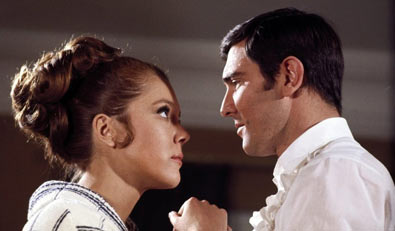
There was a moment they tried to fix this. After Sean Connery left his breakthrough role, the producers made the bold experiment ON HER MAJESTY’S SECRET SERVICE (1969) with a new lead, which tried humanizing Bond as an agent, a person, a lover. It reached a shocking conclusion that no one saw coming. And, expecting the formula they’d become accustomed to, not enough patrons came to see it. Retreating from the promise of change, the franchise then reverted back into cycles of formula ever more stylish and less risky (Connery’s brief return; Moore’s ‘70s films). Bond had become a posture on a poster, interchangeable but invariable.
There are essentially two Bond films: Spy and Spectacle. Across the years, the franchise sways between the two.
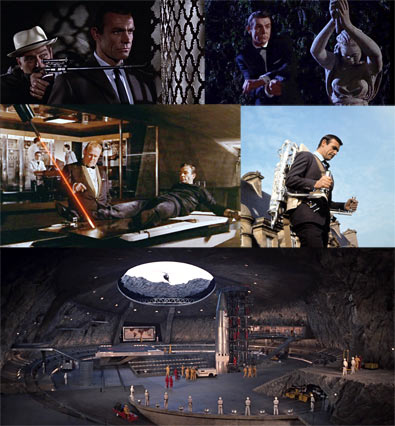
GOLDFINGER; THUNDERBALL;
YOU ONLY LIVE TWICE
After the initial light adventure of DR. NO (1962), the Bond films defined themselves with the serious Cold War spy film, FROM RUSSIA WITH LOVE (1963): all practical stunts and political intrigue, noir tone and sober suspicion. Spy. With the next film, GOLDFINGER (1964), they redefined themselves by going more spectacular: pulp adventure, sci-fi devices, theatrical villain, giant lair set, huge finale. Spectacle. Then the hybrid comes in, THUNDERBALL (1965). Then the ultra-Spectacle of YOU ONLY LIVE TWICE (1967), which went so far so well they didn’t know how to top it, only to repeat it in variations later.
The Moore films of the ‘70s essentially remade this same arc, getting more stylish and less serious as they went. (All fine fun, by the way, to be fair.) But after THE SPY WHO LOVED ME (1977) remade YOU ONLY LIVE TWICE underwater, and MOONRAKER (1979) remade both in outer space, the cycle had played out. Stylism and trend-chasing had eaten itself and it was time to start over.
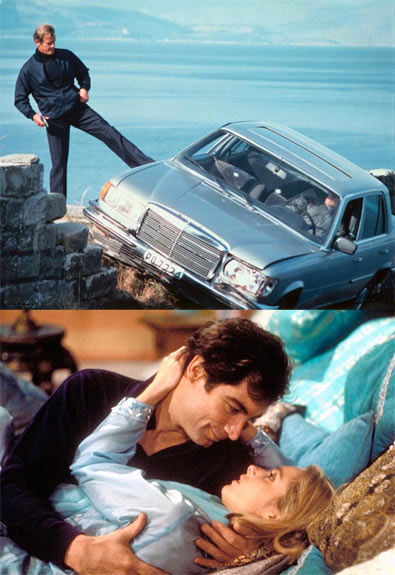
THE LIVING DAYLIGHTS
Fully in the spirit of FROM RUSSIA WITH LOVE, the reset movie FOR YOUR EYES ONLY (1981) began a stealth change in Bond conventions: more realistic and less fantastic, more stunts and less effects, more flirty and less sexist. This continued with the underrated OCTOPUSSY (1983) and the first half of the wonky A VIEW TO A KILL (1985). From this decade on, the Bond franchise is trying to streamline Spy and Spectacle into one, now becoming taut intrigue thrillers with spectacular practical stunts and locations. It’s like sobriety after a long bacchanal.
Still the suave agent icon we'd come to expect, he will become tougher and more shrewd as the years continue. The intense Dalton’s takeover in THE LIVING DAYLIGHTS (1987) gave the franchise a chance to do a smoother variant of MAJESTY’S, flexing change again. (Note the unusual turn at the end. But also how continuity never followed up on it.) Maybe the truest seed of things to come is the brutality of Dalton’s performance in LICENSE TO KILL (1989), where he has the smooth veneer of Moore but the flinty edge always underlying Connery. This synthesis of manner and actions ushers in Brosnan, who will arc from the practical Spy of GOLDENEYE (1995) to the hybrid Spectacle of DIE ANOTHER DAY (2002). Suave while steely.
To go forward, Bond had to be more real for us to relate to him anymore.
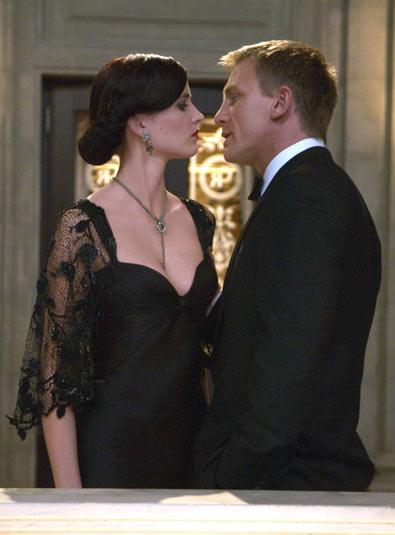
CASINO ROYALE
What JAMES BOND
Needed To Become.

Steve McQueen, BULLITT (1968)
During one of the Bond franchise’s periodic hiatuses, THE BOURNE IDENTITY (2002) stole their car and put a kit on it, stripping the Bond archetype down to a robotic rogue agent doing astounding physical stunts which seemed real. [re: Hong Kong action flicks] Meanwhile, the current producers had finally reeled in the rights to the first Bond book, "Casino Royale" (1953), and made the brazen choice to discard all formula and start over.
If Connery/Lazenby/Moore/Dalton/Brosnan had each reflected Cary Grant, all charm and coif at embassy receptions, the new archetype was instead in the mode of Lee Marvin and Steve McQueen, all tough pug and coiled rage from street brawls. Enter Daniel Craig.

BOURNE had raised the heat and the Bond creators responded with the flamewar of CASINO ROYALE (2006), a comprehensive beatdown from which the usurper never recovered: the stunts were better, the vision inspired, the story eternal. James Bond was rejuvenated in ways we had never seen or (most importantly) felt before. The film’s excellence is so universally hailed that it has become a standalone classic beyond the franchise itself.
To a fault, the love for the film is so fervent that it is held unfairly against its follow-ups, often obscuring their own merits or awareness of the progressing story they are telling. Looking closer, it was the beginning of a James Bond origin arc that would tell how he came to be the agent we know. Deeper still, it was a complete rewrite and upgrade of the man for the present, replacing the sexism and sleek perfection with vulnerability and rough realism, humanizing him as an agent, a person, a lover. And it reached a shocking conclusion that no one could get over, including him.
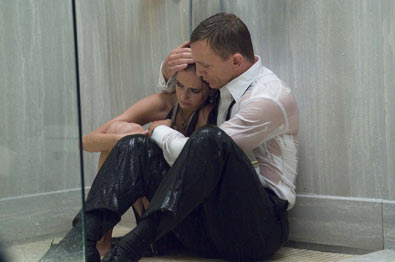
The book "Casino Royale" ended on an uncensored statement that sealed Bond as a callous killer going forward, a dead-hearted gunman. The film deconstructs this, making that spoken line ironic as time -and the following film arc- reveals his conflicted soul. It’s the key to the new doorway. Now the blunt thug of the books is a front for a fractured spirit.

SKYFALL;
SPECTRE
Rather than a one-off adventure like the past installments, the film began what seemed like a sly ongoing prequel arc to Connery’s ’60s run, sewing the origin seeds for everything that was fully in place in those films, but now told solely in realistic, contemporary terms.
Watch how the seeds took root: the spy games, the secret enemy organization, the front villain, and the (real world Ken Adam-style) Mod hotel in the wrongly under-valued QUANTUM OF SOLACE (2008); his outcast past, M, and Q in SKYFALL (2012); and reaching familiar fruition with Eve, the proto-crater base, the unstoppable henchman, and the Enemy in SPECTRE (2015). All there now: the gun, the car, the suit, the demeanor, the mistrust, the jokes, the devices, the team, the enemy, paced in piece by piece.

SKYFALL; SPECTRE;
NO TIME TO DIE
Look again, at what wasn’t there before in the agent: hurt by any collateral death; comforting Vesper after a trauma; working with Camille and Paloma as a colleague instead of a lover; trolling M yet respecting her, while she scolds him for behaving like a thug; the reveal of his Scottish/French heritage and hard childhood; his absolute disdain for establishment, class, rank, arrogance, rote, slickness, red tape, falsity; saving his civility for working people; helping save the Bolivian poor from the soulless Capitalist; choosing not to kill a villain (directly); using devices, vehicles, credentials like throwaways (but never so regarding loyalty, trust, respect); treating the suit like a costume, and resorting to casual clothing every chance he can; slicing through protocol, manners, borders, buildings like a scythe; his brotherhood with Felix; intimation of wider sexual latitude; his reflexive pride, stealth loyalty, tortured mistrust, aloof loneliness, soft forgiveness; reading heavily in his off-time (including "Zen And The Art Of Motorcycle Maintenance"); the arc of his love, from her to them.
He’s a different guy. There’s been a stealth switch-up underneath. The hardboiled assassin transplanted from the first books now sheaths a wounded soul onscreen. A lover corrupted into a killer, looking for redemption. Daniel Craig’s Bond occupies the same conceptual space as his suave predecessors, but he is the direct counter to them in every way: appearance, motivation, subtlety, complexity, outlook, moves, edge, possibility. Beyond his buff form, always watch his eyes.

NO TIME TO DIE
This is the moment where everything could have gone conventional, a fifth film wrapping the saga up in a crowd-friendly smoothie of the standard Bond we expect him to become. Though seeming to hem itself into the outlines of the vintage Bond, the previous movie SPECTRE had instead ended with three things that can’t happen in continuity as we know it. The ominous implication was that the creators would have to wipe all that away to go back to what’s expected.
But, with admirable bravery, the producers instead stayed true to the course in the final Craig film. This wasn’t really just a prequel arc harkening the classic Bond. It was a five-chapter story, from beginning to end, of the new Bond beyond. NO TIME TO DIE (2021) is the yang to CASINO’s yen, the other bracket, the inevitable endgame. It sews all of the aspects (and foreshadowings) of the previous four chapters into an unparalleled climax completely past the range of any Bond film done before.
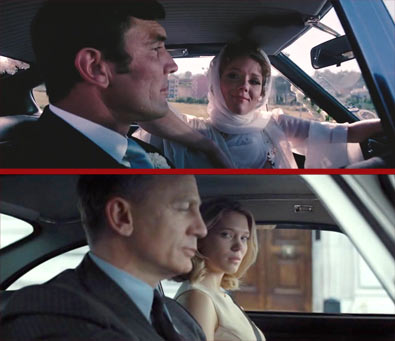
Daniel Craig and Lea Seydoux
Look at how it now only echoes the past to replace or counter it. If ON HER MAJESTY’S SECRET SERVICE was the fledgling seed for a possible new Bond, then this film is the arboretum of its fruition. Deep fans will note the quiet use of MAJESTY’S music, locations, and inversion of key story beats in NO TIME TO DIE, a metatext for what was being replaced with what will be.
Note also how it covertly mirrors Connery’s run, if only to reconsider every allusion with other options. Not imitation, but reformation. Just as Connery’s run started with the Jamaican lilt of DR. NO (1962) and climaxed with the spectacular Japanese volcano base of YOU ONLY LIVE TWICE (1967), Craig’s arc went from the Bahamas of CASINO to the pan-Asian waters military island of NO TIME TO DIE, with the unwavering distinction of staying realistically grounded the entire span. NO TIME TO DIE’s finale may have parallels to YOU ONLY LIVE TWICE, but only as a realist overwrite. Notice how the fantastic volcano base is replaced by an actual Cold War base, referencing the Connery-era history as an architecture that has been repurposed. The Craig arc has built a new past for Bond with a different future.
This is the movement where the Bond films had the courage to grow up. Consider everything NO TIME TO DIE does that hasn’t been done before. The elongated opening, the emotional break, the eerie flashbacks, the artful framing, the sober angst, the fatalism, the skewed humor (from co-writer Phoebe Waller-Bridge), the hope, the complex romance, the kinship ties, the fully proactive women, the anti-villain villain and his score-settling, the personal reveals, Bond's mea culpas, the formula inversions, and the epic length.
Most crucially, an unprecedented revelation in the heart of the film is the decisive moment that breaks from all formula and hinges everything straight into completely unknown territory. And it all pivots on unconditional love.

QUANTUM OF SOLACE;
SKYFALL;
SPECTRE
The quiet truth of the Craig arc is that James Bond has been revealed as what he has always been, not a charming libertine, but a hired killer. Bereft of love, embittered by any betrayal of it, he has lived heedless like he has nothing to live for. He's not afraid of death because he is death. And this starts to destroy everyone around him as it steadily catches up with him. Watching the five chapters in sequence, the foreshadowings of this inevitable spiral are everywhere. (Spirals are used to denote death and life throughout NO TIME TO DIE.)

But what if there was something worth living for? Something more important than yourself? Under the pain, this Bond does care and wants to make a difference. His compassion has come to the fore in the abstract -for country, justice, the world- as well as the implicit -for friends, lovers, mentors. Each loss that leaves him alone deepens a grief that hastens his self-destruction cycle. He seeks redemption through eros, but unconditional love can regenerate in new forms. In NO TIME TO DIE, this revelation comes home to him in a profoundly personal way.
From that point on, Bond goes fully from paper doll to person, operating off-mission for personal reasons beyond any Bond we known, with motivations and outcomes that change our entire perception of what is now possible in these films. With the Craig arc, we don’t look at Bond anymore, we now fully see and feel him. All of this change culminates in a shocking conclusion that no one can get their head around.
What if re-evolution happens in front of you, but you lack insight to asses it?
15 years for an arc is a bit of a span. (More production delays.) When pop culture reviews are now often written by novices with no cultural memory for context, all trivia and no awareness, this thoroughly subversive film gets mistaken at face value as more franchise formula. But it’s been the precise opposite all along for those paying attention to the revolution. Maybe some diehards were threatened, coasters were baffled, latekids shrugged. That’s fine. Go watch the previous 20 films before Craig if you wanted the past to stay fixed. But what was before has now gone beyond.

Where Does JAMES BOND
Go After This?
He’s not the same guy. And realizing all Bonds are actually separate liberated the creators to go forward into the future.
The long-time fan theories were off-base, holding the concept hostage to formula. No, all six actors are not playing the same guy with a single continuity. No, ‘James Bond’ is not a rotating codename shared across successive agents. James Bond is a book character, interpreted like a standard song by different singers. Imagine each actor/era as a parallel earth in a Bond multiverse, each telling its one arc across a select run. Craig is the unique ballad of Earth 6. Yes, James Bond will return with a seventh face, a new person. And, if the creators hold true to what they’ve just accomplished, will be more unbound, human, and believable than ever before. And hopefully do what hasn’t been done but now can.
Bond beyond.
© Tym Stevens
See also:
• BEST MOVIES + TV: 2021
• JOHN BARRY: The Influence Of The JAMES BOND Sound On Pop Music, with 2 Music Players!
• 20 Most Badass JAMES BOND Women!
• THE PRISONER: Its Influence On Music, TV, and Comics, with Music Player!
• JIM STERANKO, Agent of S.T.Y.L.E.! - His Inspirations and His Influence
• 2001: A SPACE ODYSSEY - Its Transcendent Influence on all Pop Culture, with Music Player!
• How STAR WARS Is Changing Everything!
• TWIN PEAKS: Its Influence on 30 Years of Film, TV, and Music!, with 5 Music Players!
• The Real History of ROCK AND SOUL!: The Music Player Checklist




 Posts
Posts