Showing posts with label Barack Obama. Show all posts

Thursday, September 13, 2012

ROCK Sex: JIM STERANKO, Agent of S.T.Y.L.E.! - His Inspirations and His Influence


JIM STERANKO is a powerhouse of graphics innovation whose legacy is continually reflected today.

One of his most iconic works is the cover to Nick Fury, Agent of S.H.I.E.L.D #4 (September, 1968).

This has become a classic work of Pop Art. It came from varied inspirations, and continually inspires many tributes.

Today, we look at what had inspired him and what he has inspired.

Chapter quick links:
INFLUENCES:
Pop Art, James Bond, Movie Posters, Bob Peak

The AGENT OF SHIELD Cover,
and its disciples

STERANKO At Marvel
HIS INFLUENCE
CAPTAIN AMERICA 2: THE WINTER SOLDIER


- - - - - - - I N F L U E N C E S - - - - - - -


Steranko looked for inspiration in all other media to expand the comics palette.

He was responding to the latest advances made in the arts, film, magazines, and graphics.


_________________________


- - - POP ART - - -


From the fine arts scene he admired Pop Art, Op Art, and collage.


Robert Rauschenberg, "Retroactive I" (1964).

Eduardo Paolozzi.

Bridget Riley, "Britannia" (1961)

Op artist Bridget Riley>.


_________________________


- - - JAMES BOND - - -


One certain influence on his Nick Fury work -and the entire era- is the James Bond films, with their stylish Mod opening titles (Maurice Binder), gargantuan layered sets (Ken Adam), and male power fantasies.

Maurice Binder, GOLDFINGER main titles, 1964.

Maurice Binder, YOU ONLY LIVE TWICE main titles, 1967.


_________________________


- - - MOVIE POSTERS - - -


He favored the bold modernist graphics of film posters.

Saul Bass, VERTIGO (1958).

VERTIGO Main Titles, by Saul Bass (1957)

if... (1968)

BARBARELLA (1968)


_________________________


- - - BOB PEAK - - -


All of these influences were also reflected in the magazine and poster art of the celebrated illustrator Bob Peak.

Bob Peak, Modesty Blaise illustration.

Bob Peak, MODESTY BLAISE poster (1966)

Bob Peak, "Save the Mark".


The AGENT OF S.H.I.E.L.D. Cover

And Its Continuous Influence


Distill this Molotov cocktail, shaken not stirred, and you get a unique Pop Art masterpiece.


See bigger here


_________________________


- - - S.H.I.E.L.D. Agents - - -


Steranko's cover has been homaged many times by artists since.


1 - Dave Johnson (2000) / John Cassaday (2000)
2 - Danny Miki (2005) / Greg Horn (2007)
3 - Adi Granov (2007) / Obama support (2008)
4 - Tomm Coker (2009) / Mariano Laclaustra (2017)


STERANKO at Marvel


The prime visual force that defined Marvel Comics in the 1960s was Jack Kirby. (And Steve Ditko, to less degree, with Spider-Man and Dr. Strange).

But the prime force who redefined Marvel Comics was Jim Steranko. He was Stan Lee and Jack Kirby combined and amplified.

Because his stylistic innovations are too numerous for anything outside of a coffee table book, here are some varied highlights.


More than any other comics artist in the '60s, Steranko thought like a cinematographer and a graphic designer at the same time.


With the smash success of the campy Batman TV series (1966), the media described the show as a visual expression of Pop Art. Both Marvel and DC Comics tried to cash in on this cache, but no one came close to combining the potential of graphic comics with fine arts like Steranko did.


In the '40s, Jack Kirby had created the first double-page spreads with his Captain America comics. Steranko pushed that to new extremes with a modernist design sense.

See bigger here


His ambition was so boundless that he actually had a double-double page spread, opening to a vista of four pages!

See bigger here


_________________________


When Steranko stepped in for two issues of The X-Men, he redesigned their logo while he was at it, creating this iconic masthead.


His cover for a Hulk annual has also been homaged many times by later artists.


_________________________


Steranko is most known for his runs on Nick Fury and then Captain America. Because of him, these characters have become intertwined since the '60s.


During his issues, he created Madame Hydra.


There was a rule at Marvel Comics: "Bucky has died, and he can't come back." Steranko was the first to play with the idea of what if the 1940s sidekick did, in this celebrated hallucinatory sequence with Dali influence (1969). This planted the seed for The Winter Soldier three decades later.


Although he only worked in comics for a couple years, Steranko opened up wide possibilities that every creator has been exploring ever since.


- - - MASTER - - -

The television Westerns of the '50s and '60s were deconstructed in the early '70s by the final Western, an Eastern called Kung Fu (1972-1975), which challenged manifest destiny and colonialist hegemony with the heterogenous outlooks of those marginalized by it, using the hybrid perspective of Kwai Chang Caine. The Nick Fury, Agent Of S.H.I.E.L.D. comic, a product of the '60s spy boom, was likewise radically inverted and reconstructed by its direct heir, Master Of Kung Fu (1974).

The celebrated run of artists -Jim Starlin, Paul Gulacy, Mike Zeck, and Gene Day- used Steranko's techniques of cineramic scope and intense graphic design, while Doug Moench's scripts replaced the gung-ho patriot (or imperialism avatar, depending) with the introspective and spiritually conflicted hero Shang Chi, who called into question the ties of violence, honor, tradition, loyalty, and dogma that bound his soul. At their best, Fury was an honorable soldier while Shang was an ethical philosopher.


Paul Gulacy's art synthesized Bob Peak, Hitchcock, and Steranko.

Paul Gulacy (#38, 1976)

Paul Gulacy (#48, 1977)
See bigger here.


Gene Day's art blended Will Eisner and Steranko.

His double-paged spreads were more ambitious and hyper-detailed than anyone, and he had a direct influence on Moore, Bissette, and Totleben's revolutionary revisal of Swamp Thing directly after. (The first Alan Moore issue of ST was illustrated by his similar brother, Dan Day.)
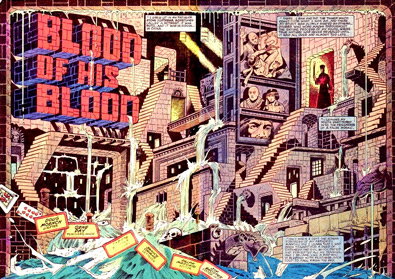
Gene Day (#116, 1982)
See bigger here

Gene Day (#117, 1982)
See bigger here

✭ Gene Day's criminally-overlooked art (MOKF #101-120) was finally reissued and remastered after three decades of legal stasis within the Shang-Chi: Master Of Kung Fu Omnibus, VOlume #4 (2017).


Without this chain of iconoclasts, J.H. Williams III's legendary art for Batwoman would have been impossible.

J.H. Williams III (2009)
See bigger here

J.H. Williams III (2012)
See bigger here


[Nick Fury was further deconstructed and critiqued as The Comedian in Alan Moore and Dave Gibbons' WATCHMEN (1986).]


- - - S.T.Y.L.E Agents - - -


Will Eisner created the CITIZEN KANE of comics with his series The Spirit (1940-1952). His use of noir lighting, skewed perspective, nuanced dramedy, and dramatic splash pages and much more set the standard for all mature innovations to follow.


In 1976, Steranko's hardboiled graphic novel CHANDLER: RED TIDE refined film noir into full-contrast black and white.


The combination of Eisner and Steranko's works is reflected in Frank Miller's SIN CITY series.


_________________________

- - - RAIDERS OF THE LOST ARK - - -

George Lucas called in Steranko for design art for his homage to 1930s movie serials, who then added George's bomber jacket into the mix.


_________________________

- - - OUTLAND - - -

Steranko adapted the SciFi movie OUTLAND (1981), now a cult classic, for Heavy Metal magazine by distilling it into a cutting-edge series of double-page panoramas.


_________________________

- - - THE ESCAPIST - - -

In his early years, Steranko was an escape artist in the mode of Houdini. This inspired Jack Kirby to create this New God for DC Comics.

Jack Kirby (1972)


For his book "The Amazing Adventures of Kavalier And Clay", author Michael Chabon combined Will Eisner, Jack Kirby, and Jim Steranko into the protagonist artist and his character, The Escapist. The acclaimed novel won the Pulitzer Prize in 2001.


- - - CAPTAIN AMERICA 2: THE WINTER SOLDIER - - -


When Captain America (literally) returned from deep freeze in the '60s, his acclimation to the modern world became irrevocably intertwined with Steranko's innovations and amplifications in the Nick Fury and Captain America books.

In the cinematic version of the same return, this is why Steranko is so strongly homaged by the iMax poster and the film's end credit design.


Watch the credits video here.


© Tym Stevens


See Also:

Four Color Films, THE Comic Movie Review Site!


BEST COMICS: 2012

JOHN BARRY: The Influence Of The JAMES BOND Sound On Pop Music, with 2 Music Players

20 Most Badass JAMES BOND Women!

THE PRISONER: Its Influence On Music, TV, and Comics, with Music Player!


THE CANON 1: 50 Books That Created Modern Culture, with Music Player
THE CANON 2: 50 More Books That Created Modern Pop Culture, with Music Player
THE CANON 3: 50 Recent Books That Created Modern Culture, with Music Player


The Real History of Rock and Soul!: A Music Player Checklist

Monday, January 17, 2011

The Struggle For the Moral Soul: MARTIN LUTHER KING and Civil Rights


"Justice at its best is power
correcting everything that stands against love."

-Dr. Martin Luther King, Jr.


I think the Civil Rights Movement was the best thing that ever happened to America, because it forced us to redeem ourselves. And it still is.

I grew up in the South and Midwest during the Civil Rights years and their aftermath. It challenged everything about my world and deepened my appreciation of humanity. Not a single day passes where the lessons learned are not affecting my perceptions, my outlook, or my aspirations. What is right nowadays stems from their moral paths, what is wrong tends to come from where any of us have lost the way. It's on each of us to make it better for each other. Selflessness brings us into the better angels of our nature. This is my psalm of love to my heroes, the bravest of the brave.

When you look back at the black and white photos of the tense events of the civil rights struggle in the '50s and '60s, like those shot by Charles Moore, there is a strangely brutal clarity. It seems like all artifice strips away leaving only hate and heroism. There is no theatre. There's only that queasy moment when something terrible is happening, when someone is doing wrong to someone, or recklessly trying to stand up in the face of danger. It is immediate, it's serious, it's real. A black woman cringing from a swung baseball bat. People slammed to the ground by the high-pressure firehoses of Alabama firemen. State Troopers charging church marchers with batons through tear gas. College students bludgeoned by horseback cops. And this was America.

There is a sickness so terrible in those frames, it chills the heart. Studying those snapshots and films, you look in the faces of the racist cop, the klanswoman, the corrupt governor, and you can perhaps also see their fear...of the modern, of change, of the truth. They look like sad relics not quite grasping that their hold is slipping, that critical mass is tiding against them. That every wrong they've ever done is coming up for account.

Hindsight is one thing, but living through that revolution was far more intense; it was painful, personal, and ongoing. And there was really nothing black and white about any of it. Black And White was just ink on a copy page, photos on newsprint, flickers on a television. It was the medium for conveying this moral war, but the reality was too complex for polar absolutes. Those shocking events were actually an alarmingly clear mirror showing the spectrum of our neglect. It ripped up laissez-fair dismissals about the reality of racism to shreds. It stripped away the firewalls that we used to separate it from our lives. Most of all, it forced us to question our national identity, and our personal character. Were you really what you said you were, who you thought you were? Where did you stand, and why? This was no civics lesson or some marketing campaign. This was the new true reality. Not shopping, not cruising, not the cinema. Those images and stories radically challenged how you behaved and what you believed in.

This was a new era where the political was a personal as it gets. Who was the Enemy here; was it the Klan South, the segregationist politicians, outmoded laws? Or also benign ignorance, local injustice, personal acts? Racism was as pervasive in all regions of the country and society as the South. People may have been carefully segregated by opposing terms like Black or White, male or female, Christian or heathen. But that aritifice stripped away when you had to stand at the mirror and face who you really were inside. The truth was that the real enemy was the ugliness in the human heart. There was no Us and Them. There was only each of us having to atone for any flaws in our own daily actions going forward. The moral struggle for the soul of the nation had to happen ultimately within each of us.

Part of the pain of living in the South and Midwest was seeing that poison directly in the ones you loved, in yourself. It's easy for someone to stand outside of an area and point out cardboard villains. It was another thing to live there and see the loved ones you trusted -who put church above all else, were wise and kind, who raised you- also believing in the same cruel hatred that compelled Sheriff James Clark to violently assault protesters. Another thing then to find some of these seeds in yourself and weed them out. Facing these truths left you feeling like a smashed windshield after a collision. It called into question your faith in love itself. How could these very moral people teach such immoral attitudes? How could they be Christian while excluding everyone they were afraid of? The sadness was compounded by watching these people you respected -who cared about family, led decent lives, worked hard every day- then having their sad fears twisted into hate for personal power by men in suits: pastors, police, politicians. Who could you believe in anymore?


"It may well be that the greatest tragedy of this period of social transition is not the glaring noisiness of the so-called bad people, but the appalling silence of the so-called good people."
-Dr. Martin Luther King, Jr.


Rosa Parks was tired. She'd worked hard all day and she didn't want to give up her seat on the bus. The law said she should but the law was immoral. By trying to hold on to her dignity in one small moment, Rosa took a stand that changed everything. People stepped forward to stand with her, and more, and more. Now we all had to make decisions on what was better for everyone, even if the written law was unequal to the task.

You could instead choose an honest love, a compassionate outlook, a giving hand, that left hate and hypocrisy behind. The Civil Rights Movement forced you to make a choice. Often between relationships and principle, selfishness and selflessness, between the past and the future, repression or progress. It was the hardest break of all but it was necessary for the soul.

Dr. King never succumbed to hate. He steadfastly remembered that his enemies were just people who could still be reached, befriended, forgiven. Resorting to brutality or hatred only dehumanized any of us. He put all his faith in human dignity, and in the world's support when they saw it being assailed. He was right to and always will be. No one could see the bombing of the church which killed four little girls and not be moved on the deepest level. King believed foremost in our humanity, that we would come through for another in pain. This redemptive love ennobled our nation and inspired us to be better people.

When a flash flood hits, it's pretty overwhelming and dramatic. Then it seeps down out of view, only to flourish seeds in the future. The 1960s and the empowerment ethos ignited by the Civil Rights Movement were like a flash flood worldwide.

Before, the mainstream culture at large had been strictly for the Included. TV ads and shows, churches, schools, and industry were very good about reminding everyone what those parameters were, and how you did or didn't fit into them. But in the biggest generation ever, that left a lot of ostracized people to meet each other and bond together. There was nothing black or white about any of them, they were like a prism of possibilities; Ban The Bomb activists, Folk protestors, Rock hedonists, Jazz boppers, ecologists, vegetarians, student uprisers, international dissidents, disillusioned soldiers, young college women, banned writers, progressive teachers, pacifist clergy, migrant workers, repressed voters, closeted gays, starving artists, fashion forwards, philosophers, shafted unions, poor people...the list was limitless. No one had a monopoly on pain. Its universality connected them. By sharing common grievance they began to see an end to limitations when they pooled their strengths. That's the true '60s...the Empowerment era. En masse, their alienation created a sort of sub-nation, a counterculture. This humanist movement's mantra was freedom, in the sense of personal emancipation.

There's a clear throughline from the Civil Rights movement to Farmworkers' rights, the Paris revolts, Prague Spring, the Counterculture, Feminism and ERA, Chicano pride, AIM, Solidarnosc, Eastern European liberation, ecology, Apartheid's end, and Gay rights. They are all the seeds that grew from the flood that Rosa Parks unleashed that fateful day she made her stand.

For his humane efforts, King was called "an extremist" by conservative attackers. Though never elected to the office, Martin Luther King was the moral President of the United States...and he still is.

"Why have we substituted the arrogant undertaking of policing the whole world, for the high task of setting one's own house in order?

For the evils of racism, poverty, and militarism to die, a new set of values must be born.

Our economy must become more person-centered
than profit- and property-centered."


-Dr. Martin Luther King, Jr., 1967


Let's keep going forward together.


© Tym Stevens


See Also:

REVOLUTION! - A 'Fight The Power' Music Player

SHAKE AND FINGER POP! Soul Music and the Interior Truth, with Music Player!

"I Fought the Law and I Won!" - The Crickets > Bobby Fuller > The Clash > Metric

"For What It's Worth": - Buffalo Springfield > Led Zeppelin > Public Enemy

"Chase the Devil Out of Earth!" - Max Romeo > Lee Perry > The Prodigy


The Real History of Rock and Soul!: The Music Player Checklist


Saturday, August 28, 2010

The Struggle For the Moral Soul: MARTIN LUTHER KING and Civil Rights


"Justice at its best is power
correcting everything that stands against love."

-Dr. Martin Luther King, Jr.


I think the Civil Rights Movement was the best thing that ever happened to America, because it forced us to redeem ourselves. And it still is.

I grew up in the South and Midwest during the Civil Rights years and their aftermath. It challenged everything about my world and deepened my appreciation of humanity. Not a single day passes where the lessons learned are not affecting my perceptions, my outlook, or my aspirations. What is right nowadays stems from their moral paths, what is wrong tends to come from where any of us have lost the way. It's on each of us to make it better for each other. Selflessness brings us into the better angels of our nature. This is my psalm of love to my heroes, the bravest of the brave.

When you look back at the black and white photos of the tense events of the civil rights struggle in the '50s and '60s, like those shot by Charles Moore, there is a strangely brutal clarity. It seems like all artifice strips away leaving only hate and heroism. There is no theatre. There's only that queasy moment when something terrible is happening, when someone is doing wrong to someone, or recklessly trying to stand up in the face of danger. It is immediate, it's serious, it's real. A black woman cringing from a swung baseball bat. People slammed to the ground by the high-pressure firehoses of Alabama firemen. State Troopers charging church marchers with batons through tear gas. College students bludgeoned by horseback cops. And this was America.

There is a sickness so terrible in those frames, it chills the heart. Studying those snapshots and films, you look in the faces of the racist cop, the klanswoman, the corrupt governor, and you can perhaps also see their fear...of the modern, of change, of the truth. They look like sad relics not quite grasping that their hold is slipping, that critical mass is tiding against them. That every wrong they've ever done is coming up for account.

Hindsight is one thing, but living through that revolution was far more intense; it was painful, personal, and ongoing. And there was really nothing black and white about any of it. Black And White was just ink on a copy page, photos on newsprint, flickers on a television. It was the medium for conveying this moral war, but the reality was too complex for polar absolutes. Those shocking events were actually an alarmingly clear mirror showing the spectrum of our neglect. It ripped up laissez-fair dismissals about the reality of racism to shreds. It stripped away the firewalls that we used to separate it from our lives. Most of all, it forced us to question our national identity, and our personal character. Were you really what you said you were, who you thought you were? Where did you stand, and why? This was no civics lesson or some marketing campaign. This was the new true reality. Not shopping, not cruising, not the cinema. Those images and stories radically challenged how you behaved and what you believed in.

This was a new era where the political was a personal as it gets. Who was the Enemy here; was it the Klan South, the segregationist politicians, outmoded laws? Or also benign ignorance, local injustice, personal acts? Racism was as pervasive in all regions of the country and society as the South. People may have been carefully segregated by opposing terms like Black or White, male or female, Christian or heathen. But that aritifice stripped away when you had to stand at the mirror and face who you really were inside. The truth was that the real enemy was the ugliness in the human heart. There was no Us and Them. There was only each of us having to atone for any flaws in our own daily actions going forward. The moral struggle for the soul of the nation had to happen ultimately within each of us.

Part of the pain of living in the South and Midwest was seeing that poison directly in the ones you loved, in yourself. It's easy for someone to stand outside of an area and point out cardboard villains. It was another thing to live there and see the loved ones you trusted -who put church above all else, were wise and kind, who raised you- also believing in the same cruel hatred that compelled Sheriff James Clark to violently assault protesters. Another thing then to find some of these seeds in yourself and weed them out. Facing these truths left you feeling like a smashed windshield after a collision. It called into question your faith in love itself. How could these very moral people teach such immoral attitudes? How could they be Christian while excluding everyone they were afraid of? The sadness was compounded by watching these people you respected -who cared about family, led decent lives, worked hard every day- then having their sad fears twisted into hate for personal power by men in suits: pastors, police, politicians. Who could you believe in anymore?


"It may well be that the greatest tragedy of this period of social transition is not the glaring noisiness of the so-called bad people, but the appalling silence of the so-called good people."
-Dr. Martin Luther King, Jr.


Rosa Parks was tired. She'd worked hard all day and she didn't want to give up her seat on the bus. The law said she should but the law was immoral. By trying to hold on to her dignity in one small moment, Rosa took a stand that changed everything. People stepped forward to stand with her, and more, and more. Now we all had to make decisions on what was better for everyone, even if the written law was unequal to the task.

You could instead choose an honest love, a compassionate outlook, a giving hand, that left hate and hypocrisy behind. The Civil Rights Movement forced you to make a choice. Often between relationships and principle, selfishness and selflessness, between the past and the future, repression or progress. It was the hardest break of all but it was necessary for the soul.

Dr. King never succumbed to hate. He steadfastly remembered that his enemies were just people who could still be reached, befriended, forgiven. Resorting to brutality or hatred only dehumanized any of us. He put all his faith in human dignity, and in the world's support when they saw it being assailed. He was right to and always will be. No one could see the bombing of the church which killed four little girls and not be moved on the deepest level. King believed foremost in our humanity, that we would come through for another in pain. This redemptive love ennobled our nation and inspired us to be better people.

When a flash flood hits, it's pretty overwhelming and dramatic. Then it seeps down out of view, only to flourish seeds in the future. The 1960s and the empowerment ethos ignited by the Civil Rights Movement were like a flash flood worldwide.

Before, the mainstream culture at large had been strictly for the Included. TV ads and shows, churches, schools, and industry were very good about reminding everyone what those parameters were, and how you did or didn't fit into them. But in the biggest generation ever, that left a lot of ostracized people to meet each other and bond together. There was nothing black or white about any of them, they were like a prism of possibilities; Ban The Bomb activists, Folk protestors, Rock hedonists, Jazz boppers, ecologists, vegetarians, student uprisers, international dissidents, disillusioned soldiers, young college women, banned writers, progressive teachers, pacifist clergy, migrant workers, repressed voters, closeted gays, starving artists, fashion forwards, philosophers, shafted unions, poor people...the list was limitless. No one had a monopoly on pain. Its universality connected them. By sharing common grievance they began to see an end to limitations when they pooled their strengths. That's the true '60s...the Empowerment era. En masse, their alienation created a sort of sub-nation, a counterculture. This humanist movement's mantra was freedom, in the sense of personal emancipation.

There's a clear throughline from the Civil Rights movement to Farmworkers' rights, the Paris revolts, Prague Spring, the Counterculture, Feminism and ERA, Chicano pride, AIM, Solidarnosc, Eastern European liberation, ecology, Apartheid's end, and Gay rights. They are all the seeds that grew from the flood that Rosa Parks unleashed that fateful day she made her stand.

For his humane efforts, King was called "an extremist" by conservative attackers. Though never elected to the office, Martin Luther King was the moral President of the United States...and he still is.

"Why have we substituted the arrogant undertaking of policing the whole world, for the high task of setting one's own house in order?

For the evils of racism, poverty, and militarism to die, a new set of values must be born.

Our economy must become more person-centered
than profit- and property-centered."


-Dr. Martin Luther King, Jr., 1967


Let's keep going forward together.


© Tym Stevens


See Also:

REVOLUTION! - A 'Fight The Power' Music Player

SHAKE AND FINGER POP! Soul Music and the Interior Truth, with Music Player!

"I Fought the Law and I Won!" - The Crickets > Bobby Fuller > The Clash > Metric

"For What It's Worth": - Buffalo Springfield > Led Zeppelin > Public Enemy

"Chase the Devil Out of Earth!" - Max Romeo > Lee Perry > The Prodigy


The Real History of Rock and Soul!: The Music Player Checklist