remained strong through each decade!
(#2 of 6 parts)
world-spanning
Music Player!

brings you the actual, all-inclusive
history of Rock'n'Soul music,
with essay overviews and Music Players.
▶ History Checklist
Today, the story of how '50s Rock'n'Roll was revived in 1970s music and film!!
Hear an exhaustive music player, with worldwide artists maintaining the '50s styles from 1970 through 1979!
by Tym Stevens
Hear the unlimited Playlist here.)
Learn the whole history, with Music Players!
▶ 1950s Rock, A: The '60s Disciples
▶ 1950s PUNK: Sex, Thugs, and Rock'n'Roll!
▶ 1950s Rock, C: The '80s Disciples
▶ 1950s Rock, D: The '90s Disciples
▶ 1950s Rock, E: The 2000s disciples
▶ 1950s Rock, E: The 2010s disciples
C h a p t e r
l i n k s :
𝟭 • I Rocked the Crowd (But FM Won)
𝟮 • Celluloid Graffiti
𝟯 • Revivals:
𝟯a • • Roots
𝟯b • • Glam
𝟯c • • Pubs
𝟯d • • Punks
𝟯e • • Teds
The 1950s Rock styles returned in the early '70s in a full-on Revival.
I Rocked the Crowd (But FM Won)

Woodstock was the peak of the counterculture tsunami. The largest generation ever now had full presence and progress in its hands.
The festival personified a crux-point for the past and future of both music and society. Rock had started in the '50s by pushing back the margins and pushing forward the marginalized, and after 15 years it had become the universal language connecting an eclectic alternate society. Where would it all go next?
As dynamic as Rock may have matured in the wake of The Beatles and Jimi Hendrix, it all was still an extension of the styles that had inspired it. The setlists at Woodstock were a catalog of all the roots musics that underlay it: folk, blues, country, jazz, gospel, bluegrass, salsa, soul, international musics. Rock was now like wild branches spreading rapidly from deep roots, all loose but twined tight to the communal trunk. This reflected the diverse creativity and backgrounds of the cosmopolitain audience.
So it was time for Money to get in there and mess that up. FM radio would reduce all of that promise and possibility to rigid style formats that would divide the listeners and conquer that progressive unity. Rock was the common tongue of the freespirits. But that's why the real Big Brother and its holding companies wanted to control what was expressed.

The dominant AM radio in the '60s had played everyone together as long as they had hits. By 1967, the underused FM became a haven for the counterculture to play underground rock with extended lengths and no censorship. Ever quick to milk the movement, corporations started buying up all the indie labels to form mega-labels and co-opted FM as the new wavelenth. At exactly the moment Woodstock was freeing everyone to be inclusive and expansive, the labels and radio became excluding and constrictive in what people could hear. They sifted communal creativity and interaction into niche markets they could control and fleece for money. This divided and conquered the cultural future, and continues to.
(There's no better or sadder analogy of the conservative backlash slowly strangling the counterculture in the '70s than in watching the corporate label machine streamline, sterilize, and segregate music year by declining year. Easy proof: compare any act from the funky early '70s to their slick shadow in the late '70s.)

But how do you rock the party when you can't get in the door?
The most insidious and damaging fallout of FM is how it intensified the codifying of music by the same old false racial and gender divisions. The unspoken formula had distilled to Rock=Guitar=White(male), Soul=Dance=Black, and Female=Soft=Sex. People got so used to it that to this day they take this controlling propaganda for given truth. FM, like repressive society, operated on erase-ism: anyone who didn't fit the profiles got eliminated.
Women were (and are) stringently catalogued as pop singers or dance divas, so tough Rock acts like Fanny, Birtha, Cradle, Isis, Mother Trucker, Yoko Ono, NQB (Sweden), and The Runaways that negated the stereotype in the '70s weren't supported properly with marketing or airplay. If they weren't seen or heard, they didn't exist in history. But, like climate change, they existed anyway.
This segregation mentality from programmers had always been there since the '50s. The same music was called two different names -Rock'n'Roll or Rhythm'n'Blues- depending on the skin of the players. But it was the same music. FM worsened this. Even though modern Rock music (post-1967) was bestowed by Jimi Hendrix, hardcore rocker acts like Funkadelic, Black Merda, Death, and Mother's Finest never got played on Rock radio. But it was the same music.
The original Rock allowed for sounds from the post-Gospel Doo Wop groups; though these traditions still informed the harmonies of every current vocal combo like The Temptations, The Dramatics, The Pointer Sisters, Bloodstone, and The Chi-Lites, they were steadily consigned to another planet called Soul separate from Rock as tough guitar was cleansed from their mixes. (The Persuasions were so proud of the Doo Wop heritage that they always sang a capella, on records like "Street Corner Symphonies".)
So, although women and diverse faces were a huge portion of the original '50s Rock explosion>, they were enforcedly absent from its 70's Revival, to everyone's great loss. (They contributed anyway, and this music player returns them properly.)
"There's so many people'll be there to love and cheer
some of the greatest guitar playing in the Western hemisphere
Got The Who, The Band from across the north border,
Canned Heat, The Fifth Dimension, Creedence Clearwater,
And oh, Brother Hendrix, Sister Joplin, we wish you were here."
-Chuck Berry, "Festival" (1971)
Rock only knew where to go from remembering where it came from.
As crazed and divergent as it was now becoming (Psychedelic, Funk, Fusion, Soul, Prog, Bubblegum, etc.), its young artists always hearkened back to the original styles -Rockabilly, Rhythm'n'Blues, Blues, Honky Tonk, Doo Wop, Cajun, Mambo- to keep their bearings. By 1970 this began to hit critical mass in cover versions, homage tunes, and tour mentors.
Many of the '50s elders -like Chuck Berry>, Little Richard>, Bo Diddley>, Big Mama Thornton, Muddy Waters, The Everly Brothers, and Jerry Lee Lewis- enjoyed recurrent crests in the '60s because of each new wave that built on their work. Now in the dawning '70s they were touring the counterculture festivals as peers with their scion.
But FM heard them knocking and didn't let them in: radio only programmed them as oldies hits while ignoring their new albums. This slowly segregated them from youth festivals into Oldies tours and pegged them as nostalgia acts instead of being respected as thriving legacy artists.

Young acts in Festivals were expected to metamorphisize, but elder stars found that Oldies package tours were sealing them in amber. Audiences expected them to be a strutting simulacrum of their past, while buyers went for albums of younger acts doing their styles. There was a major Rock Revival show at Madison Square Garden in 1971; when Ricky Nelson played a Stones song looking modern, reflexive booing drove him from the stage.
"But if memories were all I sang, I'd rather drive a truck.
But it's alright now, I've learned my lesson well
You see, you can't please everyone so you've got to please yourself."
-Ricky Nelson, "Garden Party" (1972)
Negative undertow like ageism and pop disposability continued dividing Rock. The Rolling Stones, the solo Beatles, The Doors, Creedence Clearwater Revival, Led Zeppelin, T. Rex, David Bowie, Suzi Quatro, BTO, and Bruce Springsteen could burn rubber on Gold hubcaps while their heroes were just spinning wheels. The '50s pioneers were making money but without progress, while the times traded on everything they had invented.
It was hard to be a rock and not to roll.
Celluloid Graffiti

The phenomenal success of 'HAIR' on Broadway (1968) ducktailed into the debut of the 'GREASE' musical in 1971. Owing to the times and the audience, the original production was much grittier, daring, and socially relevant. But, much like Rock'n'Roll hits in the '50s, it was tamed down from edgy rebellion to sock hop silliness for mainstream appeal. (And further for film and high school productions.)
George Lucas flipped a 180 from the glacial Kubrick futurism of his debut feature THX-1138 into the intimate warmth of his breakthrough follow-up AMERICAN GRAFFITI (1973). The counterculture was beginning to reflect on the social upheaval that had formed their lives, as mirrored in New Hollywood films like THE LAST PICTURE SHOW and SUMMER OF '42. Lucas' coming-of-age homage about the summer of '62 hit a resonant chord with a generation looking back, as well as new youth coming up.

A crucial factor in this was the double-album soundtrack of hits from the '50s and early '60s. This watershed event alone invented industries: the parallel rise of archival compilations like NUGGETS and labels like Rhino Records and Bomp; the waves of Top 40 Oldies radio stations essentially templated by the album; and the amped merchandising of film soundtracks as pop hit machines instead of scores.
More importantly, GRAFFITI made the original Rock'n'Roll era cool again in the mainstream, as a chaser to the turbulent '60s, as an antidote to current Rock bloat and listlessness, and as fresh inspiration to new artists.
Through the decade similar films and shows rollicked and rolled, from edge to affect to kitsch.
The ascent of Glam nostalgia underwrote THAT'LL BE THE DAY (1973) featuring Ringo Starr, Keith Moon, and David Essex in a tale of an aspiring early rocker. The sequel STARDUST (1974), adding Dave Edmunds and Adam Faith, detailed the career of his band 'The Stray Cats'. (Hmmm.)

This hit critical mass through one show.
The TV-series 'Happy Days' traced over GRAFFITI, even down to tagging its star, Ron Howard. The first two seasons were like the film in style and period accuracy. But the third season became a live-audience flourescent sitcom with lazy catchphrases and hazy detail. Naturally, this feel-good cartoon/painful sell-out led to explosive success, and to spin-offs like 'Laverne and Shirley' (and perversely 'Mork and Mindy', along with three more best ignored). It was still an enjoyable show with occasional nods to civil rights issues and social conflicts. But 'Happy Days', with its massive audience, also unintentionally did the most to crystallize the generic stereotype of the era as diners, poodle skirts, and suburban oblivion (sappy daze), once again defanging the original Rock'n'Roll of all its edge and social power.
Thus by the time GREASE (1978) was finally filmed, it had inverted into corny cringe, goony stupidity, and disco anachronisms. And it was a massive hit, worsening the trite overwrite with waterfalls of dumb money.

Chuck Berry in 'American Hot Wax';
Ken Wahl in 'The Wanderers'
Some films tried to offset this disturbing trend.
The solid drama THE BUDDY HOLLY STORY (1978), though factually blurry, restored Buddy firmly into the pantheon while inspiring new cover versions and much New Wave and Power Pop style. There was also the underrated AMERICAN HOT WAX (1978), a biography of seminal DJ Alan Freed, in which Chuck Berry, Jerry Lee Lewis, and Screaming Jay Hawkins played themselves. To its credit, this film correctly posited '50s Rock as the catalyst for the age of social rebellion. And tough gang films like THE LORDS OF FLATBUSH (1974) and THE WANDERERS (1979) shook brass knuckles at an indifferent box office.
If the screen dreams were struggling between hawkeyed, cockeyed, and myopic, music was still revising new visions.

Revivals:
Roots, Glam, Pubs, Punks, and Teds
It's sometimes said broadly that if Chuck Berry is the father of Rock'n'Roll (rollicking boogie), then Jimi Hendrix is the father of ROCK (godzilla marches). As Rawk in the wayward 1970s then became solos or symphonies or soft, many hungered again for brisk music to dance and roll and grind and shout to.
They wanted to feel like they did in the beginning, so they kept dropping the coin into the slot.
Roots
= restart
The revivalists and the traditionalists opened the decade, followed by the memorialists.
Almost like an unapologetic manifesto, the Berry/Elvis echoplex of Dave Edmunds' cover "I Hear You Knocking" (1970) kicked the door down and the dominoes in motion. ("Keep A-Knockin'" and its answer song "I Hear You Knocking" are Blues standards that Little Richard and Huey 'Piano' Smith first adapted into Rock hits.)

Revivalist acts like Sha Na Na and Frank Zappa's resuscitated Ruben and The Jets redressed the '50s like fun pantomimes of a bygone time. Showaddywaddy really went for it, pushing the range with some contemporary flair, and coiffing and draping in finest Teddy Boy fashion.
But traditionalists like Dave Edmunds, The Flamin' Groovies, Commander Cody And The Lost Planet Airmen, Nick Lowe, and Chris Spedding treated the '50s styles as living traditions to extend the spirit and range of. In this they were like contemporary Blues artists, picking up the relay and running further afield with it.
The pulse also choogled in Boogie Rock acts like Canned Heat, Savoy Brown, J.J. Gunne, Brownsville Station, Foghat, Barrabas (Spain), and Los Puntos (Mexico). And grandiose acts like The Move and their spinoffs, Electric Light Orchestra and Wizzard.
The common undercurrent was nostalgia and reflection.
The entire Rock era was memorialized in Don McLean's "American Pie"> (1971), a symbolist exam on the promise and pitfalls of the paths taken. Other hits took the sentimental look back with doo wop daydreams like B. J. Thomas' "Rock and Roll Lullaby" and The Carpenters' "Yesterday Once More". Loggins and Messina's "Your Mama Don't Dance" was a '70s anthem based on '50s themes.
And fond remembrance drove hit covers like Ringo Starr's "Sixteen", Johnny Rivers' "Rockin' Pneumonia and the Boogie Woogie Flu", and Linda Ronstadt's glosses on Chuck Berry, The Everly Brothers, and Buddy Holly.
Glam
= theater
John Lennon is oft-quoted for cheekily calling Glam "Rock'n'Roll with lipstick on". It was really a malatov mix of the androgynous theater of Little Richard, the riffs of Chuck Berry, the sleaze of Times Square, the ironic camp of cabaret, and the bracing jolt of shock.
"Meanwhile I was still thinkin'
If it's a slow song, we'll omit it
If it's a rocker, that'll get it."
-Chuck Berry, "Little Queenie" (1959)
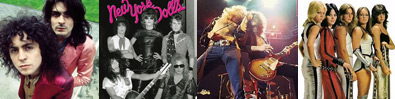
Glam Rock was the sassy stepchild of '50s Rock'n'Roll. It reduced Prog pomp to curt burlesque, and marathon jams back to tight riffs. T. Rex's breakout monster "Bang a Gong (Get It On)" builds on Chuck Berry's "Little Queenie" and quotes its 'meanwhile' asides. And Chuck's plucks duckwalk amok in the New York Dolls, Suzi Quatro, Bonnie St. Claire (Sweden), and Mud.
Slyly transgressive, the proudly low-culture cuisinart THE ROCKY HORROR PICTURE SHOW (1975) was rampant with 50's odes, as wildly embodied by Meat Loaf.

All flash aside, Glam was vital to refocusing Rock'n'Roll back to core basics like three-minute-Pop, catchy verve, sexy sway, and fun dancing. It brought platforms stomping to the floor yelling more more more.
Pub
= stripped down
But some acts just wanted to skin all the varnish off Rock'n'Roll down to the raw wood.
U.K. Pub Rock bands in 1975 dropped all the extended solos, strings, irony, camp, or platforms in favor of the unapologetic rawbone boogie. Where riffs were knuckles and guitars were bats, where gritty was good and greasy was better.

First Shakin' Stevens and then Crazy Cavan And The Rhythm Rockers galvanized the gin joints, followed by Dr. Feelgood, The Count Bishops, Ducks Deluxe, The 101ers (with Joe Strummer), and Kilburn And The High Roads (with Ian Dury). Stadium rockers had left the bar stages empty and these acts cleaned up doing the down and dirty. With their near gangland attitude and turf grabs, they were the petrol that sparked the UK Punk scene.
That spartan, speed-addled approach also resounded in artists like Sonic's Rendezvous Band (post-MC5), The Runaways, Modern Lovers, Eddie And The Hot Rods, Radio Stars, and Ramones.
Punk
= danger
If Rock had originally rebelled against the status quo, it seemed that with Punk in 1977 Rock was rebelling against itself. But in reality, Rock had started by fighting social complacency, and now it was fighting complacency in itself.
Backs to a brick wall in leather jackets and glaring, The Ramones were the poster boys of stark rebellion. They embraced looking like a biker gang because primal instinct drove them to kill frills and scorch through the thrills.
Punk declared 'Year Zero' to burn down the entire past and create their own future. But, like every child, they were just deconstructing the before to reconstruct an after. They selected the best parts that moved them and let passion guide them to next. This is normal, natural, and necessary. Punk was bringing the danger back to Rock'n'Roll.
Creative culture is a family affair. Elders give wisdom to youth, youth gives back vitality to elders. Ageist divides are a two-way deadend, mutual respect is the intersection. Under all the brief yelling still lies the common bond.
Elvis died in 1977 exactly as Punk was learning to walk. "The king is gone but he's not forgotten/ This is the story of Johnny Rotten," sang Neil Young. The flame before is the fire next time. The platitude that each decade was a lump generation turning against a previous is idiotic. Kids may yell at their parents but they still love them. The '60s was informed by the '50s, and the '70s was informed by both. Under all that posturing and smack talk, Punk had put the rebel back into the cause.

There was 1950's Punk and there was 1960's Punk. This was just the latest reiteration.
The Ramones were The Stones and The Sonics, Elvis Costello was Buddy and Dylan, Suicide was Elvis and Orbison, Joan Jett was Chuck and Wanda, Billy Idol was Elvis and Morrison, The Jam were The Who and Small Faces. X-Ray Spex even rattled punkers by bringing back crazed saxophone solos again. Even the use of "The" for band names, short slicked hair, and tight clothes was a callback to early Rock. And older kin like The Who, Led Zeppelin, Queen, Genya Ravan, Crazy Horse, and The Rolling Stones were revitalized by the threat or thrill of Punk.
Many songs were written about the death of "the King of Rock'n'Roll" by the expected peers. But Generation X proudly punked Punk by rebel yelling "King Rocker". And when The Clash sang "No Elvis, Beatles, or The Rolling Stones/ in 1977", they were actually lamenting the current loss of the vitality they had brought to music, not disparaging them. Stealthily, many punkers were traditionalists bringing new breath.
Teds
= rebirth
If Pub rockers brought back the spirit, and Punks brought back the edge, the Teddy Boy Revival in the late '70s UK brought back original Rock'n'Roll style (almost) completely.
Acolytes always aggragate all. The Teds were Elvis echo, Berry bristle, Richard ripple, Burnette barnstorming, and Lewis lairyness.
(However they were too pale and male, unlike the diverse range of the original Rock. In fact, a wretched wave of bigots calling themselves Rockabillies tried to crash the movement's party, waving ludicrous Confederate flags and playing 'white-only' covers, but were thankfully driven out.)

The fuel of the rocket was the Teddy Boy Revival bands.
New stages, tour circuits, and fanbases across Europe shook, rattled, and rolled to Crazy Cavan, Matchbox, Crepes And Drapes, Riot Rockers, The Jets, Danny Wild and The Wildcats, Rock Island Line, and Shotgun. Barked, battled, and balled to country cousins like Spider Murphy Gang (Germany), Les Alligators (France), and the fireball Hank C. Burnette (Sven-Ake Hogberg from Sweden). Flipped, flopped, and flew to Original School rockabillies like Sleepy LaBeef, Mac Curtis, and Ray Campi returning to show 'em how it's done.
These bands blazed a new batch of rockin' standards that would be covered as readily in decades to come as the original hits, especially Cavan's. They spit in fashionable turnover's face as they proudly made Rock'n'Roll an underground music again. They were the bedrock of a now permanent 1950's revival that has thrived across the world ever since, from Stray Cats and Barrence Whitfield, to The Meteors and El Vez, to TWIN PEAKS> and Reverend Horton Heat, to Kay Lenz and King Salaami.
Interviewer: "Are you a Mod or a Rocker?"
Ringo Starr: "I'm a mocker."
-from A HARD DAYS NIGHT (1964)
The original Teddy Boys of England hadn't got on well with the emerging Mods in the early '60s. Minor scuffles led to hysterical headlines because false conflict sells news. (You may've noticed that.) Ringo was past it, loving both and more.
When the Teddy Boys returned, tabloids played up a new false war with the Punks. But they were both rooted through Pub Rock to original Rock, and admired each other's energy and style.

By 1978, inevitable synthesis brewed. Sid Vicious sang Gene Vincent songs in a leather jacket (and a bullet belt given to him by Joan Jett). The Rezillos growled like yob-abillies in "Somebody's Gonna Get Their Head Kicked In Tonite", a cover of an early Fleetwood Mac spoof. The Clash found their calling in a "Brand New Cadillac" looking like Gene Vincent And The Blue Caps. And Nikki And The Corvettes declared that "girls like me/ were born to Rock'n'Roll!"
Thesis > anthithesis > synthesis. In "One Piece At a Time" (1976), Johnny Cash scrapped together a "psychobilly cadillac". The collision of Ted style and Punk energy was of course inevitable. The birth pangs of Psychobilly thus wail through Robert Gordon's rumbles with the returned Link Wray, the kinky carnival of The Cramps, the noize of The Sting-Rays, the buzzsaws of The Rezillos, and particularly in Misfits' "American Nightmare".
"Rock and Roll is here to stay, it will never die
I don't care what people say, Rock and Roll is here to stay!"
-Danny And The Juniors (1958)
The original Rock'n'Roll had reemerged at the start of the '70s, and now it would stay -like a spiritual anchor, a looming threat, a palette-cleanser, a fond friend, a rebel faith, a refresh button- through the decades to come.
Next:
▶ 1950s Rock, C: The '80s disciples
© Tym Stevens
See Also:
• Revolution 1950s: The Big Damn Bang of Rock'n'Roll!
• 1950s PUNK: Sex, Thugs, and Rock'n'Roll!
• CHUCK BERRY: The Guitar God and His Disciples
• BO DIDDLEY: The Rhythm King and His Disciples
• BUDDY HOLLY: Rock's Everyman and His Disciples
• LITTLE RICHARD: The Voice of Rock and His Disciples
• JIMMY REED: The Groover of Rock, From Motown To Sesame Street
• 1950s Rock, A: The '60s Disciples
• 1950s Rock, C: The '80s Disciples
• 1950s Rock, D: The '90s Disciples
• 1950s Rock, E: The 2000s disciples
• 1950s Rock, E: The 2010s disciples
• The Real History of Rock and Soul!: A Manifesto, A Handy Checklist





 Posts
Posts