Showing posts with label Joan Jett. Show all posts

Monday, February 2, 2015

CHUCK BERRY: The Guitar God and His Disciples


...with 2 roaring
Music Players!


RockSex
brings you the actual, all-inclusive
history of Rock'n'Soul music,
with essay overviews and Music Players.

History Checklist


Today, the road-rippin' Chuck Berry, emperor of electric guitar!
Hear 2 massive music players, one of Chuck and one of all his disciples from the 1950s to today!

Music Player quick-links:
𝟭 Chuck Berry
𝟮 Chuck Berry's disciples: 1950s-Today


𝟭
LET IT ROCK:
The Music of Chuck Berry


CHUCK BERRY
by Tym Stevens

This is a Spotify player. Join up for free here.


It was all new.

Sleek aerodynamic autos clacking down all that fresh freeway tarmac, silver bullets soaring you from city to city, idyllic neighborhoods where families could breathe in space and television, and the mystery world of airwaves whispering melodies in the night. The Depression was a sepia memory, the War a receding ache.

Everything was wide open in 1955.

Bo Diddley and Chuck Berry, circa 1970


Bo Diddley> was the beat, Little Richard> was the voice, but Chuck Berry was the total.

He was the rhythm and the roll, the voice, the theater, the instrument, the speed. "If you're going to give Rock'n'Roll another name," John Lennon opined, "you might try Chuck Berry." The hard-charging riff into a stomping 4/4 beat, that comes from this man. The terse clang of a guitar (rock) with the rollicking laughter of piano (roll), that's Chuck.

The attitude, whether flush with adrenalin, joyful in youth, scornful of entanglement, celebratory of lust, outrunning the Man, or spinning cinematic fantasies, that's our hero. Though older, Chuck was careful to articulate the triumphs and tensions of the new post-War youth. Better yet, his rapier wordplay staccato-ing at a breakneck tear was rich, vibrant, eagle-eyed, and silver-tongued. He was haughty, hilarious, and horny. He was the brown-eyed handsome man and he was perfect.

His show and persona were absolute style: sharp suits, hair to die for, duck walks, wild kicks, and cocky ease. No rocker would exist without his granduer and theater. And the guitar, well, come on: the Riff, the rhythmic hum, the bristling leads, the fretboard as an arm a lover a battering ram a communal tuning fork a divining rod of the soul. And that clackclackclack roar straining the speedometer. Every king and queen in the '50s rock pantheon gave us great gifts, but Chuck had it all in one gleaming caddy.

Jerry Lee Lewis; Little Richard; James Brown


He wanted it fast and free.

From a large St. Louis family, he dreamt big and wide. His early gigs fused bluesy boogie with hillbilly gallup and bluegrass flux. When he walked into Chess Studios with a homemade demo, his cover of Western Swing king Bob Will's "Ida Red" startled them. He retorqued it as "Maybelline" and hit the tar a star. Most bought a suit, car, and house. Chuck bought real estate and blueprinted a theme park. He opened a nightclub mixing the musics and the audience to the city's ire.

As his breakneck classics redefined Rock and empowered him, he was suddenly hit with a suspect charge that undid him; he'd once given a ride across state lines to a club greeter later busted for prostitution. That thin association was used to put him in prison for two years. Meanwhile Elvis was drafted by his neighbors, Buddy and Eddie died, Richard went God, and Jerry Lee redefined 'young love' badly. Rock'n'Roll got pulled over to the shoulder.

Chuck came back out in the early '60s embittered. But his influence was suddenly all around again in the British Invasion. He spun a new bluestreak that reflected the Beatles reflecting him. He rocked the hippies at the Fillmores, and rolled into the 1970s on the '50s revival spurred by AMERICAN GRAFFITI and Glam and then Punk. He may never have matched that bracing blast-off, but migod what a fabulous ride he gave us!


2
AROUND AND AROUND:
The Disciples of Chuck Berry


CHUCK BERRY: Disciples 1950s-Today
by Tym Stevens

This is a Spotify player. Join up for free here.

*(This Player is limited to the first 200 songs.
Hear the unlimited Playlist here.)


All songs in order from the 1950s to today.

24 hours and seven decades of music
influenced by Chuck Berry, including:

Buddy HollyCarl PerkinsGene Vincent
Fats DominoDuane EddyLink Wray

The Beach BoysDick DaleThe Shirelles
The BeatlesThe CrystalsRolling Stones
The KinksBob DylanThe Small Faces
The AnimalsThe SonicsThe Yardbirds
The MonkeesJimi HendrixVelvet Underground

Led ZeppelinThe DoorsThe Stooges
MC5The BandThe Guess Who
David BowieT.RexSuzie QuatroELO
John LennonCCRNew York DollsZZ Top
AerosmithPaul McCartneyRamones
The DamnedSex PistolsThe Runaways
MotorheadCheap TrickMotorhead
BlondiePatti SmithElvis Costello
Radio BirdmanThe PoliceThe Undertones

DevoRockpileGirlschoolPretenders
HeartBruce SpringsteenThe BusBoys
Peter ToshHanoi RocksJoan Jett
Demented Are GoMisfitsThe Milkshakes

The GoriesPussy GaloreL7
Latin PlayboysEl VezThe A-Bones
Reverend Horton HeatThe Bobbyteens

The HivesThe White StripesThe Black Keys
The KillsLos LobosCeeLo Green
Mos DefLez ZeppelinThe GoGirls

King SalamiThe Let Go'sLos Mambo Jambo
Gary Clark JrThe Alabama ShakesM. Ward
La FemmeNight BeatsWasurete Motels
and many, many more!


The original power trio:
Ebby Hardy, Chuck Berry, Johnnie Johnson


Chuck Berry is the throughline of Rock'n'Roll.

Boogie was the secret spine of the Twentieth Century. It twined though Ragtime, Swing Jazz, Country Swing, acoustic and electric Blues, Honky Tonk and Hillbilly. It is the thread that sutured them all into Rock'n'Roll. That briskly walking bassline stairsteps through Bob Will's "Ida Red" until the guitar does that crucial lockstep kick that enflamed Chuck's heart. Then, the boogie woogie pound and ripple of his foil Johnny Johnson's piano routed his sound onto the road as they rode shotgun into the future.

Buddy Holly; Dick Dale; The Beatles; Bob Dylan


His '50s Rock> peers were immediately peeling rubber in pursuit. Buddy Holly> is singing Chuck's praise as much as his song, "Brown Eyed Handsome Man". And Carl Perkins, Ernest Tubb, Margaret Lewis, Wanda Jackson, and Los Teen Tops (Mexico) are churning asphalt into ash behind him.

Those are his treads blazing through The Beach Boys' and Dick Dale's early '60s Surf whorls and drag strips. Surf> and Hot Rod artists like The Ventures, The Surfer Girls, The Challengers, and The Rip Chords woodshopped their chops on Berry covers before cascading waves and scorching raceways. At this point the interaction becomes intwined; with "Surfin' U.S.A.", Brian Wilson> brought a harmony dimension to Chuck's riffs that will ripple through the tides to come ("Back In the U.S.S.R.", "Ca Plane Pour Moi")>.

The Beatles and their British Invasion> flank -such as Gerry And The Pacemakers, The Kinks, The Hollies, and The Searchers- existed because of Chuck, and they test-drove dozens of his songs. The royalties and exposure even brought Chuck back into the race again. Chuck's blues-base was the starting gate for purist bluesers like The Rolling Stones, The Animals, The Pretty Things, and The Blues Project to expand the tracks. Jeff Beck of The Yardbirds paved his future path with his retread of "Guitar Boogie" as "Jeff's Boogie".

Bob Dylan hotwired the cadence of "Too Much Monkey Business", which Chuck picked up from little girls skipping rope, to getaway from his folk box with the pumping "Subterranean Homesick Blues". This signature beat will ricochet through the future. He was opening up lanes of exploration for other artists from the Folk and Country scenes across the coming years who paid homage to Chuck Berry, like Nina Simone, Joni Mitchell, The Flying Burrito Brothers, John Prine, Paul Simon, Emmylou Harris, Carole King, George Jones + Johnny Paycheck, Johnny Cash, and Neko Case.

The combo of Berry fire, Beatles style, and Dylan snarl led to mid '60s Garage Rock>, whose bands flushed the engines with fuzz. Cutting you off in the lane with a sneer were artists like The Shadows Of Knight, The Keymen, The Deviants, and The Golliwogs (who would travel on to become CCR). Blazing in late, the crazed and underrated Dean Carter kept '50s rock revved through his Garage stylings the entire 60's, such as covering "40 Days".

Chuck Berry had become the songbook for every budding band, the road map by which to escape. Artists from all over the world channeled his paths to find themselves, like Les Chaussettes Noires, Les Blousons Noirs, and Johnny Halliday from France; Willy And His Giants (Netherlands) and The Tages (Sweden); Los Apson (Mexico); Los Sirex, Los Pantalones Azules, Els Xocs, and Los Gatos Negros from Spain; Les Luths (Canada); Conjunto 'Night Stars' (Mozambique); and The Spiders and Takeshi Terauchi And The Bunnys from Japan.

The Rolling Stones; The Yardbirds; Jimi Hendrix; MC5


Late '60s Psychedelia> seemed like a different model, a plastic fantastic funnycar assembled by Coltrane and Kesey, but Chuck still fueled the silver machine. What was Jimi Hendrix> but the cosmic jetcar sparked by Chuck's airmobile? Just buckle tight and soar with the roar of his live staple, "Johnny B. Goode". Jefferson Airplane, Love Sculture, and The Chambers Brothers hyperdrove the torque into new planes.

In the hangover from Psyche, when The MC5 and The Stooges wanted a return to brute essence, it was Chuck who was the vehicle; the former's "Back In the USA" cover rolls like a stroll through better days. This blunt, stripped-down approach -along with tours of the counterculture ballrooms and festivals by 50's Rock mentors like Berry, Diddley, and Thornton- led from nostalgia to a spin-around '50s renaissance>.
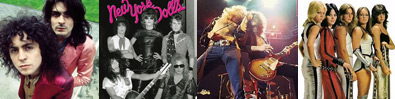
T.Rex; Led Zeppelin; New York Dolls; The Runaways


Psychedelia was a hydra, with rough corrosive rock as one head and expansive dynamics as another.

In the early '70s these heads morphed into Glam and Progressive Rock: Prog was all spectacle, sonic wizardry, ambition, a showboat; but Glam was an ironic glitz, tighter, all three-minute pop in a boogie chassy. Both are trails forged in Rock by Chuck.

T-Rex put a Glam kit on his "Little Queenie" and even quote it at the end of their breakthrough "Bang a Gong (Get It On)". Suzi Quatro jacked a rhinestone chevy with "Glycerine Queen", playing chicken with Gary Glitter's "Do You Wanna Touch Me". (The Runaways and Joan Jett are the collision.) The New York Dolls, whose butch tranny take on Chuck had inspired Glam, rip it up in their dragster "Personality Crisis".

Led Zeppelin grounded themselves in the basics with "Communication Breakdown" and "Rock'n'Roll". As Hard Rock came roaring over the mountains like gods agley, every Blues-based band always broke out with Chuck Berry's lighting bolts on the solos. That's his spray of sparks lighting up the amps of Steppenwolf, Mountain, Cactus, Jo Jo Gunne, Foghat, ZZ Top, Rick Derringer, Mott The Hoople, Aerosmith, Steve Miller, The Runaways, Motorhead, Cheap Trick, Ram Jam, and Heart.

As the counterculture crested in the mid-'70s, the impulse to pull over and review the journey took over. Movies like AMERICAN GRAFITTI and THAT'LL BE THE DAY (with Ringo) and THE WANDERERS, top-rated TV shows like 'Happy Days' and 'Laverne and Shirley', Broadway musicals like "Grease", and boogie bands and cover songs stoked the flames fo the '50s Revival. The terse, raw, careening riffs were a revelation and a transport for new youth, speaking to their lives and fantasies in a direct way that didn't "sound just like a symphony" like Prog.

Drop the coin right into the slot!


Mick Jagger; John Lennon; Debbie Harry.


50s Rock had initially been rebel music>, but now recognition of it as a tradition took hold. A generation of the perverse versed on the psalmbook were angels with dirty faces like revivalists Showaddywaddy; high-mercury guitarist Chris Spedding; Rockabillies like Hank C. Burnette, Sleepy LaBeef, and Robert Gordon; and unreconstructed Bluesers like George Thorogood.

Soon a stripped-down mover called Pub Rock hit mid-'70s England, simply '50s Rock and R'n'B on new cylinders. Thumping 4/4 like four to the floor were unapologetic traditionalists like Dr. Feelgood, Ducks Deluxe, The 101ers (with Joe Strummer), and Kilburn And The High Roads (with Ian Drury).

If Eddie And The Hot Rods injected youth frustration into this mix with "Teenage Depression", then Punk flooded it magnificently. In early rehearsals, Johnny plunged the Sex Pistols off a cliff trying to be good, in their wipeout of "Johnny B. Goode". It mutates into songs like "No Future", The Damned's "New Rose", and The Clash's "I'm So Bored With The U.S.A.". Under its ragged veneer, Punk was high-octane Rock'n'Roll grinding the guardrails and shredding the shiny off. Scarring the tarmac were disparate ruffians like Neu!, The Dictators, The Stranglers, Generation X, DMZ, The Boys, Circle Jerks, The Undertones, and The Cramps.

That "Too Much Monkey Business" staccato rattles back in again in Ultravox's "Satday Night In the City", jumps in with Elvis Costello's "Pump It Up", and scats through The Police's "It's Alright For You". Meanwhile, Plastic Betrand (France) covered Elton Motello's "Jet Boy, Jet Girl" in his global hit "Ca Plane Pour Moi" with all of the "Johnny Be Good" intact, adding falsetto highs from The Beach Boys' "Surfin' USA".

Those retro reprobates, Dave Edmunds and Nick Lowe, hotwired Chuck's torch; in solo songs like "Crawling From the Wreckage" and "Maureen", and with their band Rockpile's "Oh What a Thrill". Meanwhile, back in the USA, Bruce Springsteen prowled the byroads of the interior with "From Small Things (Big Things One Day Come)". Punk was a raspberry to traditional Rock that was still actually rooted in it. Many recognized this blatant contradiction and refused to arbitrarily jettison proven doorways to possibility just to spite it. This led many artist to re-explore timeless '60s styles like Beat Music, Garage Rock, and hits of Psychedelia again, all of it still rooted in Chuck's riffs. Putting some hard jang in their jangle were Flamin' Groovies, The Nerves, Blondie, Modern Lovers, Beat'hoven, Badfinger, Nikki And The Corvettes, and The Beat (with Paul Collins).

By the late '70s, the spectre of Johnny B. Goode flies full-bore past the flagman in Punk, stadium rock, Power Pop, and New Wave; Cheap Trick cruising the night when the "Clock Strikes Ten", Ohio expatriate Chrissie Hynde chauffeuring the coupe to England with The Pretenders' "Watching the Clothes", Nikki and The Corvettes clamping the clutch with the "Criminal Element".

His influence still resonated around the world in tracks by Hungaria (Hungary), Rita Lee (Brazil), Polifemo (Argentina), Los Puntos and Mermelada (Spain), Torfrock (Germany), and Protex (Ireland).

Rhythm'n'Blues and Rock'n'Roll have always been the same music, but given different names specifically to separate people. By 1980, FM radio had programmed this segregation into mass minds simply by formatting: you could be played on Rock stations for sounding like Chuck Berry, but not for looking like him, and R'n'B stations played neither. It takes two dummies to complete a shared delusion. The BusBoys parodied this blinkered idiocy of dividing music and humans by skin and sound barriers with the acerbic "Johnny Soul'd Out".

The Cramps; The BusBoys; The Stray Cats; Gary Clark, Jr.


The essence of "Johnny B. Goode" -furious riff, rapidfire rap, strutting singer, and guitar god- defined essential Rock'n'Roll for the ages. More so than any singer or song ever. Ever.

It's the rev in the '80s Rockabilly> of Shakin' Stevens (Wales), The Polecats (England), Spider Murphy Gang (Germany), The Kingbees, and Stray Cats.

It spurrd the gallop of '80s Roots Rock for troubadours traveling the blue highways off the grid, likeThe Blasters, The Long Ryders, The Fabulous Thunderbirds, Mason Ruffner, and Ry Cooder.

It's catalyzes Psychobilly reprobates like Guana Batz, Demented Are Go, Restless, Misfits (with Glenn Danzig), and The Reverand Horton Heat, and the Trashabilly claxons of Bodeco. It's the fuel under the engine roar of Noize of Japanese troublemakers like Teengenerate, Guitar Wolf, Mikabomb, The Jikens, The Let Go's, and Wasurete Motels.

It's the electricity coursing through the Garage Rock and NeoPsyche of The Fleshtones, Barrence Whitfield, The Milkshakes (with Billy Childish), and The A-Bones. And amplifying '90s succesors like The Nomads, The Kaisers, The Bobbyteens, and The Hellacopters. And galvanizing 2000s cousins like The Hives (Sweden), The White Stripes, The Black Keys, The Raveonettes (Netherlands), The Flaming Sideburns (Brazil), The Kills, Wau Y Los Arrrghs!!! (Spain), The Wildebeests, The Hi-Risers, Fabienne DelSol (France), and Gore Gore Girls.

And on Johnny B. Goode careened, in every chunky riff, arrogant swagger, and rushing roar that highways Boogie Rock to Trashabilly to AfroPunk, that throughlines cycles of disciples in cascades from Aerosmith to Guns'n'Roses, from George Jones to Heavy Trash, from The Twangies (IndoRock) to Peter Tosh, from Pussy Galore to The White Stripes, from Joan Jett to The Kills, from Robert Gordon to Guitar Wolf, from Steve Miller to Gary Clark, Jr..

Flipping donuts brings you full circle.

Paul McCartney had convertabled "Back In the U.S.S.R." once, and told John to slow "Come Together" down so it wouldn't sound sooo much like Chuck (dig the "flattop grooving" lines copped from his "You Can't Catch Me"). In recent years he re-swung through the swamplands with the full-on Chuck amok of "Run Devil Run". And Swedish Nic Armstrong And The Thieves brought it all roundtrip with his cover of "I Want To Be Your Driver", a Beatles freak doing Chuck Berry doing The Beatles doing Chuck Berry!

Around and around, forever fast and free...


Johnny B. Goode


© Tym Stevens


See Also:

Revolution 1950s: The Big Damn Bang of Rock'n'Roll!

1950s PUNK: Sex, Thugs, and Rock'n'Roll!

BO DIDDLEY: The Rhythm King and His Disciples

BUDDY HOLLY: Rock's Everyman and His Disciples

LITTLE RICHARD: The Voice of Rock and His Disciples

JIMMY REED: The Groover of Rock, From Motown To Sesame Street

_____________________


Shock Waves: How SURF MUSIC Saved Rock'n'Roll!, with 2 Music Players!

THE BRITISH INVASION!, with Music Player!

_____________________


The Real History of Rock and Soul!: A Manifesto, A Handy Checklist


Friday, March 11, 2011

ROCK Sex: "Bad Reputation" - Joan Jett > Peaches


ROCK Sex knows "a girl can do what she wants to do".

Todays culture relay is the song "Bad Reputation".

_______________

After the pigboy record industry chased out the group The Runaways, they gave guitarist Joan Jett the runaround for years.

But when her hit record "I Love Rock'n'Roll" became one of the biggest single smashes ever, she had her revenge with this follow-up hit and video.

JOAN JETT -"Bad Reputation" (recorded 1980)


Electroclash provocateur Peaches took that sentiment to its most blatantly profane conclusion using this sample.

PEACHES -"I Don't Give a F@#*!" (2004)


And then Joan joined Peaches for this raucous fracas.

PEACHES with Joan Jett -"You Love It" (2004)


"A girl can do do what she wants to do
And that's what I'm gonna do
And I don't give a damn about my bad reputation!"


© Tym Stevens


See Also:

THE RUNAWAYS, And Why Women Are Essential To The History Of ROCK!

"Exile On GRRL Street", Or How THE STONES Can Tribute Riot Grrrls Tributing Them!


"Everyday People" - Sly Stone > Joan Jett > Arrested Development


The Real History of Rock and Soul!: The Music Player Checklist


Sunday, July 18, 2010

THE RUNAWAYS Invade Your Home!


The Queens Of Noise

THE RUNAWAYS movie is out on DVD and you should see it.


Today's ROCK Sex Blog is an open letter to all those young people who want to start a Rock'n'roll band. It will hip you to why women are crucial to Rock, how to spot a sexist pig writer, and finally why seeing the movie THE RUNAWAYS is essential to your health.

(Note: The whole history of women in Rock is too huge to be told here, so consider this primer Herstory as a general overview.)

I think young women should see this movie to be inspired to make Rock better. The Parties-Of-NO want you to miss it, the same way they wanted you to miss the original band in 1975. It's time to kick them where it hurts.

Let's do this!


Chapter links:
1- Destroying All The Stupid Attitudes About Women In Rock
2- Why The RUNAWAYS Film Is Essential Viewing


DESTROYING
ALL THE STUPID ATTITUDES
ABOUT WOMEN IN ROCK
,
Parts 1-7


THE RUNAWAYS were a brilliant band in the mid-'70s who did as much as anyone to open the gates for the other half of the human race to Rock freely. This is just a flat fact. BUT...they were part of a long path of Rock women from the '50s to now. This goes unacknowledged because of sexism or ignorance or often both.

The history of Rock'n'Soul is often trapped by two things: blindpsot narratives enforced by Rock critics and the segregation of Radio playlists. These limitations are theirs and we can reject them by looking at the whole picture.

There are certain outlooks critics have used for decades to shortchange women in Rock...and I'm going to destroy them for you right now.


THE STUPID ATTITUDES ABOUT WOMEN IN ROCK:

1) 'Rock has always been a man's game.'
2) 'Only men can Rock convincingly.'
3) 'Women are eye candy for conquest.'
4) 'Exclude female Rockers from your histories.'
5) 'Ignore Rock women for Pop women.'
6) 'Repeat what your grandfather said.'
7) 'Call them Women In Rock.'


1) 'ROCK HAS ALWAYS BEEN A MAN'S GAME.'

Not true. Women have been a part of Rock'n'Roll since the beginning.

Firstly, this was a natural extension of their vital presence in Country, Blues, Jazz, Mambo, and all the other varied roots of Rock. Here are some examples.

-The First Family of Country music was the Carter Family, led by guitarist Mother Maybelle. When anyone like The Staple Singers sings "Will the Circle Be Unbroken", it's because of her. Her unique picking style led to the guitar becoming the lead instrument in all the musics that followed. From her we also get June Carter, Carleen Carter, and Roseanne Cash.

-Blues music only took off in the '20s because of the huge popularity of its female stars like Bessie Smith, Ma Rainey, and Ethel Waters. We sing "See See Rider", "Sugar In My Bowl", "Hound Dog", "Whole Lotta Shakin' Goin' On", and "When the Levee Breaks" because of them.

-During WWII, there were all-female Big Bands who toured the country while the enlisted men were away, like The International Sweethearts of Rhythm, Ivy Benson & Her All-Star Girl Orchestra, and Ida Ray Hutton & Her Melodears.

-The Rhythm'n'Blues songs of the early '50s helped pave much of Rock, and female stars like Ruth Brown led the way. Ruth put Atlantic Records on the map with her big hits, and from their success we got the golden age of '60s Soul (Ray Charles, Otis Redding, Aretha Franklin) and '70s Rock (Led Zeppelin, Rolling Stones) because of it.

In each case these musics were kept alive by the crucial works of women.

Lita Ford, Joan Jett, Robert Plant, Cherie Currie


Secondly, it's lazy journalism to call Elvis the King of Rock. It's supposed to tribute his social impact, which is true and unassailable, but it just makes everyone else an also-ran. In reality the dawn of Rock'n'Roll in the 1950s was a pantheon of great talents who all deserve equal credit. We appreciate men like Little Richard, Jerry Lee Lewis, Chuck Berry, Buddy Holly, Bo Diddley, Ritchie Valens, and Link Wray. But there were women right along with them that are only lately getting some due credit.

These women rocked, and you need to know it to know Rock'n'Roll at all: Wanda Jackson, Janis Martin, Big Mama Thornton, Sparkle Moore, LaVern Baker, Alis Lesley, Lorrie Collins, and Joyce Green are only a few.

Social attitudes and sexist marketing may have tried to confine women soon after into making marriage cheerleader songs in Pop Girl Groups', but women who wanted to Rock were in every genre that ever followed. There were female singers, guitarists, and full bands all the way through Surf, British Invasion, Garage Rock, Psychedelia, Electronic Music, Glam, Funk, Hard Rock, Punk, New Wave, PostPunk, HipHop, Alternative Dance, Metal, Retro, Grunge, Riot Grrrl, and Electro.

They have always been here, and they always will be.


2) 'ONLY MEN CAN ROCK CONVINCINGLY.'

Please. This is sad front is known as the Scared-Little-Boy mentality.

Let's nail this for what it is. Most societies split humanity into gender, then they codify them by strength and weakness; Male=Hard=Strength, Female=Soft=Weak. Macho versus Ladylike. Thanks to Latin, entire languages are split in two with separate gender distinctions just to reinforce this fake division. The dumb end of males picks up this superiority complex and reinforces it through aggression and ego, poisoning society.

Enough, time to grow up. There is no difference. You're a soul in a body and you can do anything you want. You don't 'grow up to be a man', you grow deeper to become an adult. An adult has proper respect for the family of humanity and doesn't hold anyone back with immature ideas of why they are better than anyone else.


Now here's the deal: Rock'n'Roll in its true sense has always rejected segregation. It is the antidote to separatist deadends. It is all about inclusion and synthesis, about hybrid and mutation: combine two cool things to make a third new thing. There is no such thing as Either/Or, there is only And-Also. Now repeat.

Let's not be so foolish as to confuse expression with agression and think that this is empowerment. No one's really interested in six-foot boys who love their muscles and their ego. And no one has to spend time at the gym to be able to pull guitar strings or tap a drum. Everyone's got soul and anybody can create a melody. Rock'n'Roll is not about macho posturing, it's about personal expression. A guitar isn't a phallus, it's an arrow for the spirit.

Real Rock has always challenged gender. In the beginning, Little Richard and Alis Lesley mocked barriers of male and female style. The Beatles brought long hair in for men. David Bowie and Suzi Quatro turned sexuality inside out. Jayne County, Genesis P-Orridge, and Lynn Breedlove (Tribe 8) made gender a spectrum. Rock is liberation, not suppression.

Enough with this kid mentality. Now pick up your toys coz we're tired of tripping over them.

L7 & JOAN JETT -"Cherry Bomb" (live, 1992)


3) 'WOMEN ARE EYE CANDY FOR CONQUEST.'

Born To Be Bad


Women have been in Rock since the beginning, but who does the magazine Guitar World put on the cover?: bikini models and porn starlets fondling guitars.

This kind of moron's attitude thinks girls are meant to scream at your concert, young women are groupies, and 'whatever' for the rest.

"Rock'n'Roll" was a Blues euphemism for having sex. Sexuality is the primal pulse behind almost all Rock and Soul music. Good. That's a natural and positive thing. But there is a difference between sensual and sexist. Sensuality is essential, sexism is an evil. Sort it out.

Two of the best 45rpm's in history were Dion's "Runaround Sue" and "The Wanderer". But it also sums up what's wrong here. Both run around having sex but he's a stud and she's a slut. That tired hypocrisy still governs our attitudes.

We laud Elvis Presley, Mick Jagger, Jim Morrison, Isaac Hayes, and Usher for the liberation of their sensuality. We should do the same for Betty Davis, Cherie Currie, Grace Jones, Courtney Love, and Peaches. Drop the double standard, what's good for the goose is good for the goddess.


4) 'EXCLUDE FEMALE ROCKERS FROM YOUR HISTORIES.'

The official Lazy-Journalist-View-Of-Women-In-Rock is this:
The Gogo's > The Bangles > The Spice Girls.

The lazy Rock-Critic-View-Of-Women-In-Rock is:
Janis Joplin > Suzi Quatro > The Runaways > Joan Jett > The Gogo's > The Bangles > Bikini Kill > Liz Phair.


These people have rarely heard of Goldie And The Gingerbreads, Fanny, or Birtha. Or think you haven't so they don't mention them. And you probably haven't because, hey, they didn't mention them.

This kind of attitude comes from blatant ignorance reinforced by a sexist music industry.

It's all about access. 45 singles were a brand new thing in the mid-'50s. You were lucky to get one chance at doing two songs at a fly-by-night label. Even luckier if it became an area hit through local radio. There were no record corporations, no radio networks, no mass distrubution to help these people. You threw your luck in the wind and sometimes it worked. This was made far harder if you had brown skin, were a woman, or other annoying aspects of real life interrupting the program. So yes, there were many women who somehow managed to get recorded against these odds but they had no support system to promote them. Some like Wanda Jackson and Lorrie Collins were lucky to guest on TV music shows, Lavern Baker had the R'n'B crowd with her back. But the rest were systematically ignored out of the scene and history.

When The Beatles exploded and reignited Rock'n'roll, it's obvious that untold thousands of boys started banging away on starter guitars. But so did girls. They didn't want to just chase the Fabs, they wanted to be them. There were myriad all-female rock combos in the mid-'60s, a lot of whom got to record at least a single, have a local hit, and go on regional tours: like The Liverbirds, The Luv'd Ones, The Pleasure Seekers (with Patti and Suzi Quatro), Patti's Groove, Dara Puspita (Indonesia), The Ace of Cups, The Feminine Complex, and She, to name only a few. But Goldie & The Gingerbreads were the first all-female band to get a record contract with a major label...for singles. That's the hitch. No LPs. Then the label failed to promote those singles, even when one of them became a career-making hit when covered by a male band ("Can't You Hear My Heartbeat", Herman's Hermits).

In 1970, the first all-female band signed to make full albums was Fanny. This is one of the most important victories in the history of women in Rock. After a couple years they were joined by Birtha. They rocked as hard, played as well, made strong albums, and wowed the tour crowds as strongly as any male band. Too often, they got treated like groupies with attitudes by other bands, road crews, and press hacks. But they had forced the door open.

FANNY -"Blind Alley" (1972)


The tide began turning because of Feminism and critical mass. Feminism took on Civil Rights' mantle as the expansion of equality and for most of the '70s was in general favor as such. Plus there were too many tough female acts coming out to ignore: Cradle, Yoko Ono, Suzi Quatro, The Runaways, Heart, and Patti Smith.

But the single most crucial catalyst for the explosion of women in Rock was Punk music. It's Do-It-Yourself attitude flung more women into Rock history than the previous two decades combined, an exponential wave crossing all genres through to the present day. They did it by creating their own access, their own labels, their own fanzines, their own undergrounds. In short, they went around the record industry.


Which is another way they get written out. Joan Jett, The Go-Go's, and The Bangles are thought of as the beginning of women in Rock in the early '80s because you saw them on MTV. It's that simple. You could finally see them so it seemed like they came out of nowhere. They were actually indie acts that had managed to crack the mainstream and get some record label support for awhile.

The upshot is that your CD compilations and Box Sets rarely include those pioneering women. Your Rock museum doesn't nominate them. Your movie reviewer steers you from THE RUNAWAYS to that cookie-cutter romance comedy. The deciders still think women are Pop divas and any Rockers are rare flukes.

Did the first two NUGGETS box sets have women in them? No, so an underground series called "Girls In the Garage" compiled 9 (!) CDs of them. Then smart, sympathetic producers in the know like Alec Palao and Lois Wilson included several of them on later NUGGETS and GIRL GROUPS box sets. Rock grrrls, rediscover history and rewrite it. Force your own access.


5) 'IGNORE ROCK WOMEN FOR POP WOMEN.'

This typical ploy just happened when the Rock'n'Roll Hall Of Fame nominated Madonna and Abba. They're fine acts. But let's be clear; they made great Pop, but they are not Rockers. Meanwhile, it took eight tries for The Stooges to be nominated (?!!!), and Fanny and The Runaways have never even been considered. Huh.

Likewise, the mainstream media of the '90s thought of women in Rock as The Spice Girls, seemingly without having the slightest clue about the Riot Grrrl and Queercore movements. Really?


It's always been this way. Pop women are selected over Rockers. The prom queen trumps the scary artist girl. Haven't we been beaten to death with dance dolls like Madonna/Britney/Christina/Beyoncé for years, but who in the mainstream ever talks about the thousands of female Rawk groups struggling for attention on MySpace, YouTube, and Vevo? The lazy narrative of early Rock history thinks any Rockabilly women were an exception, and that women in Rock only meant Girl Groups. This specifically homogenized '60s women into a broad category of Pop music that's seen as a brief blip before The Beatles. They're relegated as polite belles decorating chapels of love, produced and manufactured by male creators. It reinforces the Female=Soft=Weak yawn. (Often the music critic's lazy formula is Pop=Soft=Female, Rock=Hard=Male.)

The sequel to this is when they group all '70s women as singer-songwriters. It's as if before The Gogo's there was only The Shirelles and then Joni Mitchell. Or Carole King, to compress them both. This Laurel Canyon mentality of women in Rock was primarily purveyed by Rolling Stone magazine and the contemporaries they hung with. Now I respected publisher Jann Wenner growing up and I'd like to give him the benefit of the doubt. But damn.

Maybe a telling anecdote is this. In the mid-'60s there was a great Garage Rock single called "Boy, What'll You Do Then?" by Denise & Co. The tough young singer, Denise Kaufman, turns the usual Garage song stance around by chastizing her boyfriend for being a supressive control freak who holds her back from having wild fun. Denise then formed the all-female band The Ace Of Cups during the heyday of San Francisco psychedelia. The former boyfriend she was upbraiding was Jann Wenner. Now, again, I want to give Jann the benefit of the doubt on this. And Wenner is the prime mover behind the Hall Of Fame. So, Jann... as someone who has dedicated his life and made his fortune protecting the legacy of Rock'n'Roll, show us that you can stand behind your proud woman and nominate real Rock grrrls into the Rock'n'Roll Hall Of Fame.

You can start with The Runaways. And then backtrack to include Goldie, Fanny, Birtha, and Suzi.

(By the way, Cherie Currie was wearing her corset and underwear onstage a decade before Madonna, but she was blasting actual Rock'n'Roll when she did it.)


6) 'REPEAT WHAT YOUR GRANDFATHER SAID.'


'When in doubt, repeat the lie you've always heard.' This attitude is basically akin to the 'Bash Yoko' mentality.

There were no Rock critics until the late '60s. There was an elitist cult of Jazz critics, but what we now think of as great Rock music was written off as 'stupid Pop music for stupid people' by the Classical and Jazz scribes in the '50s and '60s. We should give brave new counterculture magazines like Rolling Stone, Crawdaddy, Cream, Oz, NME, and their ilk the credit for legitimizing Rock as a valid form of artistic expression.

But the male writers were only human with the flaws of their moment. They coined offensive terms like Kraut Rock that we still use, and they still thought women were groupies until the early '80s. Even Joni, who matches the most holy Dylan move for move, got subjected to that. But then...there's how Yoko got treated.


Yoko Ono was famous before The Beatles. She was a world-reknowned conceptual artist from the Fluxus Group, with John Cage and Al Hanson (Beck's grandfather). She made experimental serial music with La Monte Young a decade before anyone heard of Reich and Glass. She was a Feminist activist before most people had ever heard of Gloria Steinem. No one had a problem with Marianne Faithfull or Anita Pallenberg because they were seen then as sexy arm charms for The Rolling Stones. But they weren't Japanese, outspoken, and marrying the critically-preferred Beatle. Like the Kraut Rock thing, many critics and fans turned post-War hate against her heritage; they resented her individuality and were threatened by her politics; and they wrote off her work having seen or heard almost none of it. Because of them this became the broad social impression of Yoko, sealed in amber.

The Lazy-Opinion-Of-Yoko is: made screech music > broke up The Beatles > feminazi. This hand-me-down hate has been repeated ad nauseum for four decades now. Just watch what some 15-year-old male goofball mis-types as a comment onto any Yoko video on YouTube. Grandfathered hatred. Well, I grew up in the South and I know a bigoted idiot when I hear one, whether it's a Fox blowhard with a chalkboard or Bigot III on his parents' computer.> So I'm calling this third gen' inbreed out.

Now let's get real. The Beatles broke up The Beatles because it was time, be grateful we had them at all. Yoko made ranges of music that included ambient dub, proto-Punk, and melodic beauty. We routinely applaud Bowie, Eno, and Pattie Smith for similar advances while ignoring what she was already doing first. She was the strongest voice for Women's Lib that ever happened in Rock music. She is the big bang of truly fearless artists like Annette Peacock, X-Ray Spex, Nina Hagen, Lene Lovich, Cosey Fanni Tutti, The Au Pairs, Crass, Poison Girls, The B-52's, Jarboe, Diamanda Galas, Kathleen Hanna's riot grrrl brigade, The Boredoms, L7, Tori Amos, Shonen Knife, Cibo Matto, and Peaches. She also opened John Lennon up into what he considered to be his true self, and when someone insults her, they are insulting their idol.

Most Beatles fans are cool. Because, come on, they're Beatles fans. They love and respect Yoko for who she is and what she's done. But there are still some peripheral idjits and walk-bys who have a problem with her. To which I say, "In an age where everyone is jaded about everyone being co-opted, it's wonderful that she is still so dangerous and edgy that she still scares people like you. So suck it."

This parallel example sums up the sexist hand-me-down that gets used to this day against Rock grrrls. The idiot bigot view of women in Rock is: can't play > uh, gimme a beer. Whenever you hear this slug, let him know his balls aren't his strength by breaking them.

The double standard is sadly hilarious: Garage Rock bands are touted proudly for being amateurs with heart and maybe one good song; Unless you're female, and suddenly you have to play better than Hendrix and have made REVOLVER before you get half a grunt of notice, and still no inclusion on the compilation. Well, maybe your grandfather might remember that the men won WWII because of the planes, ships, and tanks the women built for them. She could save the planet before you were born so if she wants to play a fricking guitar, get out of the way and shut up.

THE SHE TRINITY -"Climb That Tree" (1970)


7) "CALL THEM WOMEN IN ROCK.'

Then there's the whole thing of grouping them at all.

Patti Smith and Chrissie Hynde will punch you in the face before you can call them "women in R- owwww!" They want to be thought of as musicians, stand or fall. And ideally they're right.

I remember the term 'negro' being used by older relatives. It struck me as ancient and insane. 'Black' (identity) was the beginning of the social arc toward 'African-American' (citizen), and someday we'll get to words like Human or Brother and Sister or Sweetheart. This is one of those. We need to show people women have always been in every era of Rock until the commonality of it finally forces the focus only on someone's talent. I can remember when Tina Weymouth was relentlessly singled out as 'the female bass player' of Talking Heads. Now a female bass player seems like a standard requirement in most bands.


Why The RUNAWAYS Film
Is Essential Viewing


Now why did I go on about all that at length?

Because when you see any of these archaic mindsets creeping into any review of THE RUNAWAYS movie, or about your favorite band, or about your band, you can call it out for the lazy stupidity it is.

This film moved me. It spoke to a lot of emotional and cultural things that are just as relevent today as the era of the film. I saw none of that spoken to in some of the movie reviews I was seeing. Don't let them put you off. They're doing it for all of the reasons above. But they are failures at their jobs. 'To criticize' doesn't mean to rip something apart. There's a positive critique and a negative critique: A negative critique tears something up with no respect or solutions, which is useless cruelty; A positive critique respects someone's intentions while offering possible options to explore, which is helpful advice.

In particular, a useless review of THE RUNAWAYS tries dismissing it as a formula biopic. I find that self-damning. Maybe they've seen Thirteen and they're jaded to this story, or they've seen too many episodes of "Behind The Music". But what they don't speak to is that this really happened to 15-year-old girls in 1975 who were misused by all the adults around them in the record industry, the press, and the drug scene. The world treated children with a dream like they were whores. It took their great work despite all these odds and simply threw it away.

I find these adults just as guilty today of pimping an ego-star culture that promises teens everything while using them for quick profit and discarding them. Thirteen only happens because of the symptoms of that same old-boy capitalist system. That system is kept in motion by a parade of exploitative Consumer clutter designed to use youth... like fake Idol contests, bling videos, and the latest device. But this movie condemns them for that criminal neglect and exploitation. It should be no surprise that your corporate-owned paper, magazine, channel, or website didn't speak to that. It struck me that 35 years later they're still just trying to write The Runaways off and steer young girls away to heartthrob franchise films. In that sense these reviews are just cynical manipulation and ass-covering.

Underlying that are the 7 shopworn excuses for dismissing Rockgirls listed above. When you're reading a review of the film, separate out what's helpful or maliscious. If they have valid concerns about the structure of the story, or issues about missing characters and perspectives, or suggestions about how the impact could have been enhanced, that's all fair and good. But if they obviously can't wrap their head around the idea of women Rockers, broader sexuality, the social responsiblity to protect youth instead of using them, or calling out gender slavery, then flip them the bird right back.

Kristen Stewart, Joan Jett, Dakota Fanning, Cherie Currie


Here's what I think about the strengths of the film, without giving anything away:

-The soundtrack is the smartest set of choices I've heard forever in a Rock film. They kick it off right with Wanda Jackson's "Fujiyama Mama", already acknowledging the history of women in Rock, before rolling right into Suzi Quatro, the heir to '50s Rock and inspiration for young Joan Jett. From there it only gets better, with pitch-perfect choices of songs by Bowie, The Stooges, The MC5, Sex Pistols, and more, each spot-on for the scene and the vibe. This movie makes a Rock lover's heart pump just the way these songs did for the teens in the story.

-Also impressive is the cinematography of Benoit Debie, most particularly in the intense intimacy of the close-ups. The use of grain, depth-of-field, delirium, and montage bring the two lead's emotions into fuller frution. And the lushly impressionistic love scene set to The Stooges' "I Wanna Be Your Dog" is absolutely excellent.

-Kristen Stewart is Joan Jett. I didn't know that would be possible but she does it with such ease that it amazed me. She has the little things down, like body language, moves, vocal inflections. The singing was so exact I thought it had to be lip-synchs of Joan, but no, homegirl was doing it herself. I found Kristen's Joan to be strong, cool, sweet, sensual, anguished, and very moving.

-I've always enjoyed Dakota Fanning since I AM SAM, a film that has deep personal connection for me. She captures Cherie's toughness and vulnerability really well. (She does valiantly with the singing, but it would be tough for most to match the coolness of Cherie's basso edge.)

-The movie is mainly about Cherie, Joan, and their insane producer Kim Fowley. A fixture of the '60s and '70s LA Rock scene, Fowley is infamous for his combustible combo of music insight and manic behaviour. Michael Shannon does an startling job capturing him exactly, in appearance, style, and brutal hyperbole. I hate how he treated the band but I sure relish how well he was played.

-It's easy to think of The Runaways as twentysomethings who were punk as nails, but seeing how they really were only just teenagers, with all the goofiness, guilessness, and confusions of that age, really brought home to me how horrendous this situation could be for them. They just seem like kids getting deeper and deeper into something that can't end well. It's alarming and heartbreaking. A lot of the film's value comes from alerting you to how young stars should have a saner support system. (Nowadays young women are more fortunate with training grounds like the Institute of Musical Arts, and summer camps for teaching young girls. It should be pointed out these were created by female rockers who got abused by the music industry and put their wisdom to work for the new generations.)

-At the same time the movie reminds you of what it's like to be a teenager and have a dream in front of you that you're willing to run through fire to achieve. Their enthusiasm is contagious and reaffirms why Rock'n'Roll is a great catalyst for the soul. When Cherie flips off a chucklehead crowd that heckles her early on, I empathized as keenly as any time I've given a deserved kick to the pricks. Yeahhh!


-Another crucial dimension of this film is sexual identity and trying to express it while society selectively rewards or condemns you for it. One of the key aspects of the Glam Rock era was upending gender roles and expanding sexual preferences. The Runaways were a band with well-rounded sexual appetites. There's a contrasting facet to that here; the Rock world was all too eager to exploit their emerging sensuality like they were lucrative jailbait, but would have destroyed them for the taboo range of their true desires. At the heart of this film is a love story, a courageous one that reviewers are conspicuously silent on. Especially cowardly of them when 35 years on this is more timely than ever, with culture wars over suppressing or liberating same-sex love. Despite them, the film becomes that much more relevent in its connections to the underground gay and bi history of Rock, from Bessie Smith and Alberta Hunter to Lesley Gore to Carol MacDonald (Gingerbreads, Isis) to Fanny to Nona Hendryx to Queercore to Boyskout. It reaffirms that, though history denies them, they have always been a part of history, and that that closet is getting emptier by the day.


PEACHES And JOAN JETT -"You Love It" (2006)


To all you young women who love TWILIGHT, I say go to this movie and get inspired. After all, why just yell at The Beatles when you can become The Beatles? Or you can watch THE RUNAWAYS and become your own Runaways. Don't just moon over a goth boy, become a Goth band. The Runaways were a crucial breakthrough for women in Rock and you can be, too. Don't listen to negative people. Don't put it off until the video. See it now...big, loud, and with cool friends.


THE RUNAWAYS movie is out and you should see it.
Today.
At the theatre.


And then see this.


© Tym Stevens


See Also:

YOU DON'T OWN ME: The Uprising of the 1960s GIRL GROUPS, with Music Player

SHE'S A REBEL: Decades Of Songs Influenced By The GIRL GROUPS
, with Music Player


WOMEN OF ROCK: The 1950s, with 2 Music Players

WOMEN OF ROCK: The 1960s, with 2 Music Players


ROCK Orgy: Le Tigre's "Hot Topic" + Women Who Rock!

"Time Has Come Today" - Chambers Brothers > Angry Samoans > Ramones > Joan Jett

"Bad Reputation" - Joan Jett > Peaches


The Real History of Rock and Soul!: The Music Player Checklist


Saturday, March 20, 2010

THE RUNAWAYS, And Why Women Of Rock Are Essential!


The Queens Of Noise


Today's ROCK Sex Blog is an open letter to all those young people who want to start a Rock'n'roll band. It will hip you to why women are crucial to Rock, how to spot a sexist pig writer, and finally why seeing the movie THE RUNAWAYS is essential to your health.

(Note: The whole history of women in Rock is too huge to be told here, so consider this primer Herstory as a general overview.)

I think young women should see this movie to be inspired to make Rock better. The Parties-Of-NO want you to miss it, the same way they wanted you to miss the original band in 1975. It's time to kick them where it hurts.

Let's do this!


Chapter links:
1- Destroying All The Stupid Attitudes About Women In Rock
2- Why The RUNAWAYS Film Is Essential Viewing


DESTROYING
ALL THE STUPID ATTITUDES
ABOUT WOMEN IN ROCK
,
Parts 1-7


THE RUNAWAYS were a brilliant band in the mid-'70s who did as much as anyone to open the gates for the other half of the human race to Rock freely. This is just a flat fact. BUT...they were part of a long path of Rock women from the '50s to now. This goes unacknowledged because of sexism or ignorance or often both.

The history of Rock'n'Soul is often trapped by two things: blindpsot narratives enforced by Rock critics and the segregation of Radio playlists. These limitations are theirs and we can reject them by looking at the whole picture.

There are certain outlooks critics have used for decades to shortchange women in Rock...and I'm going to destroy them for you right now.


THE STUPID ATTITUDES ABOUT WOMEN IN ROCK:

1) 'Rock has always been a man's game.'
2) 'Only men can Rock convincingly.'
3) 'Women are eye candy for conquest.'
4) 'Exclude female Rockers from your histories.'
5) 'Ignore Rock women for Pop women.'
6) 'Repeat what your grandfather said.'
7) 'Call them Women In Rock.'


1) 'ROCK HAS ALWAYS BEEN A MAN'S GAME.'

Not true. Women have been a part of Rock'n'Roll since the beginning.

Firstly, this was a natural extension of their vital presence in Country, Blues, Jazz, Mambo, and all the other varied roots of Rock. Here are some examples.

-The First Family of Country music was the Carter Family, led by guitarist Mother Maybelle. When anyone like The Staple Singers sings "Will the Circle Be Unbroken", it's because of her. Her unique picking style led to the guitar becoming the lead instrument in all the musics that followed. From her we also get June Carter, Carleen Carter, and Roseanne Cash.

-Blues music only took off in the '20s because of the huge popularity of its female stars like Bessie Smith, Ma Rainey, and Ethel Waters. We sing "See See Rider", "Sugar In My Bowl", "Hound Dog", "Whole Lotta Shakin' Goin' On", and "When the Levee Breaks" because of them.

-During WWII, there were all-female Big Bands who toured the country while the enlisted men were away, like The International Sweethearts of Rhythm, Ivy Benson & Her All-Star Girl Orchestra, and Ida Ray Hutton & Her Melodears.

-The Rhythm'n'Blues songs of the early '50s helped pave much of Rock, and female stars like Ruth Brown led the way. Ruth put Atlantic Records on the map with her big hits, and from their success we got the golden age of '60s Soul (Ray Charles, Otis Redding, Aretha Franklin) and '70s Rock (Led Zeppelin, Rolling Stones) because of it.

In each case these musics were kept alive by the crucial works of women.

Lita Ford, Joan Jett, Robert Plant, Cherie Currie


Secondly, it's lazy journalism to call Elvis the King of Rock. It's supposed to tribute his social impact, which is true and unassailable, but it just makes everyone else an also-ran. In reality the dawn of Rock'n'Roll in the 1950s was a pantheon of great talents who all deserve equal credit. We appreciate men like Little Richard, Jerry Lee Lewis, Chuck Berry, Buddy Holly, Bo Diddley, Ritchie Valens, and Link Wray. But there were women right along with them that are only lately getting some due credit.

These women rocked, and you need to know it to know Rock'n'Roll at all: Wanda Jackson, Janis Martin, Big Mama Thornton, Sparkle Moore, LaVern Baker, Alis Lesley, Lorrie Collins, and Joyce Green are only a few.

Social attitudes and sexist marketing may have tried to confine women soon after into making marriage cheerleader songs in Pop Girl Groups', but women who wanted to Rock were in every genre that ever followed. There were female singers, guitarists, and full bands all the way through Surf, British Invasion, Garage Rock, Psychedelia, Electronic Music, Glam, Funk, Hard Rock, Punk, New Wave, PostPunk, HipHop, Alternative Dance, Metal, Retro, Grunge, Riot Grrrl, and Electro.

They have always been here, and they always will be.


2) 'ONLY MEN CAN ROCK CONVINCINGLY.'

Please. This is sad front is known as the Scared-Little-Boy mentality.

Let's nail this for what it is. Most societies split humanity into gender, then they codify them by strength and weakness; Male=Hard=Strength, Female=Soft=Weak. Macho versus Ladylike. Thanks to Latin, entire languages are split in two with separate gender distinctions just to reinforce this fake division. The dumb end of males picks up this superiority complex and reinforces it through aggression and ego, poisoning society.

Enough, time to grow up. There is no difference. You're a soul in a body and you can do anything you want. You don't 'grow up to be a man', you grow deeper to become an adult. An adult has proper respect for the family of humanity and doesn't hold anyone back with immature ideas of why they are better than anyone else.


Now here's the deal: Rock'n'Roll in its true sense has always rejected segregation. It is the antidote to separatist deadends. It is all about inclusion and synthesis, about hybrid and mutation: combine two cool things to make a third new thing. There is no such thing as Either/Or, there is only And-Also. Now repeat.

Let's not be so foolish as to confuse expression with agression and think that this is empowerment. No one's really interested in six-foot boys who love their muscles and their ego. And no one has to spend time at the gym to be able to pull guitar strings or tap a drum. Everyone's got soul and anybody can create a melody. Rock'n'Roll is not about macho posturing, it's about personal expression. A guitar isn't a phallus, it's an arrow for the spirit.

Real Rock has always challenged gender. In the beginning, Little Richard and Alis Lesley mocked barriers of male and female style. The Beatles brought long hair in for men. David Bowie and Suzi Quatro turned sexuality inside out. Jayne County, Genesis P-Orridge, and Lynn Breedlove (Tribe 8) made gender a spectrum. Rock is liberation, not suppression.

Enough with this kid mentality. Now pick up your toys coz we're tired of tripping over them.

L7 & JOAN JETT -"Cherry Bomb" (live, 1992)


3) 'WOMEN ARE EYE CANDY FOR CONQUEST.'

Born To Be Bad


Women have been in Rock since the beginning, but who does the magazine Guitar World put on the cover?: bikini models and porn starlets fondling guitars.

This kind of moron's attitude thinks girls are meant to scream at your concert, young women are groupies, and 'whatever' for the rest.

"Rock'n'Roll" was a Blues euphemism for having sex. Sexuality is the primal pulse behind almost all Rock and Soul music. Good. That's a natural and positive thing. But there is a difference between sensual and sexist. Sensuality is essential, sexism is an evil. Sort it out.

Two of the best 45rpm's in history were Dion's "Runaround Sue" and "The Wanderer". But it also sums up what's wrong here. Both run around having sex but he's a stud and she's a slut. That tired hypocrisy still governs our attitudes.

We laud Elvis Presley, Mick Jagger, Jim Morrison, Isaac Hayes, and Usher for the liberation of their sensuality. We should do the same for Betty Davis, Cherie Currie, Grace Jones, Courtney Love, and Peaches. Drop the double standard, what's good for the goose is good for the goddess.


4) 'EXCLUDE FEMALE ROCKERS FROM YOUR HISTORIES.'

The official Lazy-Journalist-View-Of-Women-In-Rock is this:
The Gogo's > The Bangles > The Spice Girls.

The lazy Rock-Critic-View-Of-Women-In-Rock is:
Janis Joplin > Suzi Quatro > The Runaways > Joan Jett > The Gogo's > The Bangles > Bikini Kill > Liz Phair.


These people have rarely heard of Goldie And The Gingerbreads, Fanny, or Birtha. Or think you haven't so they don't mention them. And you probably haven't because, hey, they didn't mention them.

This kind of attitude comes from blatant ignorance reinforced by a sexist music industry.

It's all about access. 45 singles were a brand new thing in the mid-'50s. You were lucky to get one chance at doing two songs at a fly-by-night label. Even luckier if it became an area hit through local radio. There were no record corporations, no radio networks, no mass distrubution to help these people. You threw your luck in the wind and sometimes it worked. This was made far harder if you had brown skin, were a woman, or other annoying aspects of real life interrupting the program. So yes, there were many women who somehow managed to get recorded against these odds but they had no support system to promote them. Some like Wanda Jackson and Lorrie Collins were lucky to guest on TV music shows, Lavern Baker had the R'n'B crowd with her back. But the rest were systematically ignored out of the scene and history.

When The Beatles exploded and reignited Rock'n'roll, it's obvious that untold thousands of boys started banging away on starter guitars. But so did girls. They didn't want to just chase the Fabs, they wanted to be them. There were myriad all-female rock combos in the mid-'60s, a lot of whom got to record at least a single, have a local hit, and go on regional tours: like The Liverbirds, The Luv'd Ones, The Pleasure Seekers (with Patti and Suzi Quatro), Patti's Groove, Dara Puspita (Indonesia), The Ace of Cups, The Feminine Complex, and She, to name only a few. But Goldie & The Gingerbreads were the first all-female band to get a record contract with a major label...for singles. That's the hitch. No LPs. Then the label failed to promote those singles, even when one of them became a career-making hit when covered by a male band ("Can't You Hear My Heartbeat", Herman's Hermits).

In 1970, the first all-female band signed to make full albums was Fanny. This is one of the most important victories in the history of women in Rock. After a couple years they were joined by Birtha. They rocked as hard, played as well, made strong albums, and wowed the tour crowds as strongly as any male band. Too often, they got treated like groupies with attitudes by other bands, road crews, and press hacks. But they had forced the door open.

FANNY -"Blind Alley" (1972)


The tide began turning because of Feminism and critical mass. Feminism took on Civil Rights' mantle as the expansion of equality and for most of the '70s was in general favor as such. Plus there were too many tough female acts coming out to ignore: Cradle, Yoko Ono, Suzi Quatro, The Runaways, Heart, and Patti Smith.

But the single most crucial catalyst for the explosion of women in Rock was Punk music. It's Do-It-Yourself attitude flung more women into Rock history than the previous two decades combined, an exponential wave crossing all genres through to the present day. They did it by creating their own access, their own labels, their own fanzines, their own undergrounds. In short, they went around the record industry.


Which is another way they get written out. Joan Jett, The Go-Go's, and The Bangles are thought of as the beginning of women in Rock in the early '80s because you saw them on MTV. It's that simple. You could finally see them so it seemed like they came out of nowhere. They were actually indie acts that had managed to crack the mainstream and get some record label support for awhile.

The upshot is that your CD compilations and Box Sets rarely include those pioneering women. Your Rock museum doesn't nominate them. Your movie reviewer steers you from THE RUNAWAYS to that cookie-cutter romance comedy. The deciders still think women are Pop divas and any Rockers are rare flukes.

Did the first two NUGGETS box sets have women in them? No, so an underground series called "Girls In the Garage" compiled 9 (!) CDs of them. Then smart, sympathetic producers in the know like Alec Palao and Lois Wilson included several of them on later NUGGETS and GIRL GROUPS box sets. Rock grrrls, rediscover history and rewrite it. Force your own access.


5) 'IGNORE ROCK WOMEN FOR POP WOMEN.'

This typical ploy just happened when the Rock'n'Roll Hall Of Fame nominated Madonna and Abba. They're fine acts. But let's be clear; they made great Pop, but they are not Rockers. Meanwhile, it took eight tries for The Stooges to be nominated (?!!!), and Fanny and The Runaways have never even been considered. Huh.

Likewise, the mainstream media of the '90s thought of women in Rock as The Spice Girls, seemingly without having the slightest clue about the Riot Grrrl and Queercore movements. Really?


It's always been this way. Pop women are selected over Rockers. The prom queen trumps the scary artist girl. Haven't we been beaten to death with dance dolls like Madonna/Britney/Christina/Beyoncé for years, but who in the mainstream ever talks about the thousands of female Rawk groups struggling for attention on MySpace, YouTube, and Vevo? The lazy narrative of early Rock history thinks any Rockabilly women were an exception, and that women in Rock only meant Girl Groups. This specifically homogenized '60s women into a broad category of Pop music that's seen as a brief blip before The Beatles. They're relegated as polite belles decorating chapels of love, produced and manufactured by male creators. It reinforces the Female=Soft=Weak yawn. (Often the music critic's lazy formula is Pop=Soft=Female, Rock=Hard=Male.)

The sequel to this is when they group all '70s women as singer-songwriters. It's as if before The Gogo's there was only The Shirelles and then Joni Mitchell. Or Carole King, to compress them both. This Laurel Canyon mentality of women in Rock was primarily purveyed by Rolling Stone magazine and the contemporaries they hung with. Now I respected publisher Jann Wenner growing up and I'd like to give him the benefit of the doubt. But damn.

Maybe a telling anecdote is this. In the mid-'60s there was a great Garage Rock single called "Boy, What'll You Do Then?" by Denise & Co. The tough young singer, Denise Kaufman, turns the usual Garage song stance around by chastizing her boyfriend for being a supressive control freak who holds her back from having wild fun. Denise then formed the all-female band The Ace Of Cups during the heyday of San Francisco psychedelia. The former boyfriend she was upbraiding was Jann Wenner. Now, again, I want to give Jann the benefit of the doubt on this. And Wenner is the prime mover behind the Hall Of Fame. So, Jann... as someone who has dedicated his life and made his fortune protecting the legacy of Rock'n'Roll, show us that you can stand behind your proud woman and nominate real Rock grrrls into the Rock'n'Roll Hall Of Fame.

You can start with The Runaways. And then backtrack to include Goldie, Fanny, Birtha, and Suzi.

(By the way, Cherie Currie was wearing her corset and underwear onstage a decade before Madonna, but she was blasting actual Rock'n'Roll when she did it.)


6) 'REPEAT WHAT YOUR GRANDFATHER SAID.'


'When in doubt, repeat the lie you've always heard.' This attitude is basically akin to the 'Bash Yoko' mentality.

There were no Rock critics until the late '60s. There was an elitist cult of Jazz critics, but what we now think of as great Rock music was written off as 'stupid Pop music for stupid people' by the Classical and Jazz scribes in the '50s and '60s. We should give brave new counterculture magazines like Rolling Stone, Crawdaddy, Cream, Oz, NME, and their ilk the credit for legitimizing Rock as a valid form of artistic expression.

But the male writers were only human with the flaws of their moment. They coined offensive terms like Kraut Rock that we still use, and they still thought women were groupies until the early '80s. Even Joni, who matches the most holy Dylan move for move, got subjected to that. But then...there's how Yoko got treated.


Yoko Ono was famous before The Beatles. She was a world-reknowned conceptual artist from the Fluxus Group, with John Cage and Al Hanson (Beck's grandfather). She made experimental serial music with La Monte Young a decade before anyone heard of Reich and Glass. She was a Feminist activist before most people had ever heard of Gloria Steinem. No one had a problem with Marianne Faithfull or Anita Pallenberg because they were seen then as sexy arm charms for The Rolling Stones. But they weren't Japanese, outspoken, and marrying the critically-preferred Beatle. Like the Kraut Rock thing, many critics and fans turned post-War hate against her heritage; they resented her individuality and were threatened by her politics; and they wrote off her work having seen or heard almost none of it. Because of them this became the broad social impression of Yoko, sealed in amber.

The Lazy-Opinion-Of-Yoko is: made screech music > broke up The Beatles > feminazi. This hand-me-down hate has been repeated ad nauseum for four decades now. Just watch what some 15-year-old male goofball mis-types as a comment onto any Yoko video on YouTube. Grandfathered hatred. Well, I grew up in the South and I know a bigoted idiot when I hear one, whether it's a Fox blowhard with a chalkboard or Bigot III on his parents' computer.> So I'm calling this third gen' inbreed out.

Now let's get real. The Beatles broke up The Beatles because it was time, be grateful we had them at all. Yoko made ranges of music that included ambient dub, proto-Punk, and melodic beauty. We routinely applaud Bowie, Eno, and Pattie Smith for similar advances while ignoring what she was already doing first. She was the strongest voice for Women's Lib that ever happened in Rock music. She is the big bang of truly fearless artists like Annette Peacock, X-Ray Spex, Nina Hagen, Lene Lovich, Cosey Fanni Tutti, The Au Pairs, Crass, Poison Girls, The B-52's, Jarboe, Diamanda Galas, Kathleen Hanna's riot grrrl brigade, The Boredoms, L7, Tori Amos, Shonen Knife, Cibo Matto, and Peaches. She also opened John Lennon up into what he considered to be his true self, and when someone insults her, they are insulting their idol.

Most Beatles fans are cool. Because, come on, they're Beatles fans. They love and respect Yoko for who she is and what she's done. But there are still some peripheral idjits and walk-bys who have a problem with her. To which I say, "In an age where everyone is jaded about everyone being co-opted, it's wonderful that she is still so dangerous and edgy that she still scares people like you. So suck it."

This parallel example sums up the sexist hand-me-down that gets used to this day against Rock grrrls. The idiot bigot view of women in Rock is: can't play > uh, gimme a beer. Whenever you hear this slug, let him know his balls aren't his strength by breaking them.

The double standard is sadly hilarious: Garage Rock bands are touted proudly for being amateurs with heart and maybe one good song; Unless you're female, and suddenly you have to play better than Hendrix and have made REVOLVER before you get half a grunt of notice, and still no inclusion on the compilation. Well, maybe your grandfather might remember that the men won WWII because of the planes, ships, and tanks the women built for them. She could save the planet before you were born so if she wants to play a fricking guitar, get out of the way and shut up.

THE SHE TRINITY -"Climb That Tree" (1970)


7) "CALL THEM WOMEN IN ROCK.'

Then there's the whole thing of grouping them at all.

Patti Smith and Chrissie Hynde will punch you in the face before you can call them "women in R- owwww!" They want to be thought of as musicians, stand or fall. And ideally they're right.

I remember the term 'negro' being used by older relatives. It struck me as ancient and insane. 'Black' (identity) was the beginning of the social arc toward 'African-American' (citizen), and someday we'll get to words like Human or Brother and Sister or Sweetheart. This is one of those. We need to show people women have always been in every era of Rock until the commonality of it finally forces the focus only on someone's talent. I can remember when Tina Weymouth was relentlessly singled out as 'the female bass player' of Talking Heads. Now a female bass player seems like a standard requirement in most bands.


Why The RUNAWAYS Film
Is Essential Viewing


Now why did I go on about all that at length?

Because when you see any of these archaic mindsets creeping into any review of THE RUNAWAYS movie, or about your favorite band, or about your band, you can call it out for the lazy stupidity it is.

This film moved me. It spoke to a lot of emotional and cultural things that are just as relevent today as the era of the film. I saw none of that spoken to in some of the movie reviews I was seeing. Don't let them put you off. They're doing it for all of the reasons above. But they are failures at their jobs. 'To criticize' doesn't mean to rip something apart. There's a positive critique and a negative critique: A negative critique tears something up with no respect or solutions, which is useless cruelty; A positive critique respects someone's intentions while offering possible options to explore, which is helpful advice.

In particular, a useless review of THE RUNAWAYS tries dismissing it as a formula biopic. I find that self-damning. Maybe they've seen Thirteen and they're jaded to this story, or they've seen too many episodes of "Behind The Music". But what they don't speak to is that this really happened to 15-year-old girls in 1975 who were misused by all the adults around them in the record industry, the press, and the drug scene. The world treated children with a dream like they were whores. It took their great work despite all these odds and simply threw it away.

I find these adults just as guilty today of pimping an ego-star culture that promises teens everything while using them for quick profit and discarding them. Thirteen only happens because of the symptoms of that same old-boy capitalist system. That system is kept in motion by a parade of exploitative Consumer clutter designed to use youth... like fake Idol contests, bling videos, and the latest device. But this movie condemns them for that criminal neglect and exploitation. It should be no surprise that your corporate-owned paper, magazine, channel, or website didn't speak to that. It struck me that 35 years later they're still just trying to write The Runaways off and steer young girls away to heartthrob franchise films. In that sense these reviews are just cynical manipulation and ass-covering.

Underlying that are the 7 shopworn excuses for dismissing Rockgirls listed above. When you're reading a review of the film, separate out what's helpful or maliscious. If they have valid concerns about the structure of the story, or issues about missing characters and perspectives, or suggestions about how the impact could have been enhanced, that's all fair and good. But if they obviously can't wrap their head around the idea of women Rockers, broader sexuality, the social responsiblity to protect youth instead of using them, or calling out gender slavery, then flip them the bird right back.

Kristen Stewart, Joan Jett, Dakota Fanning, Cherie Currie


Here's what I think about the strengths of the film, without giving anything away:

-The soundtrack is the smartest set of choices I've heard forever in a Rock film. They kick it off right with Wanda Jackson's "Fujiyama Mama", already acknowledging the history of women in Rock, before rolling right into Suzi Quatro, the heir to '50s Rock and inspiration for young Joan Jett. From there it only gets better, with pitch-perfect choices of songs by Bowie, The Stooges, The MC5, Sex Pistols, and more, each spot-on for the scene and the vibe. This movie makes a Rock lover's heart pump just the way these songs did for the teens in the story.

-Also impressive is the cinematography of Benoit Debie, most particularly in the intense intimacy of the close-ups. The use of grain, depth-of-field, delirium, and montage bring the two lead's emotions into fuller frution. And the lushly impressionistic love scene set to The Stooges' "I Wanna Be Your Dog" is absolutely excellent.

-Kristen Stewart is Joan Jett. I didn't know that would be possible but she does it with such ease that it amazed me. She has the little things down, like body language, moves, vocal inflections. The singing was so exact I thought it had to be lip-synchs of Joan, but no, homegirl was doing it herself. I found Kristen's Joan to be strong, cool, sweet, sensual, anguished, and very moving.

-I've always enjoyed Dakota Fanning since I AM SAM, a film that has deep personal connection for me. She captures Cherie's toughness and vulnerability really well. (She does valiantly with the singing, but it would be tough for most to match the coolness of Cherie's basso edge.)

-The movie is mainly about Cherie, Joan, and their insane producer Kim Fowley. A fixture of the '60s and '70s LA Rock scene, Fowley is infamous for his combustible combo of music insight and manic behaviour. Michael Shannon does an startling job capturing him exactly, in appearance, style, and brutal hyperbole. I hate how he treated the band but I sure relish how well he was played.

-It's easy to think of The Runaways as twentysomethings who were punk as nails, but seeing how they really were only just teenagers, with all the goofiness, guilessness, and confusions of that age, really brought home to me how horrendous this situation could be for them. They just seem like kids getting deeper and deeper into something that can't end well. It's alarming and heartbreaking. A lot of the film's value comes from alerting you to how young stars should have a saner support system. (Nowadays young women are more fortunate with training grounds like the Institute of Musical Arts, and summer camps for teaching young girls. It should be pointed out these were created by female rockers who got abused by the music industry and put their wisdom to work for the new generations.)

-At the same time the movie reminds you of what it's like to be a teenager and have a dream in front of you that you're willing to run through fire to achieve. Their enthusiasm is contagious and reaffirms why Rock'n'Roll is a great catalyst for the soul. When Cherie flips off a chucklehead crowd that heckles her early on, I empathized as keenly as any time I've given a deserved kick to the pricks. Yeahhh!


-Another crucial dimension of this film is sexual identity and trying to express it while society selectively rewards or condemns you for it. One of the key aspects of the Glam Rock era was upending gender roles and expanding sexual preferences. The Runaways were a band with well-rounded sexual appetites. There's a contrasting facet to that here; the Rock world was all too eager to exploit their emerging sensuality like they were lucrative jailbait, but would have destroyed them for the taboo range of their true desires. At the heart of this film is a love story, a courageous one that reviewers are conspicuously silent on. Especially cowardly of them when 35 years on this is more timely than ever, with culture wars over suppressing or liberating same-sex love. Despite them, the film becomes that much more relevent in its connections to the underground gay and bi history of Rock, from Bessie Smith and Alberta Hunter to Lesley Gore to Carol MacDonald (Gingerbreads, Isis) to Fanny to Nona Hendryx to Queercore to Boyskout. It reaffirms that, though history denies them, they have always been a part of history, and that that closet is getting emptier by the day.


PEACHES And JOAN JETT -"You Love It" (2006)


To all you young women who love TWILIGHT, I say go to this movie and get inspired. After all, why just yell at The Beatles when you can become The Beatles? Or you can watch THE RUNAWAYS and become your own Runaways. Don't just moon over a goth boy, become a Goth band. The Runaways were a crucial breakthrough for women in Rock and you can be, too. Don't listen to negative people. Don't put it off until the video. See it now...big, loud, and with cool friends.


THE RUNAWAYS movie is out and you should see it.
Today.
At the theatre.


And then see this.


© Tym Stevens


See Also:

YOU DON'T OWN ME: The Uprising of the 1960s GIRL GROUPS, with Music Player

SHE'S A REBEL: Decades Of Songs Influenced By The GIRL GROUPS
, with Music Player


WOMEN OF ROCK: The 1950s, with 2 Music Players

WOMEN OF ROCK: The 1960s, with 2 Music Players


ROCK Orgy: Le Tigre's "Hot Topic" + Women Who Rock!

"Time Has Come Today" - Chambers Brothers > Angry Samoans > Ramones > Joan Jett

"Bad Reputation" - Joan Jett > Peaches


The Real History of Rock and Soul!: The Music Player Checklist