(Part 2 of 7 decades)

Photo: Jim Marshall.
now brings you the actual, all-inclusive history of Rock'n'Soul music, with Music Players.
▶ Music Player Checklist
WOMEN OF ROCK:
1960s
#2 of 7
every decade of the Women Of Rock,
from the 1950s to today!
Learn the real and inclusive history
you've never heard!
Shortcut links to Music Players:
• Women Of Rock: 1960-'66
• Women Of Rock: 1967-'69
W O M E N
O F
R O C K:
1960-'66
Women Of Rock: 1960-'66
Hear the unlimited Playlist here.)
This Music Player covers women in all forms of Rock'n'Roll music, from 1960 through 1966, in chronological order.
Girl Group! Beat! Garage!
Folk! Blues! Country!
Ye-Ye! Shake! World!
Rock'n'Roll has always been shaped by everybody. So why do we even have to specify 'Women Of Rock'?
Because presence defeats absence. You have to see something to know that it's there. When someone is kept out of sight, it's that much more crucial to shine the spotlight on them at every turn, until everyone finally recognizes who was there all along.
Women have been a part of every musical movement, but for decades the cartoon history of Rock has been told as select men and modes turning over. This simplistic outlook and biased exclusion is what demands the move toward fairer inclusion. It's long past time to see clearer and deeper. In truth, Rock'n'Roll is a fluid ocean, rotating noted waves on the surface but driven by less visable and complex currents beneath. The people excluded from the narrative have ridden every wave noticed on the surface as much as those select men, while helping shape all the much subtler currents powering them.
Inclusion comes when exclusion ends. These Music Players, and the insights into them which follow, spotlight the vast range of global women who shaped Rock in the 1960s and ushers them gratefully into the room.

The original Rock'n'Roll didn't end in the early '60s just because a handful of male heroes fell out,> and didn't return magically in 1964 from English guys. It actually kept rolling right on into the new decade uninterrupted with fresh tides. What's most important to remember about Soul, Girl Group, Doo Wop, and Surf is that they were all seen collectively as forms of young Pop, all heard as Rock'n'Roll, because they were.
Repression is static, progression is dynamic. AM radio was a stealth revolution, a forum for all music forms where any record won if it had 'a good beat and was easy to dance to'. Stealthily, those dance moves were swaying into a diverse movement, a jet-age generation sharing new outlooks and expressions beyond the stolid and the segregated. Where adults outside of it just noted fads and idols, the youth were swimming in rich new possibilities that would drive the decade.

Wanda Jackson; LaVern Baker.
Rock is polyglot; it morphed from many sources and kept on mutating exponentially.> In the early '60s, women from the original wave of Rock'n'Roll> kept cresting boldly forward, like Sister Rosetta Tharpe, Wanda Jackson, Janis Martin, and LaVern Baker. Even as Elvis, Jerry Lee, Buddy, Richard,, and Chuck were sidelined, their fire was clearly relayed in songs like the all-female band The Chantels' "Well, I Told You", The Charmaines' "Rockin' Old Man", and The Crystals' "All Grown Up".

If it seems odd that those famous Girl Groups were belting Rock'n'Roll, it proves the true point; Girl Group is another catchall limitation placed on women who were beyond its doll-toy boundaries. The Shirelles, The Cookies, and The Ronettes sang a range of melodies, and their streamlined pop and production punch molded the British Invasion. As did the soulful pop of Motown with the sass and class of The Marvelettes, Mary Wells, Martha And The Vandellas, Debbie Dean, The Supremes, and Chris Clark. Keeping it streets, The Shangri-Las, The Goodies, and The Whyte Boots covertly turned goodgirl and badgirl polarities inside out with their biker songs and dramatic confessionals.
Behind the curtain lay the songwriting wizardry of Ellie Greenwich, Cynthia Weil, and Carole King at the Brill Building, and Sylvia Moy, Janie Bradford, Syreeta Wright, and Valerie Simpson at Motown.
Soul is human experience writ passionate, and mature scribes like Etta James, Aretha Franklin, Fontella Bass, Timi Yuro, and Carla Thomas reinterpreted how to be a modern song interpreter outside of lounges and cabarets, setting the new standard to follow. The rollicking Ike And Tina Turner Revue also gave us bold soul sisters like The Ikettes ["I'm Blue (The Gong Song)"], The Mirettes, and P.P. Arnold. The James Brown Show would bestow us with hard-workin' women like Yvonne Fair, Sugar Pie DeSanto, and Tammy Montgomery (Tammi Terrell).

Carol Kaye; Darlene Love.
Surf> rose past its initial wave in the sun to continue undulating for decades. Riding with it from the start were women like Kay Bell And The Tuffs' "(The Original) Surfer Stomp" (1961), Kathy Lynn And The Playboys' "Rock City", and guitarist Chiyo Ishi on The Crescents' "Pink Dominos". The great Carol Kaye played bass on all The Beach Boys and The Honeys productions. Twining some soul twist into the beach cookout were Dee Dee Sharpe, The Supremes, and The Orlons, while Darlene Love and The Blossoms sang Surf hits for Hal Blaine, Al Casey, and Duane Eddy.

Bob Dylan and Joan Baez, 1963.
Folk was the rallying call for the young, compassionate, and aware. It harbingered a back-to-the-roots outlook that embraced rural roots musics like Gospel, Blues, and Country, and vitalized populist acts like Miram Makeba (South Africa), The Staple Singers (with Mavis), Malvina Reynolds (with her pleasantly scathing "Little Boxes"), Odetta, Nina Simone, Judy Collins, and the flexible Judy Henske. Troubadour activist Joan Baez gave Bob Dylan his entrée to the scene, while Native American activist Buffy Saint Marie penned classic songs famously covered like "Universal Soldier" (Donovan) and "Codine" (The Charletans SF).
The egalitarian outlook of the folk movement was reflected in pairings like Peter, Paul, And Mary, Ian And Sylvia, and Mimi And Richard Farina (and soon in the PsychFolk duos and bands).

Barbara Dane; Judy Roderick.
Folk ignited reappreciation of Blues elders like Muddy Waters, Howlin' Wolf, Big Mama Thornton, Sippie Wallace, and Elizabeth Cotten, who toured on festival bills around the world. The healthy focus on rich traditions benefitted new artists like the soulful guitarists Barbara Lynn, Barbara Dane, and Judy Roderick, a generational hand-off of living cultural traditions that still continues. Singer Koko Taylor would bring gutbucket glory to rival Janis Joplin in the latter '60s.
Folk, Gospel, and Blues were also a refuge for female musicians to play their instruments with a little less of the pressures of the Pop world trying to domesticate or doll-ify them for mass consumption.

Kayoko Moriyama.
'50s Rock'n'Roll was immediately reflected globally, and even more so in the early '60s. All across Europe with Helen Shapiro and The Vernons Girls (England); Heidi Bruhl and Dany Mann (Germany); Hedika and Nicole Paquin (France); Les Surfs (Madagascar); Gelu, Tina Y Tesa, and Trio Juventud (Spain); and Laura Bordes And The Revolts (IndoRock from the Netherlands).
And across the Equator with Derrick And Patsy (Jamaica); Vianey Valdez and Angelica Maria (Mexico); Meire Pavão (Brazil); and T.N.T. (Uruguay).
And across all oceans with organist Cherry Wainer (South Africa); Betty McQuade, Toni McCann, and Dinah Lee (Australia); Ivor Fisher And The Satellites (New Zealand); and Kayoko Moriyama and Yukari Ito (Japan).

In France, upbeat dance music was called Yé-yé, with ironic Lolitas like France Gall ["Laissez Tomber Les Filles" (a.k.a., "Chick Habit"], Beat divas like Sylvie Vartan, rockers like Jacqueline Taïeb, and moodier interpreters like Francoise Hardy and Marie Laforet. In Italy it was called Shake, with brash belters like Mina, Rita Pavone, Catherine Spaak, and Caterina Caselli. There were equivalent scenes in Spain and Japan.
(The danger of infantalizing anyone young and female into packaged doll groups that haunted Girl Group and Yé-yé has now hyper-escalated with J-Pop and K-Pop.)

The British Invasion wouldn't exist like it did without the inspiration of Girl Group songs, as proven by career-making covers of The Shirelles' "Boys" and "Chains" and "Putty In Your Hands", The Donays' "Devil In His Heart", The Exciters' "Do-Wah-Diddy", Nina Simone's "Don't Let Me Be Misunderstood", Bessie Banks' "Go Now", and Goldie And The Gingerbreads' "Can't You Hear My Heartbeat?".
Conversely, the dialogue went both ways as the unprecedented success of The Beatles then inspired female artists. Their sound was reflected immediately by Jeannie And The Big Guys (England), Rod And Carolyn (England), The Beatle-Ettes, The Bootles, Die Sweetles (Germany), and Les Beatlettes (Canada). Ella Fitzgerald shocked her upscale set by enthusiastically swinging "Can't Buy Me Love". At Motown, Oma Heard resounded about her "Lifetime Man", and songbook cover albums like The Supremes' A Bit Of Liverpool and Mary Wells' Love Songs To The Beatles were served to a tee.
Motown made its big splash into England via a TV special by Dusty Springfield hosting label acts. Dusty led a home court of women equally vital to the range of the British Invasion, like Marianne Faithfull, Lulu, Sandie Shaw, and Cilla Black. Meanwhile, some of Jimmy Page's earliest session gigs were for Jackie DeShannon's "Dream Boy" and Brenda Lee's "Is It True?".

The most vital impact of The Beatles on women was not the screaming teens, but actually the scores of all-female bands that formed by their inspiration. Chided as novelties, under-recorded at every turn, mistreated like everything but the earnest musicians they were, these sweet punks were the future regardless of the mean and the clueless. They blasted out Beat, Freakbeat, FolkRock, and then Garage with all the gusto of their brothers. This went unheralded for decades until collectors and cratediggers brought them properly to light.

The Daughters Of Eve; Dara Puspita.
The Girls In The Garage included The Liverbirds, The Pleasure Seekers (with Patti and Suzi Quatro), The Womenfolk, Goldie And The Gingerbreads, The Girls (the teenage Sandoval sisters), The Continental Co-Ets, The Belles (who turned the garage anthem "Gloria" into "Melvin"), The Clinger Sisters, The Bitter Sweets, Les Intrigantes (Canada), The Fair Sect (New Zealand), Las Mosquitas (Spain), Las Akelas (Spain), Dara Puspita (Indonesia), and The Luv'd Ones with the brilliant guitarist Char Vinnedge. (There are scores more of all-female bands unavailable on the Player. Learn about more here and here)
Weaselspeak phrases like "one of the few female..." should always raise a red flag. It doesn't mean women couldn't do a task, it's simply doublespeak glossing over how they were kept from doing it. When historians say "rare", it really means they are just unaware. Women had been playing instruments well since they were invented; the trick is being acknowledged doing it. In the '50s, the relentless crush to domesticate women didn't curtail Rockers like Sister Rosetta and Wanda, or Jazzers like Vi Redd and Dorothy Ashby, or all-female bands like The Rhythm Ranch Girls and Las Mary Jets (Mexico), or The Mary Kay Trio (guitarist from Hawaii), from giving it their all. But if you're under-recorded or un-archived, you disappear as if you were never there.
And sometimes you can vanish in plain sight. Quite a few '60s male bands included female players, even as management tried to push them out or forward. Honey Lantree was treated like a novelty as the drummer for The Honeycombs, but other drummers like Jan Errico (first The Vejtables and then The Mojo Men) and Karen Carpenter (The Carpenters) were brought forward as the frontperson instead, made visable now more for their allure instead of for their skills.
Fortunately, some artists rebelled the other way with deliberate parity. Bo Diddley dueled happily with two female guitarists, first Lady Bo and then The Duchess. The equitable Sly And The Family Stone proudly flaunted their sisters in lyrics and onstage, with Rose Stone on keys and Cynthia Robinson on trumpet. And some won by quality and quantity: session ace Carol Kaye played bass on more timeless hit classics and TV themes than anyone can ever count.

But women held their own upfront as well with female-fronted outfits like Raylene And The Blue Angels, Denise And Co., The Clefs Of Lavender Hill, Monique And The Lions (Germany), Linda Van Dyck backed by Boo And The Boo Boos (Netherlands), and Nico with The Velvet Underground (with drummer Maureen Tucker).
Listening through the Player, it's clear that women flowed with every current and cross-current of the '60s, sidelong with Elvis, The Beach Boys, Bob Dylan, The Beatles, Marvin Gaye, and The 13th Floor Elevators. As the counterculture now consolidated in the Summer Of Love, they would become even more pervasive and integral.
W O M E N
O F
R O C K:
1967-'69
Women Of Rock: 1967-'69
Hear the unlimited Playlist here.)
This Music Player covers women in the mutating forms of Rock'n'Roll music, from 1967 through 1969, in chronological order.
PsycheFolk! World! HAIR!
Funky! Electronic! Hard Rock!
When people think of women in '60s Rock, they think of Grace Slick and Janis Joplin.
As they should, because they're both essential. But they are the surface tsunamis of a deeper, wider scene.
San Francisco became the vanguard of the social revolution precisely because it was cosmopolitan. Culture is the constant assimilation of fresh ideas from all angles, from all people, and crossroads cities have always been the nexus of progressive creativity because of it. As such, the Bay Area had more eclectic line-ups and sounds than almost anywhere, first.

It's A Beautiful Day.
Visibility is the key. Because Grace Slick of The Great Society and Jefferson Airplane and Janis Joplin of Big Brother And The Holding Company had smash hits, they were seen nationally on music shows and the MONTEREY POP (1968) and WOODSTOCK documentaries (1969). But less seen were Bay Area bands with female members also slinging modern folk and blues like The We Five, The Vejtables, The Mojo Men, The Generation (with Lydia Pense), The Serpent Power, The Peanut Butter Conspiracy, Fifty Foot Hose, Mother Earth (With Tracy Nelson), and It's A Beautiful Day.

Sly And The Family Stone are often heralded as 'the first (and only) integrated band, male and female, black and white'. But it takes nothing away from one of the greatest groups of all time to say this is inaccurate. They were cousined by US brothers and sisters like The Loading Zone (with Linda Tillery), The Rotary Connection (with Minnie Riperton), and Sweetwater; and in England with The Ferris Wheel and Blue Mink.
Also in England, illusory borders continued dissolving as P.P. Arnold jammed with The Small Faces and Rod Stewart, Marsha Hunt with Deep Purple, Sharon Tandy (South Africa) with Les Fleur De Lys, Yoko Ono with John Lennon and The Rolling Stones, and Martha Velez with everyone. If the culture at large still thought the world was color faces in slotted places, the counterculture saw one world one people and infinite possibilities.
The pattern toward progress here is hybrid. With each passing year, the sounds that youth had heard side-by-side on AM blended together into the personnel, sounds, and outlooks of new bands who embraced diversity as freedom, and who found support on college stations in the freeform frontier of the new alternative FM radio.
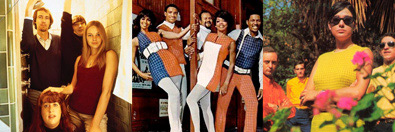
The 5th Dimension; Los Stop.
These good vibrations are why vocal groups blended Motown, Dylan, Brian Wilson, and The Beatles to become acts like The Mamas And The Papas, Spanky And Our Gang, Sagittarius, The Fifth Dimension, The Free Design, Honey Ltd., The City (with Carole King), Chorus Reverendus (France), Los Stop (Spain), and Sergio Mendez And Brazil '66 (Brazil).
The success of Grace and Janis bolstered the arrival of more female-fronted Rock bands like The Ravelles, Lydia Pense with Cold Blood, Yuya Uchida And The Flowers (Japan), Ann Wilson And The Daybreaks (who would become Heart), and the great Mariska Veres with Shocking Blue (Netherlands).
Psychedelic bands had female members in the US with Neighb'rhood Childr'n, Daughters of Albion, Birmingham Sunday, The Unspoken Word, The Savage Rose, The Love Exchange, Ill Wind, and Kangaroo; and globally with Os Mutantes (Brazil), The Executives (Australia), Hljómar (Iceland), Aguaturbia (Chile), Trúbrot (Iceland), De Kalafe (Brazil), and Os Novos Balanos (Brazil).

All-female bands opened tour bills and recorded singles, and sometimes full albums, like Dara Puspita (Indonesia), The Daisy Chain (who later became the mega-heavy Birtha), The Ace Of Cups, The Daughters Of Eve, The Puppets, The Feminine Complex, The She Trinity, and She.

Folk took on manifold forms. From the sinuous flux of Joni Mitchell and eerie soliloquies of Vashti Bunyan (England), to duos flexing out like Blackburn And Snow, Smokey And His Sister, and Lily And Maria. And into uncharted furrows with the PsycheFolk of The Insect Trust, The Bristol Boxkite, It's A Beautiful Day, and The Wind In The Willows (with Deborah Harry). Many Americana roots musics laced back to European seeds; a harvest of new English artists like Fairport Convention (with Sandy Denny), Pentangle, and Renaissance (with Annie Haslam) were now branching out into forms of progressive folk.
The back-to-the-roots music ethos rippled in tandem with the back-to-nature movement, as the counterculture embraced communalism, ecology, alternate spiritualities, rustic fashions, and natural appearance as a counterpoint to the slick, the selfish, and the flashy. Protest folk had formed an activist society grounded in the humanitarian and the equitable, in direct contrast to conformity and consumerism. It paralleled the general pattern of a massive and complex generation trying to reexamine and recontruct themselves at every turn. To be free in body and spirit, and to connect with each other fully.

Aretha Franklin redefined herself and Soul music in 1967, making it more raw, more epic, more intimate. Soul artists were singing Rock songs, Rock artists were jamming Jazz, Jazz was going funky, and everyone was playing on the same festival bills with World artists. Every soul has soul and putting passion into the compassion were The Flirtations, the swamp soul of Bobbie Gentry and Delaney And Bonnie, Linda Lyndell ("What A Man"), Chicken Shack (with Christine McVie), Laura Nyro, Las Quatro Monedas (Venezuela), the bluntly-named Females (Indonesia), Sarolta Zalatnay (Hungary), Sodsai Chaengkij (Thailand), and Les Planètes (Canada). Get it on the good foot, good god, y'all!

After decades of vanilla sing-songs, Broadway was occupied by the revolution in 1968 with HAIR: The American Tribal Love-Rock Musical, which broke every social restriction overnight to smash success. Along with the first black female Broadway lead ever with Melba Moore, its international productions launched the careers of cast members like Diane Keaton, Sonja Kristina (Curved Air), Elaine Paige, Marsha Hunt, Donna Summer, and Sônia Braga. Its songs became new utopian standards covered by The Supremes, Nina Simone, The Free Design, The 5th Dimension, Julie Driscoll, Carla Thomas, and countless more. No matter what anyone looked like, no matter what niche they were boxed by, these artists knew themselves instead as a tribal community of hearts and sounds.
Electronic music broke through to the mainstream with the 1968 success of Wendy Carlos' all-electronic Switched On Bach album. Other pioneers continued collaging patch-cord and tone-honed miracles like Delia Derbyshire (the original "Doctor Who Theme"), Alice Shields, and Pril Smiley. The revolution shifted from college labs to pop studios with the first Moog synths in 1968, as it synergized into experimental Rock by The United States Of America (who became Joe Byrd And The Field Hippies) and Fifty Foot Hose.
As Acid Rock warped into Heavy Rock, women hefted the heaviosity like Sharon Tandy with Les Fleur De Lys, the proto-Occult rock of Coven, the multinational The She Trinity, the iconoclastic Julie Driscoll with Brian Auger Trinity, Aquaturbia, and the Prog of Affinity. Char Vinnidge pitchshifted the Beatle-isms of The Luv'd Ones to full-bore Hendrix acidfuzz, as did The Pleasure Seekers in their transmutation toward becoming Cradle.
Betty Davis would outdo all of them. Being 'ahead of your time' just means everyone else was behind. The songwriter previously known as "Miles' wife", a counterculture dervish who's influence singlehandedly inspired Fusion with his BITCHES BREW (1969) album, stepped forward fronting acidic jams backed by Jimi's brothers Mitch Mitchell and Buddy Cox, and Jazz luminaries like Hancock, Masekela, Shorter, McLaughlin, Sample, and Felder. The sessions weren't released for many years, but she would ascend anyway as the queen of Funk Rock in the next decade.

Jean Millington (L), June Millington (R).
But the final word here about the '60s should be about the first word of the '70s: Fanny. In 1964, the filipina sisters June and Jean Millington of California were inspired by The Beatles to form an all-female band called The Svelts. After the usual turnovers, they were Fanny by 1969, and became the first all-female band signed by a major record label to record multiple albums. They summed up all of women's momentum of the decade in one band, ready to open the next decade with wider possibilities.
1950s Rock'n'Roll started with hundreds of female acts, and this became rapidly exponential with each decade.
As this series of Music Players will prove, they dominoed every decade through the '60s, the '70s, the '80s, the '90s, the '00s, and the '10s.
We've heard enough of his story, so let's widen the world with the history of her story.
Next:
Women Of Rock: The 1970s
© Tym Stevens
See Also:
Part 1 (of 2):
• YOU DON'T OWN ME: The Uprising of the 1960s GIRL GROUPS
Part 2 (of 2):
• SHE'S A REBEL: Decades Of Songs Influenced By The GIRL GROUPS
-Women Of Rock: The 1950s (2 Music Players!)
Coming:
• Women Of Rock: The 1970s (2 Music Players)
• Women Of Rock: The 1980s (3 Music Players)
• Women Of Rock: The 1990s (2 Music Players)
• Women Of Rock: The 2000s (2 Music Players)
• Women Of Rock: The 2010s (2 Music Players)
• The Real History of Rock and Soul!: A Music Player Checklist



 Posts
Posts