...with 2 roaring
Music Players!
RockSex
brings you the actual, all-inclusive
history of Rock'n'Soul music,
with essay overviews and Music Players.
▶ History Checklist
Today, the road-rippin'
Chuck Berry, emperor of electric guitar!
Hear 2 massive music players, one of Chuck and one of all his disciples from the 1950s to today!
Music Player quick-links:
𝟭 Chuck Berry
𝟮 Chuck Berry's disciples: 1950s-Today
𝟭
LET IT ROCK:
The Music of Chuck Berry
CHUCK BERRY
by Tym Stevens
This is a Spotify player. Join up for free here.
It was all new.
Sleek aerodynamic autos clacking down all that fresh freeway tarmac, silver bullets soaring you from city to city, idyllic neighborhoods where families could breathe in space and television, and the mystery world of airwaves whispering melodies in the night. The Depression was a sepia memory, the War a receding ache.
Everything was wide open in 1955.
Bo Diddley and Chuck Berry, circa 1970
Bo Diddley> was the beat,
Little Richard> was the voice, but
Chuck Berry was the total.
He was
the rhythm and the roll, the voice, the theater, the instrument, the speed. "If you're going to give Rock'n'Roll another name," John Lennon opined, "you might try Chuck Berry." The hard-charging riff into a stomping 4/4 beat, that comes from this man. The terse clang of a guitar (
rock) with the rollicking laughter of piano (
roll), that's Chuck.
The attitude, whether flush with adrenalin, joyful in youth, scornful of entanglement, celebratory of lust, outrunning the Man, or spinning cinematic fantasies, that's our hero. Though older, Chuck was careful to articulate the triumphs and tensions of the new post-War youth. Better yet, his rapier wordplay staccato-ing at a breakneck tear was rich, vibrant, eagle-eyed, and silver-tongued. He was haughty, hilarious, and horny. He was the brown-eyed handsome man and he was perfect.
His show and persona were absolute style: sharp suits, hair to die for, duck walks, wild kicks, and cocky ease. No rocker would exist without his granduer and theater. And the guitar, well, come on: the Riff, the rhythmic hum, the bristling leads, the fretboard as an arm a lover a battering ram a communal tuning fork a divining rod of the soul. And that clackclackclack roar straining the speedometer. Every king and queen in the '50s rock pantheon gave us great gifts, but Chuck had it all in one gleaming caddy.
Jerry Lee Lewis; Little Richard; James Brown
He wanted it fast and free.
From a large St. Louis family, he dreamt big and wide. His early gigs fused bluesy boogie with hillbilly gallup and bluegrass flux. When he walked into Chess Studios with a homemade demo, his cover of Western Swing king
Bob Will's
"Ida Red" startled them. He retorqued it as
"Maybelline" and hit the tar a star. Most bought a suit, car, and house. Chuck bought real estate and blueprinted a theme park. He opened a nightclub mixing the musics and the audience to the city's ire.
As his breakneck classics redefined Rock and empowered him, he was suddenly hit with a suspect charge that undid him; he'd once given a ride across state lines to a club greeter later busted for prostitution. That thin association was used to put him in prison for two years. Meanwhile Elvis was drafted by his neighbors, Buddy and Eddie died, Richard went God, and Jerry Lee redefined 'young love' badly. Rock'n'Roll got pulled over to the shoulder.
Chuck came back out in the early '60s embittered. But his influence was suddenly all around again in the British Invasion. He spun a new bluestreak that reflected the Beatles reflecting him. He rocked the hippies at the Fillmores, and rolled into the 1970s on the '50s revival spurred by AMERICAN GRAFFITI and Glam and then Punk. He may never have matched that bracing blast-off, but migod what a fabulous ride he gave us!
2
AROUND AND AROUND:
The Disciples of Chuck Berry
CHUCK BERRY: Disciples 1950s-Today
by Tym Stevens
This is a Spotify player. Join up for free here.
*(This Player is limited to the first 200 songs.
Hear the unlimited Playlist here.)
All songs in order from the 1950s to today.
24 hours and seven decades of music
influenced by Chuck Berry, including:
Buddy Holly • Carl Perkins • Gene Vincent
Fats Domino • Duane Eddy • Link Wray
The Beach Boys • Dick Dale • The Shirelles
The Beatles • The Crystals • Rolling Stones
The Kinks • Bob Dylan • The Small Faces
The Animals • The Sonics • The Yardbirds
The Monkees • Jimi Hendrix • Velvet Underground
Led Zeppelin • The Doors • The Stooges
MC5 • The Band • The Guess Who
David Bowie • T.Rex • Suzie Quatro • ELO
John Lennon • CCR • New York Dolls • ZZ Top
Aerosmith • Paul McCartney • Ramones
The Damned • Sex Pistols • The Runaways
Motorhead • Cheap Trick • Motorhead
Blondie • Patti Smith • Elvis Costello
Radio Birdman • The Police • The Undertones
Devo • Rockpile • Girlschool • Pretenders
Heart • Bruce Springsteen • The BusBoys
Peter Tosh • Hanoi Rocks • Joan Jett
Demented Are Go • Misfits • The Milkshakes
The Gories • Pussy Galore • L7
Latin Playboys • El Vez • The A-Bones
Reverend Horton Heat • The Bobbyteens
The Hives • The White Stripes • The Black Keys
The Kills • Los Lobos • CeeLo Green
Mos Def • Lez Zeppelin • The Go • Girls
King Salami • The Let Go's • Los Mambo Jambo
Gary Clark Jr • The Alabama Shakes • M. Ward
La Femme • Night Beats • Wasurete Motels
and many, many more!

Ebby Hardy, Chuck Berry, Johnnie Johnson
Chuck Berry is the
throughline of Rock'n'Roll.
Boogie was the secret spine of the Twentieth Century. It twined though Ragtime, Swing Jazz, Country Swing, acoustic and electric Blues, Honky Tonk and Hillbilly. It is the thread that sutured them all into
Rock'n'Roll. That briskly walking bassline stairsteps through
Bob Will's
"Ida Red" until the guitar does that crucial lockstep kick that enflamed Chuck's heart. Then, the boogie woogie pound and ripple of his foil
Johnny Johnson's piano routed his sound onto the road as they rode shotgun into the future.
Buddy Holly; Dick Dale; The Beatles; Bob Dylan
His '50s
Rock> peers were immediately peeling rubber in pursuit.
Buddy Holly> is singing Chuck's praise as much as his song,
"Brown Eyed Handsome Man". And
Carl Perkins,
Ernest Tubb,
Margaret Lewis,
Wanda Jackson, and
Los Teen Tops (Mexico) are churning asphalt into ash behind him.
Those are his treads blazing through
The Beach Boys' and
Dick Dale's early '60s Surf whorls and drag strips.
Surf> and Hot Rod artists like
The Ventures,
The Surfer Girls,
The Challengers, and
The Rip Chords woodshopped their chops on Berry covers before cascading waves and scorching raceways. At this point the interaction becomes intwined; with
"Surfin' U.S.A.",
Brian Wilson> brought a harmony dimension to Chuck's riffs that will ripple through the tides to come (
"Back In the U.S.S.R.",
"Ca Plane Pour Moi")
>.
The Beatles and their
British Invasion> flank -such as
Gerry And The Pacemakers,
The Kinks,
The Hollies, and
The Searchers- existed because of Chuck, and they test-drove dozens of his songs. The royalties and exposure even brought Chuck back into the race again. Chuck's blues-base was the starting gate for purist bluesers like
The Rolling Stones,
The Animals,
The Pretty Things, and
The Blues Project to expand the tracks.
Jeff Beck of
The Yardbirds paved his future path with his retread of "Guitar Boogie" as
"Jeff's Boogie".
Bob Dylan hotwired the cadence of
"Too Much Monkey Business", which Chuck picked up from little girls skipping rope, to getaway from his folk box with the pumping
"Subterranean Homesick Blues". This signature beat will ricochet through the future. He was opening up lanes of exploration for other artists from the Folk and Country scenes across the coming years who paid homage to Chuck Berry, like
Nina Simone,
Joni Mitchell,
The Flying Burrito Brothers,
John Prine,
Paul Simon,
Emmylou Harris,
Carole King,
George Jones + Johnny Paycheck,
Johnny Cash, and
Neko Case.
The combo of Berry fire, Beatles style, and Dylan snarl led to mid '60s
Garage Rock>, whose bands flushed the engines with fuzz. Cutting you off in the lane with a sneer were artists like
The Shadows Of Knight,
The Keymen,
The Deviants, and
The Golliwogs (who would travel on to become CCR). Blazing in late, the crazed and underrated
Dean Carter kept '50s rock revved through his Garage stylings the entire 60's, such as covering
"40 Days".
Chuck Berry had become the songbook for every budding band, the road map by which to escape. Artists from all over the
world channeled his paths to find themselves, like
Les Chaussettes Noires,
Les Blousons Noirs, and
Johnny Halliday from France;
Willy And His Giants (Netherlands) and
The Tages (Sweden);
Los Apson (Mexico);
Los Sirex,
Los Pantalones Azules,
Els Xocs, and
Los Gatos Negros from Spain;
Les Luths (Canada);
Conjunto 'Night Stars' (Mozambique); and
The Spiders and
Takeshi Terauchi And The Bunnys from Japan.
The Rolling Stones; The Yardbirds; Jimi Hendrix; MC5
Late '60s
Psychedelia> seemed like a different model, a plastic fantastic funnycar assembled by Coltrane and Kesey, but Chuck still fueled the silver machine. What was
Jimi Hendrix> but the cosmic jetcar sparked by Chuck's airmobile? Just buckle tight and soar with the roar of his live staple,
"Johnny B. Goode".
Jefferson Airplane,
Love Sculture, and
The Chambers Brothers hyperdrove the torque into new planes.
In the hangover from Psyche, when
The MC5 and
The Stooges wanted a return to brute essence, it was Chuck who was the vehicle; the former's
"Back In the USA" cover rolls like a stroll through better days. This blunt, stripped-down approach -along with tours of the counterculture ballrooms and festivals by 50's Rock mentors like Berry, Diddley, and Thornton- led from nostalgia to a spin-around
'50s renaissance>.
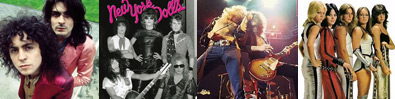
T.Rex; Led Zeppelin; New York Dolls; The Runaways
Psychedelia was a hydra, with rough corrosive rock as one head and expansive dynamics as another.
In the early '70s these heads morphed into Glam and Progressive Rock:
Prog was all spectacle, sonic wizardry, ambition, a showboat; but
Glam was an ironic glitz, tighter, all three-minute pop in a boogie chassy. Both are trails forged in Rock by Chuck.
T-Rex put a Glam kit on his
"Little Queenie" and even quote it at the end of their breakthrough
"Bang a Gong (Get It On)".
Suzi Quatro jacked a rhinestone chevy with
"Glycerine Queen", playing chicken with Gary Glitter's
"Do You Wanna Touch Me". (
The Runaways and
Joan Jett are the collision.)
The New York Dolls, whose butch tranny take on Chuck had inspired Glam, rip it up in their dragster
"Personality Crisis".
Led Zeppelin grounded themselves in the basics with
"Communication Breakdown" and
"Rock'n'Roll". As
Hard Rock came roaring over the mountains like gods agley, every Blues-based band always broke out with Chuck Berry's lighting bolts on the solos. That's his spray of sparks lighting up the amps of
Steppenwolf,
Mountain,
Cactus,
Jo Jo Gunne,
Foghat,
ZZ Top,
Rick Derringer,
Mott The Hoople,
Aerosmith,
Steve Miller,
The Runaways,
Motorhead,
Cheap Trick,
Ram Jam, and
Heart.
As the counterculture crested in the mid-'70s, the impulse to pull over and review the journey took over. Movies like AMERICAN GRAFITTI and THAT'LL BE THE DAY (with Ringo) and THE WANDERERS, top-rated TV shows like 'Happy Days' and 'Laverne and Shirley', Broadway musicals like "Grease", and boogie bands and cover songs stoked the flames fo the
'50s Revival. The terse, raw, careening riffs were a revelation and a transport for new youth, speaking to their lives and fantasies in a direct way that didn't "sound just like a symphony" like Prog.
Drop the coin right into the slot!
Mick Jagger; John Lennon; Debbie Harry.
50s Rock had initially been rebel music
>, but now recognition of it as a
tradition took hold. A generation of the perverse versed on the psalmbook were angels with dirty faces like revivalists
Showaddywaddy; high-mercury guitarist
Chris Spedding; Rockabillies like
Hank C. Burnette,
Sleepy LaBeef, and
Robert Gordon; and unreconstructed Bluesers like
George Thorogood.
Soon a stripped-down mover called
Pub Rock hit mid-'70s England, simply '50s Rock and R'n'B on new cylinders. Thumping 4/4 like four to the floor were unapologetic traditionalists like
Dr. Feelgood,
Ducks Deluxe,
The 101ers (with Joe Strummer), and
Kilburn And The High Roads (with Ian Drury).
If
Eddie And The Hot Rods injected youth frustration into this mix with
"Teenage Depression", then
Punk flooded it magnificently. In early rehearsals, Johnny plunged the
Sex Pistols off a cliff trying to be good, in their wipeout of
"Johnny B. Goode". It mutates into songs like
"No Future",
The Damned's
"New Rose", and
The Clash's
"I'm So Bored With The U.S.A.". Under its ragged veneer, Punk was high-octane Rock'n'Roll grinding the guardrails and shredding the shiny off. Scarring the tarmac were disparate ruffians like
Neu!,
The Dictators,
The Stranglers,
Generation X,
DMZ,
The Boys,
Circle Jerks,
The Undertones, and
The Cramps.
That
"Too Much Monkey Business" staccato rattles back in again in
Ultravox's
"Satday Night In the City", jumps in with
Elvis Costello's
"Pump It Up", and scats through
The Police's
"It's Alright For You". Meanwhile,
Plastic Betrand (France) covered Elton Motello's
"Jet Boy, Jet Girl" in his global hit
"Ca Plane Pour Moi" with all of the
"Johnny Be Good" intact, adding falsetto highs from The Beach Boys'
"Surfin' USA".
Those retro reprobates,
Dave Edmunds and
Nick Lowe, hotwired Chuck's torch; in solo songs like
"Crawling From the Wreckage" and
"Maureen", and with their band
Rockpile's
"Oh What a Thrill". Meanwhile, back in the USA,
Bruce Springsteen prowled the byroads of the interior with
"From Small Things (Big Things One Day Come)". Punk was a raspberry to traditional Rock that was still actually rooted in it. Many recognized this blatant contradiction and refused to arbitrarily jettison proven doorways to possibility just to spite it. This led many artist to re-explore timeless
'60s styles like Beat Music, Garage Rock, and hits of Psychedelia again, all of it still rooted in Chuck's riffs. Putting some hard jang in their jangle were
Flamin' Groovies,
The Nerves,
Blondie,
Modern Lovers,
Beat'hoven,
Badfinger,
Nikki And The Corvettes, and
The Beat (with Paul Collins).
By the late '70s, the spectre of Johnny B. Goode flies full-bore past the flagman in Punk, stadium rock,
Power Pop, and
New Wave;
Cheap Trick cruising the night when the
"Clock Strikes Ten", Ohio expatriate Chrissie Hynde chauffeuring the coupe to England with
The Pretenders'
"Watching the Clothes",
Nikki and The Corvettes clamping the clutch with the
"Criminal Element".
His influence still resonated around the
world in tracks by
Hungaria (Hungary),
Rita Lee (Brazil),
Polifemo (Argentina),
Los Puntos and
Mermelada (Spain),
Torfrock (Germany), and
Protex (Ireland).
Rhythm'n'Blues and Rock'n'Roll have always been the same music, but given different names specifically to separate people. By 1980, FM radio had programmed this segregation into mass minds simply by formatting: you could be played on Rock stations for sounding like Chuck Berry, but not for looking like him, and R'n'B stations played neither. It takes two dummies to complete a shared delusion.
The BusBoys parodied this blinkered idiocy of dividing music and humans by skin and sound barriers with the acerbic
"Johnny Soul'd Out".
The Cramps; The BusBoys; The Stray Cats; Gary Clark, Jr.
The essence of
"Johnny B. Goode" -furious riff, rapidfire rap, strutting singer, and guitar god- defined essential Rock'n'Roll for the ages. More so than any singer or song ever. Ever.
It's the rev in the '80s
Rockabilly> of
Shakin' Stevens (Wales),
The Polecats (England),
Spider Murphy Gang (Germany),
The Kingbees, and
Stray Cats.
It spurrd the gallop of '80s
Roots Rock for troubadours traveling the blue highways off the grid, like
The Blasters,
The Long Ryders,
The Fabulous Thunderbirds,
Mason Ruffner, and
Ry Cooder.
It's catalyzes
Psychobilly reprobates like
Guana Batz,
Demented Are Go,
Restless,
Misfits (with Glenn Danzig), and
The Reverand Horton Heat, and the
Trashabilly claxons of
Bodeco. It's the fuel under the engine roar of Noize of Japanese troublemakers like
Teengenerate,
Guitar Wolf,
Mikabomb,
The Jikens,
The Let Go's, and
Wasurete Motels.
It's the electricity coursing through the
Garage Rock and
NeoPsyche of
The Fleshtones,
Barrence Whitfield,
The Milkshakes (with Billy Childish), and
The A-Bones. And amplifying '90s succesors like
The Nomads,
The Kaisers,
The Bobbyteens, and
The Hellacopters. And galvanizing 2000s cousins like
The Hives (Sweden),
The White Stripes,
The Black Keys,
The Raveonettes (Netherlands),
The Flaming Sideburns (Brazil),
The Kills,
Wau Y Los Arrrghs!!! (Spain),
The Wildebeests,
The Hi-Risers,
Fabienne DelSol (France), and
Gore Gore Girls.
And on Johnny B. Goode careened, in every chunky riff, arrogant swagger, and rushing roar that highways
Boogie Rock to
Trashabilly to
AfroPunk, that throughlines cycles of disciples in cascades from
Aerosmith to
Guns'n'Roses, from
George Jones to
Heavy Trash, from
The Twangies (IndoRock) to
Peter Tosh, from
Pussy Galore to
The White Stripes, from
Joan Jett to
The Kills, from
Robert Gordon to
Guitar Wolf, from
Steve Miller to
Gary Clark, Jr..
Flipping donuts brings you full circle.
Paul McCartney had convertabled
"Back In the U.S.S.R." once, and told John to slow
"Come Together" down so it wouldn't sound sooo much like Chuck (dig the "flattop grooving" lines copped from his
"You Can't Catch Me"). In recent years he re-swung through the swamplands with the full-on Chuck amok of
"Run Devil Run". And Swedish
Nic Armstrong And The Thieves brought it all roundtrip with his cover of
"I Want To Be Your Driver", a Beatles freak doing Chuck Berry doing The Beatles doing Chuck Berry!
Around and around, forever fast and free...
Johnny B. Goode
©
Tym Stevens
See Also:
•
Revolution 1950s: The Big Damn Bang of Rock'n'Roll!
•
1950s PUNK: Sex, Thugs, and Rock'n'Roll!
•
BO DIDDLEY: The Rhythm King and His Disciples
•
BUDDY HOLLY: Rock's Everyman and His Disciples
•
LITTLE RICHARD: The Voice of Rock and His Disciples
•
JIMMY REED: The Groover of Rock, From Motown To Sesame Street
_____________________
•
Shock Waves: How SURF MUSIC Saved Rock'n'Roll!, with 2 Music Players!
•
THE BRITISH INVASION!, with Music Player!
_____________________
•
The Real History of Rock and Soul!: A Manifesto, A Handy Checklist





 Posts
Posts